
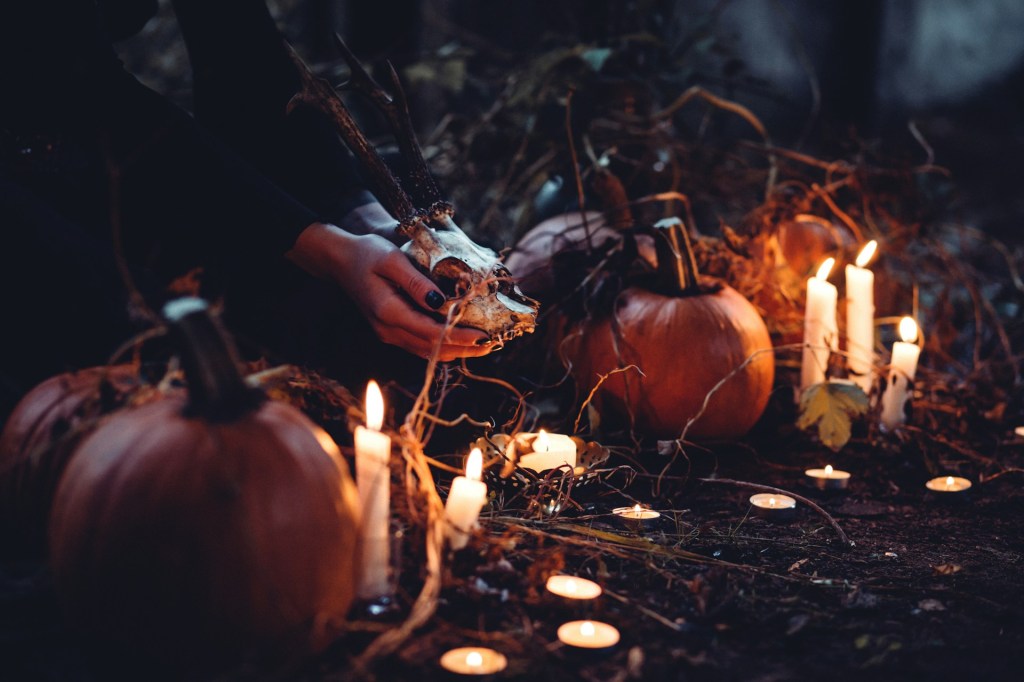
Photo by freestocks on Unsplash
The lantern is heavier than it looks.
A candle burns inside a hollowed turnip, its flame dancing behind a crooked face carved into the stubborn flesh. The light spills across the uneven stones of the village lane, illuminating little more than the ground beneath your feet. Beyond its reach, the evening belongs to shadows, interrupted here and there by the amber glow of a window or the silhouette of someone passing beneath the moon.
Autumn has settled comfortably into the Scottish countryside. The last of the harvest has been gathered, and the trees have surrendered enough of their leaves to reveal branches that had been hidden since spring. Smoke drifts from the chimneys, carrying the familiar smell of peat and burning wood through the cold evening air.
Somewhere beyond the houses, the wind moves through the fields with the quiet insistence of a season announcing its arrival.
Yet the village is unusually alive tonight.
Laughter travels along the narrow streets, punctuated by the occasional shriek and the hurried footsteps of children disappearing around corners. Strange creatures emerge from familiar doorways. A ghost wearing what looks suspiciously like someone’s best bedsheet wanders alongside a figure with a face made from scraps of painted paper. Another child has borrowed an oversized coat and a hat that slips over their eyes whenever they turn too quickly.
The disguises are imperfect, but nobody seems particularly troubled by that. Their purpose has little to do with convincing anyone that the creatures beneath them are real.
Tonight is Hallowe’en, and the village has agreed to indulge a little magic.
Through the narrow holes of your own mask, everything seems strangely different. These are streets you know. You have walked them countless times, usually under considerably less interesting circumstances. You know which house belongs to the baker, whose fence has needed mending since summer, and which neighbor can be relied upon to complain about children making too much noise.
Most of the people behind these doors have known you for years. Some remember you as an infant, and others have witnessed enough of your less admirable adventures to possess a thoroughly inconvenient understanding of your character.
Yet tonight, beneath your borrowed face, those expectations seem less important.
Your companions have been arguing over who should approach the next house. The discussion has reached the inevitable conclusion that somebody must go first, and through an unfortunate combination of encouragement and betrayal, that somebody has become you.
A friend nudges your shoulder.
You hesitate. Ordinarily, approaching a neighbor’s door and announcing yourself with a ridiculous verse would require a degree of confidence you have never been especially eager to demonstrate. The thought of forgetting the words is unpleasant enough. The thought of remembering them and looking foolish anyway may be worse.
But you’re wearing a mask, and the peculiar thing about a mask is that it gives you something to hide behind even when everyone knows you’re there.
You adjust the ribbon near your ear, gather what courage you can manage, and raise your hand.
Then you knock.
The Strange Mercy of Being Unknown
There is an unusual freedom in being unrecognized, even when the anonymity is largely imaginary.
The people who know us best are often the people who have the strongest expectations about who we are. They remember our habits and anticipate our reactions, just as they know which subjects make us uncomfortable, which responsibilities we tend to accept, and which situations we would rather avoid. Much of this familiarity is affectionate, and some of it is essential to the relationships we value.
Still, familiarity has a way of becoming a kind of boundary.
A quiet person may discover that everyone expects them to remain quiet. Someone who has spent years being dependable may feel an almost physical discomfort at the thought of behaving irresponsibly for an afternoon. The person who has earned a reputation for seriousness can find it surprisingly difficult to make a fool of themselves, even among friends who would probably welcome the entertainment.
Over time, the descriptions other people use for us can begin to resemble instructions.
We learn how to behave in ways that preserve their expectations. Sometimes we do so because those expectations accurately reflect our values. Sometimes we simply grow accustomed to occupying the space that has been made for us, and the thought of stepping outside it becomes more uncomfortable than remaining there.
There is a convenience to this arrangement. If everyone knows what to expect from everyone else, social life becomes considerably easier to navigate. We can rely on one another without reconsidering every interaction from the beginning.
But the convenience comes with a cost. We may gradually lose sight of the difference between the qualities we have chosen to cultivate and the ones we have merely become accustomed to displaying. A mask, even a rather poorly constructed one, can interrupt that process.
For a few hours, the shy child can be a fearsome creature, and a serious adult can become a ridiculous one. The person who spends most of their days making careful decisions may enjoy pretending to be someone who has never considered the consequences of anything in their life.
The transformation requires remarkably little. A change of clothing, a strange face, and an understanding among everyone involved that the ordinary rules have been temporarily relaxed.
Of course, most of us recognize that the freedom is incomplete.
Our friends still know who we are, and the consequences of our behavior generally remain our own. An unpleasant person does not become innocent simply because their unpleasantness arrives wearing a pair of horns. Yet the experience can still be revealing.
There are things we hesitate to attempt because we have become convinced that they are inconsistent with who we are. Sometimes that conviction protects commitments we genuinely value. At other times, it preserves limitations that we have never seriously considered challenging.
The mask gives us an excuse to experiment. We can behave differently without immediately announcing that we have changed. We can test an unfamiliar quality while everyone around us understands that the performance is temporary.
Perhaps that is part of the enduring appeal of masquerade. It offers us a little distance from the people we have been, and enough uncertainty to wonder whether the people we might become would feel entirely unfamiliar.
For one evening, the question of who we are becomes a little less settled, and there can be considerable comfort in that.
The Work of Pretending
As children, we spend an extraordinary amount of time pretending. We become explorers without leaving the garden. A wooden stick serves adequately as a sword, and a blanket draped between two chairs can produce a fortress of impressive strategic importance. The limitations of these arrangements rarely trouble their occupants, who are generally too busy defending their territory from imaginary dangers to concern themselves with structural engineering.
The adults observing these adventures usually recognize them as play, and rightly so; but something else is happening beneath the entertainment.
Children are experimenting with ideas about themselves and the world. They borrow the behaviors of people they admire, invent situations they have never experienced, and rehearse decisions whose real consequences remain safely beyond their reach.
A child pretending to be courageous may discover that courage involves approaching something frightening. Another playing at being a doctor may learn that caring for someone requires attention to their discomfort. Neither has necessarily acquired the qualities being imitated, but both have encountered the possibility of behaving differently.
We tend to understand this relationship between imitation and development when it concerns practical skills. Nobody expects a person learning to play an instrument to sound accomplished before they have practiced. We accept that early attempts will be awkward, and we generally encourage the learner to continue despite the considerable suffering occasionally inflicted upon everyone within earshot.
Strangely, we are sometimes less generous when the subject is character.
If someone who struggles with patience makes a deliberate effort to behave patiently, we may wonder whether the behavior is genuine. When a naturally timid person attempts to project confidence, the performance can be dismissed as an affectation. Someone learning to communicate with greater kindness may initially sound as though they are carefully selecting every word, because that is precisely what they are doing.
Yet it seems unreasonable to demand that a quality come naturally before we consider attempts to cultivate it sincere. Aristotle understood character as something developed through practice. In the Nicomachean Ethics, he argued that moral virtues are acquired through habituation, as people gradually develop dispositions through repeated action and the cultivation of sound judgment.
The relationship is more complicated than simply repeating a behavior until it becomes automatic. A person might perform an apparently generous act for selfish reasons, just as someone might learn to imitate the outward appearance of courage while carefully avoiding every situation that would require it.
For Aristotle, becoming virtuous involves learning to choose well, for appropriate reasons, with an understanding of the circumstances. The behavior matters because it participates in a larger process of developing character. Still, there is something wonderfully human about the difficulty this creates.
We must begin somewhere, and the beginning rarely resembles the finished result.
The first attempt to behave with patience may feel terribly unnatural. Generosity might initially require an uncomfortable degree of conscious effort. A person learning to stand up for themselves may rehearse a difficult conversation repeatedly, only to discover that their carefully prepared words sound rather less impressive when spoken aloud.
These awkward beginnings do not invalidate the intentions behind them. I suspect many of the qualities we eventually regard as natural began as deliberate attempts to behave like someone we weren’t entirely sure we could become.
Certainly, there have been moments in my own life when the responsibilities before me seemed better suited to someone with considerably more experience. The expectation that I would know what to do did not always arrive accompanied by the knowledge itself. Nevertheless, decisions still needed to be made.
In such circumstances, there is often little choice but to act according to the best understanding available, accept the possibility of being wrong, and learn from whatever follows. Confidence may arrive eventually, although it has an inconvenient habit of appearing most readily after the difficult part has already been completed.
Looking back, I find it difficult to identify the exact moment when acting like someone capable of carrying a responsibility became simply being someone capable of carrying it.
Perhaps there was no such moment, and the distinction gradually lost its importance as the practice became part of the person.
This is where the child’s Halloween costume becomes philosophically interesting. Behind the painted face, the child approaching the neighbor’s door may still be afraid. The borrowed identity has offered enough distance from that fear to make an unfamiliar action possible.
Tomorrow, the costume may return to a cupboard, and the child may remain as shy as ever. But tonight, they have experienced something that their previous understanding of themselves did not entirely accommodate. They were afraid, and they knocked anyway.
Whether the experience changes anything is impossible to know. The important possibility is that it might.
There are qualities we can admire long before we possess them, and the distance between admiration and character must be crossed somehow. Sometimes the crossing begins with pretending.
What the Darkness Allows
Of course, a discussion of masks would be incomplete without considering the less appealing uses to which they can be put. Halloween has never belonged exclusively to harmless play. Its traditions have long included mischief, and there is an obvious reason that disguises have sometimes accompanied behavior people would hesitate to undertake in full view of their neighbors.
Anonymity changes our relationship with consequences.
When we believe that our actions cannot easily be connected to our identities, some of the ordinary restraints on our behavior become less immediate. A person who would never openly insult a neighbor may suddenly discover a remarkable talent for unpleasantness when their face is concealed.
The same principle operates without a literal mask. We have all encountered people who behave differently when they believe nobody important is watching. Their willingness to be considerate seems dependent upon the possibility of recognition, and their generosity becomes markedly less reliable when there is no audience to appreciate it.
It would be comforting to imagine that the person revealed in those private moments is always the authentic one, but I find that conclusion too simple; our motives are rarely so obliging as to arrange themselves into a single, permanent explanation of who we are.
Someone may behave cruelly while feeling ashamed of their cruelty. A generous act can be motivated partly by vanity without being entirely devoid of compassion. A person who sincerely wishes to be courageous may occasionally retreat from a challenge because their fear proves stronger than their intentions.
Human character contains contradictions, and those contradictions do not disappear merely because we discover one behavior that seems especially revealing. The question of authenticity becomes more useful when we consider how a person responds to those contradictions.
A mask can offer an opportunity to explore a quality we wish to develop. It can also provide a convenient excuse to indulge a tendency we would otherwise recognize as unworthy of us.
The outward performance may look remarkably similar.
Consider someone who decides to become more generous. At first, the effort may be deliberate and uncomfortable. They may have to resist familiar habits of self-interest, and they may occasionally find themselves hoping that someone will notice the sacrifices they’re making. That mixture of motives doesn’t necessarily render the effort meaningless. If they continue to practice generosity because they come to recognize the needs of others as worthy of consideration, something genuinely valuable may be developing.
But imagine that the same person gradually becomes more interested in being perceived as generous than in whether anyone actually benefits from their behavior. The performance has become detached from the quality it was supposed to cultivate.
There is a difference between practicing a virtue and collecting the social rewards associated with appearing virtuous.
Determining where one ends and the other begins can require a degree of self-examination that is considerably less entertaining than putting on a costume.
This is one reason I have become increasingly interested in the relationship between integrity and identity. We often speak as though integrity requires us to remain consistent with ourselves. There is value in that idea, particularly when consistency means honoring commitments and refusing to abandon principles whenever doing so becomes inconvenient. But we can also use consistency as an excuse to preserve qualities that deserve reconsideration.
A person who has always been unkind gains little moral credit by remaining faithful to their established character. Someone who discovers that a conviction was mistaken has good reason to change their mind, even if doing so disappoints those who admired their certainty.
Integrity requires something more demanding than loyalty to our familiar behaviors: it requires an honest relationship with the reasons behind them.
A mask becomes dangerous when it allows us to avoid that responsibility. It becomes useful when it permits us to explore an unfamiliar possibility while remaining willing to account for what we do. And because human motives are seldom perfectly clean, we should probably be cautious about congratulating ourselves too quickly for understanding which sort of mask we’re wearing.
The best evidence may emerge over time, as we discover what remains of the performance when nobody is watching and there is no longer anything to gain from maintaining it.
The People We Have Already Been
One of the stranger experiences of growing older is discovering how many people we have already been. I don’t mean this in the dramatic sense of having lived entirely separate lives. Most of us retain enough continuity in our memories and commitments to recognize ourselves across the years, but there are moments when that continuity becomes difficult to reconcile with the differences.
We remember convictions that once seemed obvious and now appear incomplete. We recall decisions made with a confidence we no longer understand, and occasions when we worried terribly about things that ultimately mattered very little.
Sometimes we look back with embarrassment. At other times, there is affection for the earnestness with which our younger selves approached problems they had not yet learned to understand. I find the latter response increasingly appealing.
There is an unfortunate tendency to regard our past mistakes as evidence that we should have known better, even when the understanding required to make a different decision was acquired through the experience itself. Certainly, there are occasions when we genuinely did know better. We may have ignored a warning, acted carelessly, or allowed convenience to overrule our judgment. Responsibility for those decisions remains ours, regardless of how much time has passed.
But other mistakes arise from the ordinary limitations of being a person who has not yet encountered everything life will eventually teach them. We should be willing to distinguish between the two.
The person I was ten years ago possessed less experience than the person writing these words. That seems a relatively uncontroversial observation, although I suspect he would have been less enthusiastic about hearing it.
He also possessed perspectives that may have been valuable precisely because they had not yet been complicated by subsequent experience. Perhaps he was more willing to take certain risks, or more capable of approaching a problem without assuming he already understood its likely outcome.
Growth seldom involves the simple accumulation of wisdom. We acquire some things while losing others, and the trade is not always entirely favorable. There are aspects of our former selves that deserve to be outgrown. There may also be qualities worth recovering.
This complicates the familiar advice to discover who we really are.
The suggestion assumes that somewhere beneath our social expectations and learned behaviors exists a completed identity waiting to be uncovered. Perhaps there are enduring dispositions that shape us throughout our lives, but I struggle with the idea that authenticity requires us to locate some final, unchanging version of ourselves.
The world changes around us, and we change through our participation in it.
Experience introduces information that we did not previously possess. Relationships alter our priorities. Responsibilities reveal abilities we might never have discovered under different circumstances. Even our values can develop as we encounter situations that force us to examine what those values actually require.
I would be disappointed to discover that my understanding of the world had ceased to change. There is too much I haven’t encountered, and too much that I already understand imperfectly, for such a conclusion to inspire confidence.
Naturally, there is a limit to how far we should take this argument; if every version of ourselves is treated as an entirely independent person, accountability becomes difficult to sustain. We cannot reasonably dismiss the consequences of yesterday’s decisions by explaining that we have since developed a different understanding of ourselves.
The continuity of a life matters, even as its character changes. Perhaps we might think of our earlier selves as participants in an unfinished conversation. They made decisions whose consequences we inherited, and we are now responsible for deciding what to do with those consequences. We may disagree with their judgments, but those disagreements need not require contempt.
Sometimes the most appropriate response to an earlier version of ourselves is gratitude. They persevered through circumstances that made our present opportunities possible, often without knowing what those opportunities would eventually become. At other times, forgiveness may be appropriate, accompanied by a willingness to repair whatever harm remains within our ability to address. And occasionally, we may discover that someone we believed we had outgrown understood something we would do well to remember.
There is a quiet comfort in recognizing that none of these versions must be regarded as the final authority on who we are. The child in the Halloween mask will eventually outgrow the costume. They may even outgrow the person they imagined becoming while wearing it.
That doesn’t make the evening meaningless.
The possibilities we imagine at one stage of life can help us reach another, even if the destination bears little resemblance to what we originally expected.
The Season Between
It seems appropriate that a holiday so concerned with disguises should arrive at a time when the world itself is changing its appearance. By late October, the northern landscape has begun surrendering the abundance of summer. The fields grow quiet, daylight retreats, and trees that stood beneath full canopies only weeks earlier reveal the shapes of their branches.
Nothing about this transition requires our permission. The seasons move according to their own rhythms, indifferent to whether we have finished enjoying what they brought us.
The older Gaelic festival of Samhain was associated with this passage into the darker portion of the year, and its later folklore often imagined the boundaries between the ordinary world and the supernatural becoming unusually uncertain. The precise relationship between ancient celebrations and the many Halloween customs that followed is more complicated than popular accounts sometimes suggest. Traditions develop through centuries of adaptation, and the historical evidence rarely provides the uninterrupted story we might prefer.
Still, the seasonal imagery offers something worth considering. There are moments in life when the familiar boundaries seem to become less dependable.
A responsibility that once defined us may come to an end. A relationship changes, and with it the place we understood ourselves to occupy in another person’s life. We may discover that an ambition which once seemed essential no longer holds the same appeal. Sometimes these changes arrive as welcome opportunities. Others require us to surrender something we would have preferred to keep.
And often, the difficulty lies partly in our uncertainty about what comes next.
We are remarkably good at constructing expectations from our immediate circumstances. When life is comfortable, we imagine the comfort continuing. When a particular identity serves us well, we may unconsciously begin treating it as a permanent feature of our existence.
But permanence is a demanding standard to impose upon a changing world. I find something liberating in the thought that a thing can have been worthwhile without having to last forever.
A friendship may remain meaningful even after the lives of those involved have carried them in different directions. A role can have been worth fulfilling even when it eventually becomes unnecessary. An earlier understanding of ourselves may have been entirely appropriate for the circumstances in which it developed, despite being insufficient for those we encounter later.
We do not need to deny the sadness that sometimes accompanies these endings. Grief is a reasonable response to losing something we value, and accepting the nature of change does not require us to welcome every consequence it brings. But there is room for appreciation alongside the sadness.
The autumn landscape is beautiful partly because it reminds us that the world does not remain still. We know the leaves will fall, and that knowledge need not prevent us from enjoying their colors. Likewise, the people we have been can remain worthy of affection without being people we must continue to be.
Halloween gives us an opportunity to contemplate these uncertainties in unusually playful circumstances.
The dead return as stories. The familiar become strange. Children borrow identities that exist only until the evening ends, and everyone participates in the understanding that the ordinary world will be waiting for them in the morning.
Perhaps this is one of the holiday’s greatest gifts: it allows us to spend a little time in the space between what we know and what we can imagine, without requiring that we settle the question of what comes next.
For a night, we can simply enjoy the possibility.
An Evening Without Purpose
By this point, I suspect there is a danger of taking Halloween rather more seriously than the occasion requires. A child who spends an evening pretending to be a monster probably does not need a philosophical explanation of identity formation. They may be perfectly satisfied by the opportunity to make alarming noises at the neighbors and return home with something enjoyable to eat.
I would be reluctant to interrupt the festivities merely to inform them that they are participating in an exploration of Aristotelian virtue ethics.
There is, I think, an important distinction between discovering meaning in an experience and requiring the experience to justify itself through that meaning.
We spend a considerable portion of our lives measuring the value of our activities according to what they accomplish. Work produces results, education develops capabilities, and even recreation is sometimes defended on the grounds that it improves our health or prepares us to return to more important responsibilities.
These considerations have their place, but taken too far, they can leave us with a rather impoverished understanding of what makes a life worth living. Not every enjoyable moment needs to serve a purpose beyond being enjoyable.
A good story may expand our understanding of the world, but we can also appreciate the pleasure of listening to someone tell it. Sitting beside a fire with a warm drink may provide an opportunity for reflection, although I doubt the experience is diminished if our thoughts occasionally wander toward the quality of the drink. Sometimes the pleasure itself is sufficient reason to participate.
I think this is worth remembering because our desire to improve ourselves can quietly become another set of expectations from which we need occasional relief. If we are always examining our behavior for opportunities to become wiser, we risk approaching even our happiest experiences as unfinished assignments. The moment becomes something to evaluate rather than something to inhabit.
There is an irony in pursuing a meaningful life so diligently that we become uncomfortable enjoying the life we already have. Halloween provides a welcome excuse to set aside that discomfort.
We may dress as someone ridiculous. We may revisit stories we’ve heard a dozen times and still enjoy the familiar anticipation of their endings. We can be frightened by things we know are harmless, or laugh at the elaborate efforts people make to frighten us.
And there is something endearing about the willingness of adults to participate.
The parent who carefully constructs a child’s costume, the neighbor who pretends to be terrified by an unconvincing ghost, and the friend who commits wholeheartedly to an absurd disguise are all contributing to an experience whose value cannot easily be measured.
Much of the pleasure comes from the shared agreement to treat imagination as something worthy of our time. Perhaps that agreement deserves more appreciation than we give it.
The world contains sufficient reasons for seriousness. We need not invent additional ones for every moment that might otherwise be spent enjoying ourselves.
This does not mean that play is devoid of significance. It may teach us something, strengthen a relationship, or reveal an unfamiliar possibility, but those consequences can be welcomed without becoming conditions for the experience to have been worthwhile.
Sometimes it is enough to be alive on a cold autumn evening, surrounded by people who have agreed to be a little foolish together.
There are worse ways to spend our limited time.
When the Mask Comes Off
The door opens, and an older woman stands in the warm light spilling from the house, her expression solemn enough to suggest that she has never encountered such an extraordinary collection of creatures in all her years.
She looks from one disguised visitor to another, lingering on the little figure standing nearest the threshold.
“Well,” she says, with an admirable degree of concern, “and what have we here?”
There is a moment of uncertainty. You know the verse. You’ve repeated it enough times that the words should come easily, and the others have already performed their own contributions at several houses along the lane. But the sudden attention makes remembering anything seem considerably more difficult.
The woman waits, apparently delighted by the possibility that her visitors have been rendered speechless. Someone behind you stifles a laugh; you take a breath and begin.
The first few words emerge rather uncertainly. By the middle of the verse, you’ve found enough confidence to raise your voice. The ending arrives with a flourish that was almost certainly absent from the original rehearsal, and your companions respond with an enthusiasm that owes as much to relief as admiration.
The woman applauds. She seems to recognize you, or perhaps she recognized you from the beginning. In a village where everyone knows everyone else, a painted mask and a borrowed coat can accomplish only so much.
But she has been kind enough to play along. She offers a small reward, and the group departs into the darkness with the enormous satisfaction of having successfully completed a task of almost no practical importance.
The next house seems less intimidating.
By the time the evening draws to a close, your voice has become familiar with the verse, and the uncomfortable anticipation of approaching a stranger’s door has given way to something resembling eagerness.
Eventually, the lantern’s candle burns low, and the cold begins to find its way through the layers of clothing that seemed entirely adequate when the adventure began. The village grows quiet as families return to their homes.
At last, you find yourself back beside a familiar hearth, holding the mask that had seemed so important only a few hours earlier.
Without it, the room looks much as it always has. The fire crackles in the grate, someone remarks upon the state of your clothing, and the evening’s modest treasures are examined with a seriousness that would probably amuse anyone old enough to recognize their actual value.
Tomorrow will bring ordinary responsibilities. The excitement will fade, and before long, the costume will be put away until another occasion offers some reason to retrieve it. Most of the evening will eventually disappear into the indistinct collection of memories from which childhood is made.
Yet something happened tonight that was worth experiencing: For a little while, you behaved like someone you had not previously believed yourself capable of being. The courage was borrowed, perhaps, but the action was your own.
I think about that distinction sometimes when considering the many identities we occupy over the course of our lives. We are shaped by circumstances we did not choose, and by expectations we may never have consciously accepted. We imitate people we admire and occasionally discover, to our embarrassment, that we have also imitated qualities we would rather leave behind.
We make efforts to become better at things that do not come naturally. We grow into responsibilities that once seemed beyond us, and sometimes we grow tired of roles that previously gave us a sense of purpose. Throughout it all, we remain rather imperfect judges of which experiences will prove important.
A great deal of becoming happens while we’re occupied with the ordinary business of living. Perhaps this is why I find myself increasingly reluctant to regard the masks we wear as inherently suspect.
Some certainly deserve to be discarded. Others may have helped us survive circumstances in which we had not yet learned how to stand comfortably on our own. And some, I suspect, were the earliest attempts to express qualities that would eventually become inseparable from our character.
We may never be able to identify precisely when those performances became genuine, or whether there was ever a clear boundary between the two. I am not particularly troubled by that uncertainty.
There is a strange comfort in the possibility that we do not need to have finished becoming ourselves before we can begin living sincerely. We can recognize our limitations while imagining what might exist beyond them. We can appreciate the people we used to be without insisting that they remain the people we are. And perhaps we can extend a little kindness to the versions of ourselves that have not yet worked out how to inhabit the lives they are trying to build.
So tonight, as the candles flicker behind carved faces and unfamiliar creatures wander through familiar streets, I hope we can enjoy the occasion for what it offers. There will be time enough tomorrow to return to our responsibilities, and plenty of opportunities to consider what our choices reveal about us.
For now, perhaps we can allow ourselves a little imagination.
After all, there’s something rather wonderful about the freedom to put on a borrowed face, step into the darkness, and discover that the person we were pretending to be might someday feel perfectly comfortable without the mask.
And even if that never happens, there is still warmth waiting when we come home.
Happy Halloween.








Leave a Reply