
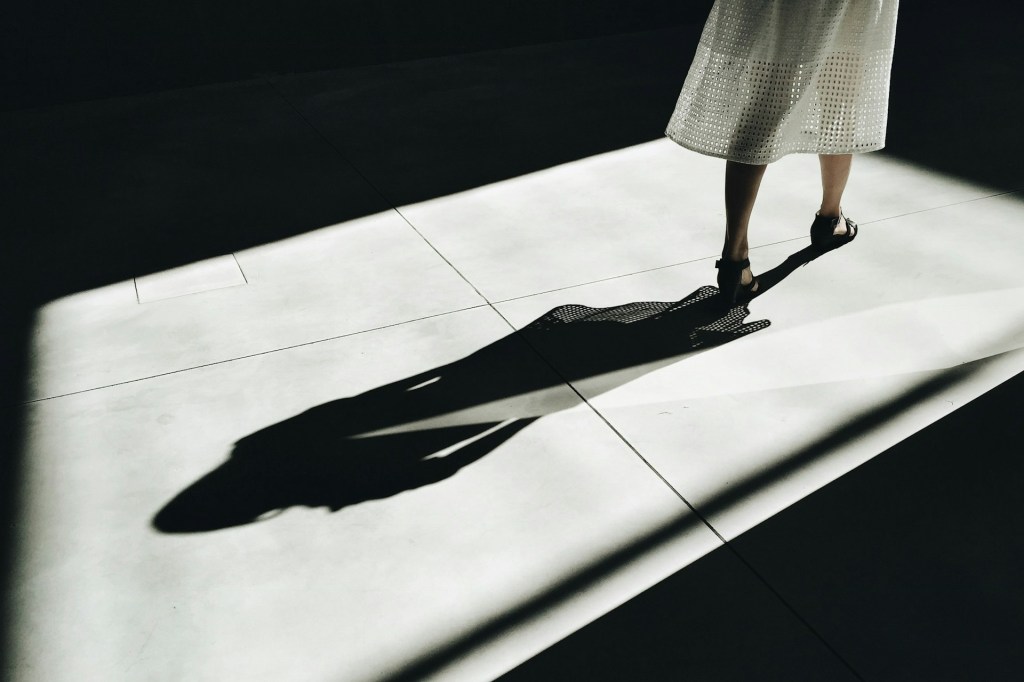
Photo by Martino Pietropoli on Unsplash
The first thing you learn is how to stand, and that alone is harder than it sounds.
Your feet sit at an angle you would never choose naturally, with your weight distributed in a way that feels vaguely like the beginning of a fall. Hands up, elbows in, chin down, shoulders loose. At first, every one of those is a separate instruction you have to think about individually. You correct your hands and your feet drift. You fix your feet and your shoulders climb. Somebody adjusts your elbow and you lose the chin.
Then you throw a punch and quickly discover that this is not one movement either. It begins against the floor, passes through the leg and hip, turns the shoulder without lifting it, extends the hand without abandoning the other one, and somehow ends with everything returning to where it started. At least, that is what is supposed to happen. In the beginning, it does not. You throw the punch and everything else falls apart to make room for it.
So you repeat it. A hundred times, then a thousand. Eventually you stop counting, which is probably for the best, because the purpose of all that repetition sounds strange when said aloud: you concentrate very hard on a movement so that someday you will not have to think about it at all.
Next come the patterns. Sequences of movement against an opponent who is not there and probably never was. An attack arrives from a known direction, you meet it with the correct response, and one movement becomes another until isolated techniques acquire context. A movement does not become a block without something to block, so you invent something and meet it correctly, over and over, until the body begins doing what the mind once had to supervise.
For a while, this feels like progress. It is progress. Then you spar, and it all comes apart.
The other person does not stand where the pattern taught you to expect them. They do not attack from the angle you prepared for, and when they do, they are already moving somewhere else by the time your response arrives. Distance changes constantly. Timing turns out to be something you never really practiced, because your imaginary opponent had always been polite enough to move at your pace. You throw a combination you have thrown a thousand times and someone interrupts it after the first strike, and nine hundred and ninety-nine repetitions suddenly seem irrelevant to the particular problem standing in front of you.
You lose. Regularly, for a surprisingly long time, and in ways obvious to everyone kneeling around the edge of the mat.
This is where many people quit. It is not necessarily the repetition that gets them; people are better at routine than we give them credit for. The harder moment comes when training finally meets something that refuses to cooperate, and the elegant structure built over months reveals itself for what it always was: a rehearsal for reality, not reality itself.
The ones who stay begin to change. The patterns get shorter and less polished. What they do starts depending less on what the formal sequence said should happen and more on the person actually standing in front of them. The movements become a little uglier and considerably more useful. Somewhere among the bruises, interrupted combinations, and lessons that only make sense afterward, they stop losing every time.
Untrained gives way to routine. Routine becomes pattern. Pattern becomes flow.
And eventually, most of us end up in a race against our own shadow.
The lazy version of this story becomes some variation of wax on, wax off: learn to fight, accidentally learn how to live. However charming the thought, that is not what happened to me. Martial arts did not install the habits I am writing about here. It gave me a vocabulary for them. The mat handed me words for something I had already been doing everywhere else.
Two Shadows
There are two shadows in this story, and they should not be confused.
The first is the one you box against. You make this one on purpose. You choose the hour, the intensity, the imagined opponent, and what that opponent does. You decide how long the exercise lasts and, if you have had enough, you can turn off the light and go home. Its artificiality is precisely what makes it useful.
The second shadow follows you. It does not need your permission, does not take days off, and moves at precisely your speed regardless of what that speed happens to be. Unemployment. Failure. Loss. Illness. The ordinary catastrophes that eventually visit almost everyone and have never once asked whether now is convenient.
Almost everything I do that looks like preparation is an attempt to turn the second kind into the first. Not because I believe most of those things can be prevented – usually they can’t – but sometimes a small piece of them can be encountered early. You can drag some fragment of an unpleasant future into a room where the stakes are lower, look at it on a day you selected, and ask what it would require of you while the answer is still inexpensive.
The catastrophe remains hypothetical. The practice does not. Living in a world where bad things happen is not optional, but rehearsing how I might meet them is.
This is not really about knowledge. Most of us already know the obvious things. Stay calm in an emergency. Keep some money aside. Back up the important thing. Tell people you love them. Accept, at least intellectually, that everything eventually ends. The problem is that knowing what we intend to do tells us surprisingly little about what we actually do once the room changes. Under pressure, intention is fragile. Habit is stubborn.
Preparation, at least as I practice it, is an attempt to choose some of those habits before circumstances choose them for me.
There is an old objection here: routine removes thought. A person acting automatically is less present because the movement has become mechanical. I have come to think nearly the opposite.
Routine does not remove thought. It relocates it.
The trained fighter is no longer thinking about hip rotation in the middle of a bout, but that attention has not disappeared. It has moved outward, toward distance, timing, weight, breath, and the shoulder that dropped half an inch before the strike began. There is less thought devoted to how, leaving more available for what. You have not stopped thinking. You have stopped spending thought on the parts that no longer require decisions.
The danger is narrower than automaticity itself. An automatic response is only as good as the world it was trained against. Left unexamined, it will eventually fire at something that resembles the old problem closely enough to trigger the pattern, but not closely enough for the pattern to work.
The technique does not fail because it became reflex. It fails at the edge of the world it was built for, and an unexamined reflex is very good at preventing us from noticing when we have crossed that edge.
Practicing Against What Isn’t There
Outside the dojo, the opponents become less dramatic and far more numerous. The easiest one for me to explain is financial.
The job ends. The income stops. Something expensive breaks at exactly the wrong time. One of two people can no longer work, or both cannot. The future changes its mind about whatever arrangement we thought we had with it. I rehearse those possibilities. Not constantly, and not with any particular sense of doom, but regularly enough that calling it a practice would be fair.
The strategy itself is painfully ordinary. Live below your means. Keep reserves. Avoid allowing every increase in income to become a permanent increase in obligation. Trade some present consumption for lower dependence on favorable circumstances later. There is nothing revolutionary in any of this. It is more or less the first chapter of every personal-finance book ever written.
In practice, it looks equally unremarkable. We do not live in the largest house our income could support. The car is not the nicest one on the street and was never intended to be. The computers are good enough for what we actually do with them, but not the sort of machines anyone would photograph for strangers on the internet. We do not organize our lives around lavish travel or visible consumption. We live well below the level our income could sustain, and have done it long enough that it no longer feels much like deliberate restraint. It simply feels like the shape of our life.
None of that is a prediction. Imagining an unpleasant future is not the same as expecting one. When I think through what would happen if the income disappeared, I am not making a wager that it will. I am asking what would need to be true if it did, and then arranging the present so that the answer is less coercive.
Preparation and pessimism can look remarkably similar while they are happening. Both imagine the same unpleasant future. The difference lies in what happens next. The pessimist believes it is coming. I only want to have met it once before it arrives.
There is, however, a cost that personal-finance books rarely spend much time discussing. The arithmetic is simple. Living inside it is not.
Very little in the world around us is designed to reinforce the idea that enough might be a destination. Every feed assumes you are trying to arrive somewhere visible from a wall, a driveway, a photograph, or a for-you page. Houses on television bear little relationship to the incomes of the characters who occupy them. Articles about people your age tend to begin from the assumption that the point is more: more house, more experience, more income, more visible evidence that the graph is still moving up and to the right. Anything else looks temporary. Or disappointing. Or like failure with good branding.
So a distance opens, but not between what we have and what we want. Most of that distance closed a long time ago. The gap is between the life we chose and the life people assume we must still be trying to reach.
That distance is the actual cost.
When the Punch Lands
The room held roughly two hundred people, and I had a piece of paper in my hand telling them the site was closing.
I no longer remember exactly how many meetings there were that day, or how many people were moved through each one. They blurred together almost immediately. What I remember are faces.
I had seen hints before most of them had. Staffing, hiring, training, scheduling – my role put me close enough to certain changes that the possibility had been forming at the edge of the picture for a while. When the day came, we prepared. There was a script, an order of operations, expected questions and approved answers. There was guidance around what could be said, what could not, and what came next. By then I had also spent years cultivating the broader habit this essay is about: think it through first, decide what matters, and do not surrender the choice merely because the moment has become loud.
If anything in my life was going to demonstrate the value of preparation, surely it would have been that day.
All of that preparation covered the first room.
It did not cover the face of the person who had been there since the building opened. It had an answer ready for the man who asked his question and then asked it again in slightly different words, which was the problem: the answer was as prepared as it was useless. It did not cover the particular silence that moves through a group when information stops being words and becomes reality. It did not cover the next room, or the days that followed. And it certainly did not cover what that day would eventually change about how I planned my own future, which is most of what this essay has been describing.
This is the correction the metaphor requires: forms do not teach you what getting hit feels like. Nothing practiced against air does. You can rehearse the response, the sequence, the words. You can practice breathing while uncomfortable and staying still when some part of you wants motion.
You cannot rehearse impact.
There is an obvious lie available here, and it is tempting because it would make the essay much cleaner. The lie is that preparation necessarily made me better at that day. I cannot know that. There is no second version of me who walked into those rooms without the habits I had built, so there is no comparison to make. Anyone who says with certainty that discipline is why they held together under something is comparing themselves against a person who never existed.
The claim I can make is smaller, and I trust it more: the first time it hurt was not also the first time I had practiced staying in the room while something hurt.
That does not describe an outcome. It does not prove that I performed well. It means only that when the intolerable thing arrived, the question of what I do in the presence of something intolerable was not entirely new. I had sat in rooms with smaller versions of it before, under conditions I chose and at scales I knew I could survive.
Watching the Tape
Not all preparation looks forward.
After a fight, you watch the tape. The result is already fixed; you won or lost the exchange, and no amount of study gets to renegotiate it. That is not why you watch. You watch because it happened too quickly to learn from while it was happening. Slowed down, the invisible becomes obvious. Your weight shifted half a second too early. Your hand dropped. The opponent saw something you did not know you were showing. A mistake that felt like bad luck at full speed becomes a sequence of perfectly ordinary causes once time is removed from it.
I have done a harder version of that four times now, after four people I loved died.
Not always immediately, and certainly not according to any schedule another person would necessarily recognize. But deliberately. I set aside time whose only purpose was to feel it and think about it. Not while driving. Not in gaps between meetings. Not as something permitted to appear only when the rest of life failed to occupy the space first. Time placed aside for that and nothing else.
I know how that sounds. Structured grief sounds procedural, and procedural can sound distant. A person scheduling grief can easily sound like a person trying to manage an experience rather than have one.
But ritualized grief is much older than anything I invented. Shiva, wakes, formal mourning periods, anniversary visits to graves on dates selected by a calendar rather than whatever emotion happened to appear that morning. We have been giving grief structure for a very long time. My version is unusual mostly because I assembled it myself instead of inheriting it.
There is also an important distinction between a pattern and an appointment. A pattern prescribes the response. An appointment only requires that I show up. I do not know what I will find when I sit down, and that is part of the point. The structure tells me only to enter the room and remain there long enough for whatever was waiting to stop having to chase me. I have often been surprised by what I find.
For that reason, I do not experience the procedure as distance. For me, it does almost the opposite. Because I have already made the decision to stay, none of my attention has to be spent negotiating whether I will. I am not standing outside the experience running a process. I can go further inside because the part of me that would otherwise be bargaining with the door has nothing left to do.
I do not offer that as the correct way to grieve. I doubt such a thing exists. It is simply a better way for me to experience grief than the alternatives I know how to inhabit. Some people need to let the feeling arrive on its own.
I seem to need to meet it halfway.
Broken Form
The beginner wants the movement to be correct, and for a while that is exactly what the beginner should want. Then something strange happens. Effective technique begins to look worse.
The stance changes because the ground is bad. The combination ends after the second strike because the fourth would accomplish nothing except creating an opening. The feet no longer land where the diagram put them because the person in front of you has committed the unforgivable offense of moving. Watch someone experienced long enough and, to an untrained eye, they may appear to be doing nearly everything wrong.
I see the same thing whenever something breaks at work. Runbooks are necessary. Architecture principles are necessary. Documented procedures are necessary, and I have written a great many of them.
Production does not care what any of them assumed.
The failure almost always arrives at the seam between two things that were individually behaving exactly as designed. The first instinct in that room is usually motion: something is broken, so do something. Restart it. Roll it back. Change the setting. Try the thing that fixed something vaguely similar six months ago. Panic frequently dresses itself as urgency, and one of its most reliable contributions is destroying evidence.
My instinct runs in the other direction. What actually failed? Work backward until the answer stops being another symptom. Find the lowest point in the chain you still trust, restore from there, and then move forward. It is often slower for the first twenty minutes and faster for everything that follows.
If I had to throw away most of what I have learned about patterns and keep one rule, it would probably be this: patterns are useful right up until preserving the pattern matters more than solving the problem. Preparation is supposed to expand the number of responses available to you. If it begins dictating the response instead, you have preserved the form and lost the reason it existed.
Eventually the strangest stage arrives: you stop consciously selecting techniques. Distance changes and you move. An opening appears and you are already there. Years of rigid, tedious, correct repetition produce something that looks from the outside like spontaneity.
This is where I would place whatever non-reactivity I possess. It is not an absence of reaction. I get angry. I am afraid of things. I feel the blows when they land. The distinction is only that I prefer enough distance between the feeling and the action that the first does not automatically become the second.
The emotion still gets a vote. It just does not get command.
The Race
And now the honest part: the martial-arts metaphor stops being useful somewhere around here.
In a fight, trained reactions receive a form of external correction unavailable almost everywhere else. There is another person. If your instincts have quietly drifted into something useless, they hit you. Reality provides immediate feedback. It does not care that the technique used to work, how elegant the form looked in practice, or how certain you were that the opening should have been there. The opponent enforces the standard, and that is one reason reflex can eventually be trusted in that environment.
Grief does not do this. Neither does financial preparation. Neither does a philosophy.
Nobody punches you when prudence becomes fear. No bell rings when discipline quietly becomes ritual, ritual becomes superstition, and superstition continues wearing discipline’s clothes. A practice can drift for years without producing an obvious failure. Worse, the instrument available to measure the drift is the same mind doing the drifting.
At that point, martial arts ceases to be evidence for anything I have said. It becomes only a language for describing it, and I would rather admit the gap than let the metaphor hide it.
One year of reserve feels prudent, so why not two? If two is good, why not enough that neither of us ever has to work again? You engineered around one failure mode, so why not the next eleven? You learned that deliberately confronting one loss helped you, so why not rehearse every loss still waiting somewhere in the future? There is always another punch to imagine. Another shadow slightly ahead.
Eventually the imagined opponent can stop being training equipment and become something you are chasing. You look around and realize you have organized a life around everything that might take it away. That possibility bothers me because preparation works often enough to make excess difficult to recognize.
The clearest example I have is recent and fairly small. I wanted a machine capable of running models locally, and I had the money for it. Not money that would have needed replacing, or borrowing against, or explaining. Pulling it from savings would have had no measurable effect on anything, and I could have done it months earlier than I did.
I did not. I saved for it separately, out of discretionary income, over a period long enough that the machine I eventually bought was not quite the machine I had originally wanted.
I still cannot tell you with confidence which thing that was. It might be exactly the discipline I have spent this essay describing: reserves exist for a very rainy day, and the way reserves stay intact is that you do not develop the habit of deciding which days qualify. Or it might be the drift. A rule that was built for genuine emergencies, quietly extended to cover an ordinary want, defended with reasoning good enough that I did not examine it at the time.
Both explanations fit the same facts, which is precisely the problem this section is about. The instrument cannot read itself.
There is another cost, too. From outside, much of this does not look like anything worth doing. Moderation resembles underachievement. Nobody sees the years of income you could survive without; they see the house and the car and conclude that perhaps you could not have afforded more. Structured grief resembles coldness. A person handling loss through a process sounds suspiciously like a person avoiding it. Working backward through a production failure while everyone else wants visible action can look slow. Sometimes it looks like indifference.
Three different practices, one remarkably similar misreading:
Deliberateness often looks like the absence of the thing it exists to serve.
That cost is not dramatic. It is paid continuously, in small amounts, usually to people who can see the result but not the reasoning underneath it.
And that is why less typical is the phrase I trust. Not better. Someone else can reasonably choose more consumption, more optimism, more appetite for novelty, and more confidence in the version of tomorrow that gets solved tomorrow. Quite often they will be happier for it. Sometimes they will be right in precisely the way I could not have been, because I spent part of today preparing for a tomorrow that never arrived.
I do not think my orientation is superior. It is better suited to the way I want to experience the world. I value having choices when circumstances deteriorate. I value understanding the ground before I move across it. I value meeting unpleasant things voluntarily when that remains an option. Those preferences cost what they cost, and I have looked at the bill and, so far, kept the arrangement.
There is still a problem. If there is no opponent, there is no one to tell me when the practice stops working. Something has to sit in for one.
For me, increasingly, that is this: writing it down. Putting the reasoning somewhere outside my own head, where another person can look at it and tell me that I have mistaken fear for wisdom, rigidity for discipline, or a windmill for something that deserved a lance. It is a poor substitute for sparring. But sometimes you need something that hits back.
Why We Fight Shadows
Imagine the room again. One person, no opponent, no audience, and nothing at stake. Movement against empty air, repeated long past the point where an observer could reasonably ask what any of it is accomplishing.
From outside, it looks slightly absurd. It is slightly absurd.
And I do not mean the shadow in the way philosophy usually borrows the word. Not the hidden self, the unconscious, or some repressed darkness waiting to be integrated. I mean the ordinary thing on the floor – the shape made because you stood somewhere light could reach you. It moves when you move. It lengthens when the day gets late. Run from it and it runs with you. Turn toward it and it remains.
You have never defeated it. You never will. The shadow was never there to be defeated.
It gave you somewhere harmless to put the movement. Somewhere to test the stance before the ground mattered. Somewhere to discover that the beautiful combination fell apart after the first strike. Somewhere to practice remaining present with discomfort while discomfort was still something you had invited into the room. It let resistance happen once before resistance carried consequences.
I have spent a great deal of my life trying to get ahead of things that cannot actually be outrun: failure, loss, uncertainty, and the possibility that tomorrow will disregard whatever arrangement I made with today. Maybe there is wisdom in that. Maybe there is fear. Most likely there is enough of both that separating them completely would destroy the point.
So I keep the shadow. Not because I believe practicing against it will make me invulnerable, and not because I think my way of meeting the world should belong to anyone else. Certainly not because I expect to win.
We fight our shadows because someday something else will occupy that space. When it does, the movement will not be perfect. The pattern will break. Something will land that no amount of rehearsal could make painless. But perhaps, beneath whatever remains, there will be one familiar thing.
A stance.




Leave a Reply