
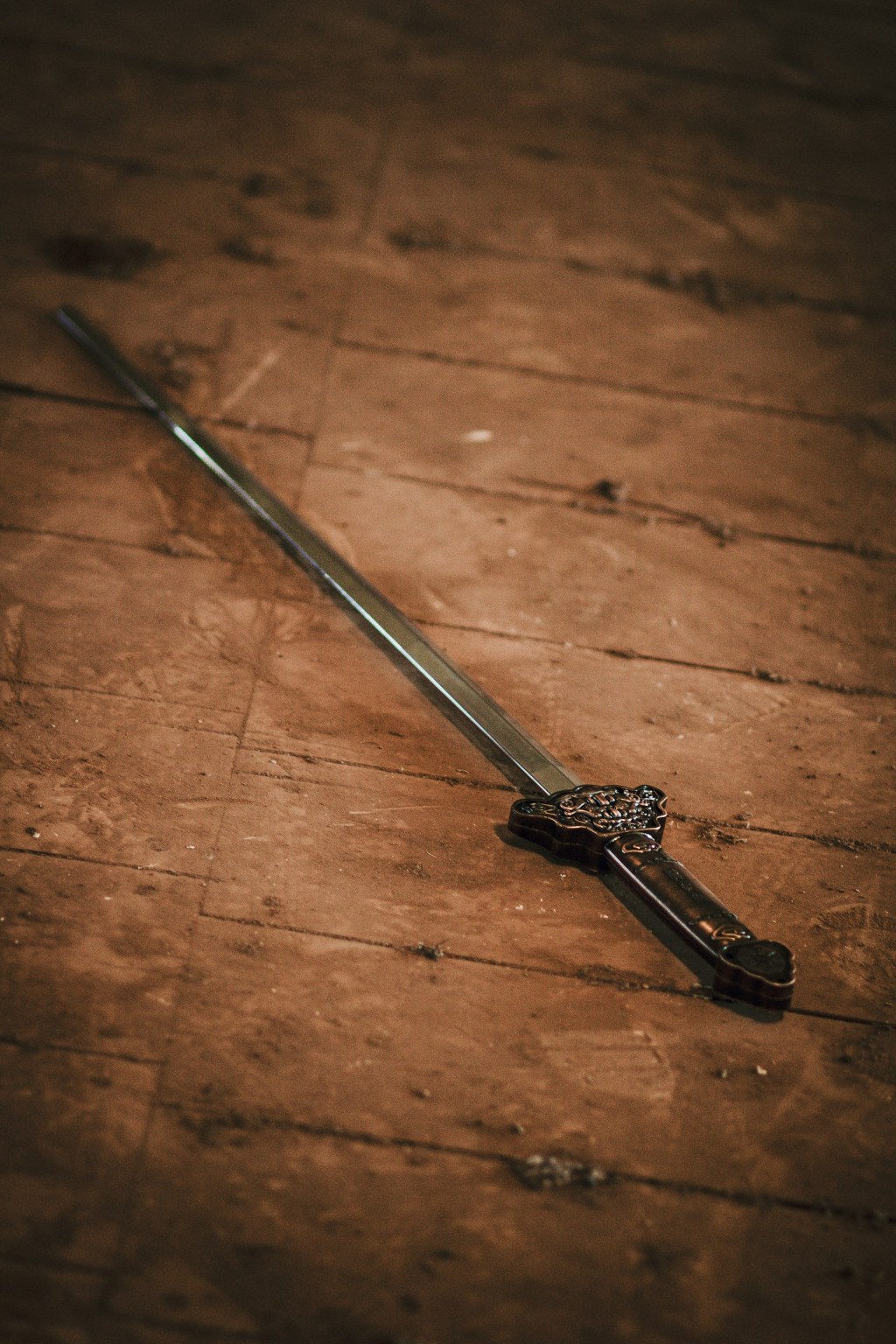
Photo by Cassiano K. Wehr on Unsplash
The first sword I ever trained with seriously was a katana.
Not, perhaps, in the exact lineage someone might imagine from that sentence. My instruction came through a Korean martial arts tradition that borrowed from several older systems, and the sword work reflected that mixture. But the blade itself was unmistakable. Curved steel. Wrapped grip. Weight forward enough to be felt, but balanced well enough to invite movement.
I had wanted one long before I had earned any right to use one, and that probably mattered more than I understood at the time. There are some objects we encounter first as things, and others we encounter as ideas; a hammer is usually a hammer before it becomes anything else. A sword, at least to a boy who grew up on stories, rarely gets that luxury.
By the time I wrapped my hands around one properly, I had already imagined what doing so would feel like for years. The answer, initially, was exactly what I had hoped. It felt right.
There was weight in the hand without clumsiness, and purpose in the shape. The first movements only encouraged the belief, because forms are forgiving in that way. They reveal many mistakes, certainly, but the air does not resist. A bad angle can still feel decisive when nothing has to absorb the consequence of it. A grip can feel comfortable when the only thing answering it is momentum. You can move through the shape of competence without ever discovering which parts of that shape are real.
And for a while, I did.
Then, as people do when repetition has ceased being exciting but wisdom has not yet caught up, I decided I wanted to hit something. There was a tree branch, and it seemed like an excellent target.
The first swing felt perfect, right up until the blade touched the wood.
Then everything went wrong. The edge rolled to the side, my wrist went with it, and the impact sent a vibration through the sword and into my hand hard enough that my fingertips buzzed afterward. What had felt like a clean and powerful cut in open air suddenly became awkward, unstable, and unmistakably wrong.
Naturally, I tried again, and it ended much the same way.
I asked my instructor later, while we were cleaning after class, what I was doing wrong. My first theory was simple: my wrist was too weak. I had swung, and the blade had turned because my wrist had failed to keep it straight. Therefore the wrist needed to be stronger. As explanations go, it had several attractive qualities: It was simple, and it preserved almost everything I already believed about what I was doing. Tragically, it was also wrong.
The problem – beyond the choice of target – was my grip. More precisely, the grip that felt natural to me placed the blade slightly off center, and my arms followed the path that felt best to them rather than the one the weapon could actually use. I was generating force, certainly, but I was generating it through a structure that could not survive contact.
The branch had not revealed weakness, exactly. It had revealed misalignment.
So began another round of practice. Correct the hands. Correct the wrists. Correct the path of the blade. Repeat.
What had felt natural had to be made unfamiliar, and what initially felt awkward had to be repeated until it became ordinary. The sword itself did not change to accommodate my intuition. Instead, my intuition had to be retrained around the realities of the sword.
I should be honest about the order of things before going any further. Three traditions flow through what follows, but none of them taught me this. I met Taoist, Zen, and Confucian thought years after my sword met the branch, and what they gave me was not instruction but vocabulary: words for something life had already planted badly enough that I remembered it. I respect them and I return to them, but I recognized the lesson in the writing because I had already paid for it in the yard.
What I collided with was this: Reality is perfectly capable of contradicting the body, the mind, and the stories we tell ourselves about both. And sometimes the most dangerous mistakes are the ones that feel perfect before they make contact.
The Way Does Not Bend for the Hand
There is a specific kind of mistake that comes from insufficient effort, and this is the kind we tend to understand easily. If we cannot lift something, perhaps we need to become stronger. If we do not know something, perhaps we need to study. If a skill is poor, perhaps we need more practice.
There is comfort in this model because the solution always points in the same direction: more strength, discipline, effort, or certainty.
There is a second kind of mistake that is harder to recognize because effort makes it worse. Sometimes the problem is not that we are failing to impose our will effectively enough. Sometimes the problem is that we are trying to impose it at all.
Taoist thought has always fascinated me in part because of its discomfort with force in this broader sense. Not force as violence alone, of course, but force as our tendency to decide what reality should be and then exhaust ourselves trying to make the world comply. The concept of wu wei is often flattened into some version of doing nothing, but that interpretation misses much of what makes the idea interesting to me. It is closer to action without unnecessary forcing; movement fitted to the nature of circumstances rather than imposed upon them from outside.
There is a difference between passivity and alignment. The sword taught me that before I had language for it.
My first instinct after the blade rolled was to assume that the solution was strength. Grip harder, and stabilize the wrist; force the blade through the line I had already chosen. There is something almost embarrassingly human about that diagnosis, and we do it everywhere. A conversation does not produce the response we expected, so we explain ourselves again, only louder or at greater length. A process does not behave as designed, so we add another layer of complexity around it. A person cannot be helped in the way we have decided help ought to work, so we try harder to help the same way.
Our own mind refuses to feel the way we think it ought to, and we turn discipline into an attempt to beat ourselves into emotional compliance.
The wrist must be weak – a reassuring conclusion because it leaves the swing we already chose intact.
Taoism introduces a more disturbing question: What if the swing is wrong?
Not morally wrong, necessarily – perhaps not even foolish or malicious. What if it is simply incompatible with what is actually in front of us? What if greater strength would only allow us to perform the wrong action more decisively?
That question has become important to me far beyond martial arts. There is a temptation, especially for people who value discipline, to treat persistence itself as evidence of virtue. We admire the person who keeps going, the person who bears more, and the person who refuses to quit. Often, rightly so.
But persistence is not wisdom. You can walk in the wrong direction with extraordinary discipline, just as you can maintain an unhealthy relationship with admirable loyalty. You can defend a broken system with incredible competence as easily as you can become extremely good at solving a problem that exists primarily because you refuse to reconsider your assumptions.
The tree does not care how committed you are to the swing.
That was one of its first lessons: the sword has a nature, as do the body holding it, and the target before it. A useful cut emerges from the relationship among them, and the weapon cannot simply be treated as an extension of the desire to cut.
That is the deeper Taoist correction. Alignment is not the discovery of a universal technique that allows us to stop paying attention; in fact, alignment requires continued attention. The fact that something worked before does not obligate reality to preserve the conditions under which it worked. The person in front of you changes. Responsibilities change. You change.
The same action can be compassionate in one circumstance and destructive in another. Silence can be patience or cowardice. Intervention can be courage or vanity. Persistence can be discipline or refusal to accept what has already become obvious. There is no virtue in forcing identical movements onto different moments merely because we have become proud of the movement.
The sword does not ask what technique I prefer. It asks whether I am paying attention.
And perhaps that is one of the first ethical obligations we owe the world around us. Not merely to act, but to notice what we are acting upon. To resist confusing our preference with its nature, and to recognize that sometimes the answer to resistance is not greater force.
Sometimes the branch is telling us to look at our hands.
The Branch Does Not Argue
There is something profoundly useful about an instructor that cannot be persuaded.
The tree had no opinion of me; it did not care how long I had wanted the sword, or how impressive the swing felt. It did not know whether I considered myself disciplined and capable. It simply occupied a place in the world. I struck it, and something happened.
That quality gives the memory an almost Zen character in retrospect. There is a persistent thread within Zen Buddhism that resists our tendency to confuse understanding something conceptually with knowing it directly.
We are very good at accumulating descriptions. We can explain patience, describe courage, and build beautiful theories about compassion, restraint, justice, humility, responsibility, love. We can become extraordinarily articulate about the kind of person we intend to be.
None of that is meaningless. But none of it is contact.
Before the branch, I knew how my sword swing felt. After the branch, I knew something about whether it worked. Those are different categories of knowledge.
That difference has stayed with me because human beings are remarkably convincing narrators of themselves, perhaps necessarily. We live inside our own reasoning. We know the circumstances surrounding our decisions; we know what we intended, and remember the choices we did not make. We know the fears we overcame and the burdens no one else could see.
That interior access is important, but it is also dangerous, because intent can become insulation. When it does, it often sounds familiar: I know I meant well. I know why I said it. I know what I was trying to prevent. I know they misunderstood. I know the alternative would have been worse.
Perhaps. But the branch still gets a vote.
That is not an argument for judging actions solely by outcomes. Outcomes can be unfair, unpredictable, or completely outside our control. It is an argument against allowing our internal explanation to become the only evidence we consider.
We say we are patient. With whom, and under what conditions? Patience in solitude is mostly hypothetical.
We say we are courageous. What happened when honesty became expensive?
We say we are compassionate. What happens when compassion requires us to disappoint the person asking for it?
We say we believe in justice. What happens when fairness costs us something we wanted?
We say we accept responsibility. Do we still accept it when the mistake threatens the version of ourselves we most want others to believe?
Many virtues are easy in open air. Contact changes the measurement.
This is where self-examination becomes uncomfortable. The most dangerous possibility is not that we are secretly monsters pretending to be good; that is dramatic, and often easy to recognize.
The more common danger is sincere error. We can be honestly wrong. We can be compassionate in intention and enabling in effect. We can be protective and become controlling. We can be disciplined and become rigid. We can prize peace and become avoidant. We can defend a principle long after we have started defending our pride instead. We can call something honesty when what we really enjoy is the permission to be cruel.
No deception is required in these cases, and that is what makes the problem difficult.
The novice swing felt correct. I was not pretending it felt correct; the sensation was real. The conclusion I drew from it was not.
That distinction matters, and has become one of the reasons I interrogate my own actions as closely as I do. I do not believe sincerity is sufficient protection against error. I can know what I meant; I cannot know that meaning automatically produced the thing I intended. I can know that a choice aligned with my stated principles; I still have to ask whether I understood the principle correctly. I can know that something feels wrong; I still have to ask whether discomfort is warning me away from something harmful or merely telling me I have encountered something difficult.
The branch does not answer those questions for me. But it does something more important: it reminds me that the questions exist.
Zen, at its best, does not simply hand us another abstraction to place between ourselves and the world. It keeps returning attention to experience. What happened? What is here? What are you adding to it? What remains when the story quiets?
The branch had no story I could understand. The vibration in my fingers did not care what I believed about swordsmanship, or what I’d learned in training. Contact stripped away interpretation for just long enough that I had to admit the obvious: something in the movement was wrong.
That admission was not defeat. It was the beginning of learning.
The Shape We Practice
Recognition alone is overrated.
There is a peculiar satisfaction in identifying our flaws. The insight feels productive; sometimes it is, but in another setting, it may become a substitute for production. I know I become defensive. I know I avoid this kind of conflict. I know I tend to overextend myself. I know I have difficulty letting go. I know I become impatient. Knowledge can become another form of comfort if nothing changes afterward.
My instructor could tell me exactly why the blade rolled, but the explanation did not correct my grip. That required practice.
This is where Confucian thought enters the lesson differently, and where I should say plainly what this essay is actually about. I do not examine my own actions in order to reach a verdict on myself.
I am not interested in deciding whether I have been good or bad, and I have no use for the version of self-examination that is mostly punishment wearing the clothes of rigor. I examine my actions because they are formative. I believe that character is not merely discovered. It is developed.
In short, what we repeatedly do shapes what becomes easier to do, and eventually what feels natural, which means that every action is – in some sense – practice for the next one.
That is a more practical moral claim than it sounds at first. We sometimes speak of authenticity as though whatever response emerges most spontaneously must therefore be the truest expression of ourselves. I have never found that convincing.
The first grip felt authentic, while the corrected one initially did not. That does not make the first better.
There are many things in life that feel unnatural because we have not practiced them: apologizing well, listening without preparing a defense, saying no before resentment makes the decision for us. Speaking when silence would be easier, or remaining quiet when our ego desperately wants the final word. Accepting praise without pretending not to deserve it, or accepting criticism without immediately trying to prove we do not deserve that either.
The unfamiliarity of a response tells us something about our history with it. It does not necessarily tell us whether it is right.
Practice changes the vocabulary of instinct.
That is why I care so much about what I do in small circumstances. Actions rehearse themselves. Every time I avoid a necessary conversation, avoidance becomes more available. Every time I choose convenience over honesty, that movement becomes slightly easier. Every time I allow irritation to justify contempt, contempt receives another repetition.
Thankfully, the reverse is true as well. Every time I slow down before responding, I practice restraint. Every time I admit something I would rather explain away, I practice honesty. Every time I establish a boundary before anger establishes it for me, I practice judgment. Every time I accept that another person may see something I missed, I practice remaining teachable.
Every choice leaves residue. If I make an excuse today, that excuse becomes easier to reach for tomorrow.
If I choose anger as a tool whenever anger works, I should not be surprised when my hand reaches for it before anything else.
If I practice patience only when patience is easy, I have practiced comfort, not patience.
This is also why I have difficulty dismissing small failures as irrelevant simply because their consequences were small. The consequence may not be the only thing that matters. What did the action teach me? What did I make easier? What kind of movement did I just practice?
None of this is because I believe repetition makes us perfect; it does not. Practice makes things practiced, and that is far more interesting.
The sword teaches you how to use it – not because steel contains moral wisdom, but because repeated contact creates capacity. At first the movement is conscious: Hand here, wrist there, align the edge. Do not overextend. Recover.
Again.
Again.
Eventually, some of the instruction disappears into the body.
This is what forms are for; they are not meant to become sacred choreography. They create structure that can survive the moment when conscious calculation becomes too slow.
Ethics has forms too. We call them principles, habits, rituals, rules, promises, ways of treating people, commitments we make before circumstances tempt us to negotiate them. At their best, they train something into us.
Confucian cultivation also offers an answer to what we do after discovering failure. We practice differently. Not: this proves I am a terrible person. Not: this is simply who I am. Both conclusions terminate the lesson. One condemns the student, the other excuses him, and neither changes the grip.
A better response is more demanding and, strangely, more merciful: Then this is what I must practice.
If I responded defensively, I practice listening. If I avoided something necessary, I practice speaking sooner. If generosity became self-erasure, I practice boundaries. If firmness became cruelty, I practice restraint. If certainty made me deaf to evidence, I practice leaving some part of the conclusion unfinished. Correction becomes instruction.
The failure does not disappear; it becomes part of the form.
I believed all of that before I picked up the second sword. I still do. I simply had not yet learned what it costs.
What the Blade Was For
Years later, during a period when I had become much more interested in fluid motion and precision than in force, I began working with the jian.
I was not a beginner anymore, and that turned out to be the problem.
The straight sword felt unfamiliar in the hand, but unfamiliarity is a condition I had been trained to work through rather than listen to. So I did what years of correction had prepared me to do. I found the structure. I aligned the edge. I moved the way good practice had made natural, which is to say I treated the jian as a katana that happened to be shaped differently.
Then, because the best lessons are rarely learned once, I took it to a tree.
The first swing did not roll. It twisted. Not the wrist, and not the edge wandering off the line I had chosen – something further down, in the steel itself, and I could see it afterward when I sighted along the blade. That should have been the end of it. I knew exactly what an off-center grip felt like, and this was not that, which meant the problem was somewhere I had no correction for.
Still, I adjusted what I knew how to adjust, and swung again. The blade broke.
There is no version of that story where the weapon was at fault. The jian was not built for what I was asking of it. It is made to deflect, to guide, to redirect, to find the opening and pierce. It is not made to clash and slice its way through resistance. Everything about its balance and geometry describes a different relationship with an opponent, and I had spent years learning to want the relationship it was not designed for.
The first branch had shown me that my structure was wrong. This one showed me something worse: My structure was fine.
I had brought a correct movement, practiced well and honestly earned, to an object that could not receive it. Nothing in the swing was sloppy – but what protects the steel of the katana is destructive to the jian.
The technique performed exactly as trained, and the training was the thing that had to change.
It took me a long time to accept that. Longer than the first correction, and for a reason I find uncomfortable in retrospect.
The first time, the evidence arrived instantly and unmistakably – hit wood, feel the buzz, know something is wrong. The second time, I had years of proof that my swing was good. Every previous piece of evidence agreed with me.
I could look at the ruined blade and still reach for the explanation that preserved the movement, because the movement had never failed me before.
Consider who is capable of that mistake. A person who has never trained does not swing a jian into a tree. They have no default about what a blade is for, so they hold the thing and wonder. It was competence that let me stop wondering. Practice had done exactly what practice is supposed to do, which is remove the question from conscious consideration, but the removed question was the one I needed.
That is the part I did not see coming when I first understood the value of cultivation. Repetition wires a chosen response in as natural response. I have argued for that, because it means I am not spending attention on the how and can inhabit the situation more fully. I still think that is right in many cases.
But a wired-in response arrives with a default about what the thing in front of me is for, and defaults do not present themselves as choices. They arrive as perception. By the time I noticed I had decided something, I had already swung.
What eventually came out of it was not resignation; I ended up loving the jian as much as I ever loved the katana. Not despite the difference, but because of it.
Once I stopped trying to make it behave like the sword I already knew, the thing it actually does became visible, and it is beautiful in a way that force is not. Economy instead of power. Continuity instead of commitment. A relationship with distance and timing rather than mass.
But I had to re-learn what my brain thought a blade was for.
That sentence carries most of what this essay is trying to say. The correction I actually needed was one level further back, in the assumption that had stopped pretending to be a choice.
The blade and the target both dictate the options available, and neither of them consults me.
The most I can bring is a hand trained well enough to do what the situation permits, and enough attention left over to notice what that is. Structure exists to make good movement possible, but it is not the same thing as movement.
The difference between them is where nearly all of my worst decisions have lived.
That distinction matters morally too. Rules are useful, and principles are necessary, but the goal is not to become so attached to the form of virtue that we stop noticing whether our actions remain virtuous. Compassion cannot have only one technique. Neither can courage, love, or responsibility.
The mature practitioner is not the person who has memorized one perfect response. It is the person whose training has become deep enough that adaptation no longer requires abandoning principle.
We practice so that when the circumstances change, we have more than impulse available. We have structure, and then, if we are fortunate, enough freedom inside that structure to meet the thing actually in front of us.
The Test of the Branch
I still think about that branch. Both of them, in fact, though not often in any deliberate sense. They have simply become part of how I examine things.
When an idea feels particularly clean, I become curious about where it will make contact. When an explanation preserves my ego a little too perfectly, I wonder whether I am diagnosing a weak wrist. When increasing effort produces increasingly poor results, I try to ask whether I am simply swinging harder. When a theory works beautifully until another human being enters the room, I pay attention.
The trees became a test. What would the branch say?
But they ask different questions, and only one of them is easy to hear. Bad execution announces itself: the blade rolls, the vibration reaches your hand, and the result is difficult to narrate around for very long. A bad premise says nothing. It performs, competently, for as long as you let it, and I am well past the age where the first mistake is the one I am likely to make.
So the test has two halves. Can the thing I believe survive something outside my own reasoning? And is the reason I believe it that it has been true, or that it was true somewhere else, once, about something with a different nature?
Can the principle survive consequences? Can my explanation survive another person’s perspective? Can my certainty survive facts I would prefer not to be facts?
Can the story I tell about myself survive the things I actually do?
That last one is the hardest.
None of this is a demand that I assume I am wrong. That would be another kind of vanity, just pointed inward, and self-doubt can become every bit as self-absorbed as certainty. The point is not to distrust every conclusion, but to instead refuse to protect conclusions from evidence merely because I like the person I get to be if they remain true.
Sometimes the grip is fine. Sometimes the obstacle really does require more strength. Sometimes the unpopular choice remains correct after every reasonable objection has been considered. Sometimes another person is simply wrong.
The branch test does not require surrender. Only contact.
And it is not a request for perfection, which is a useless training objective in any case. No one performs every movement correctly. No one interprets every situation accurately. No one lives long without discovering that some deeply held belief was built on an incomplete understanding.
The more important question is what happens after contact. Do I blame the branch? Do I swing again, harder, because admitting the technique is flawed threatens the image I have of myself? Do I construct a theory elaborate enough to protect the movement from the evidence?
Or do I look at my hands?
That is the deepest reason I return to my actions so often. Not because I believe every failure proves something terrible about me, but because failure contains information, and information ignored becomes repetition. There is a kind of freedom in treating mistakes this way. I do not have to defend every past version of myself. I only have to learn from him.
The person who struck the branch was wrong. He was also learning. Both can be true.
The person I was yesterday may have misjudged something. That does not require hatred. Only correction.
There is a moral responsibility in remaining teachable: in being able to encounter evidence without treating it as an attack, to recognize when effort has become forcing, to notice when principle has become attachment, and to distinguish the movement that feels natural from the movement that actually works.
I do not always succeed. That is why the test remains useful.
Once, the Feeling Was Perfect
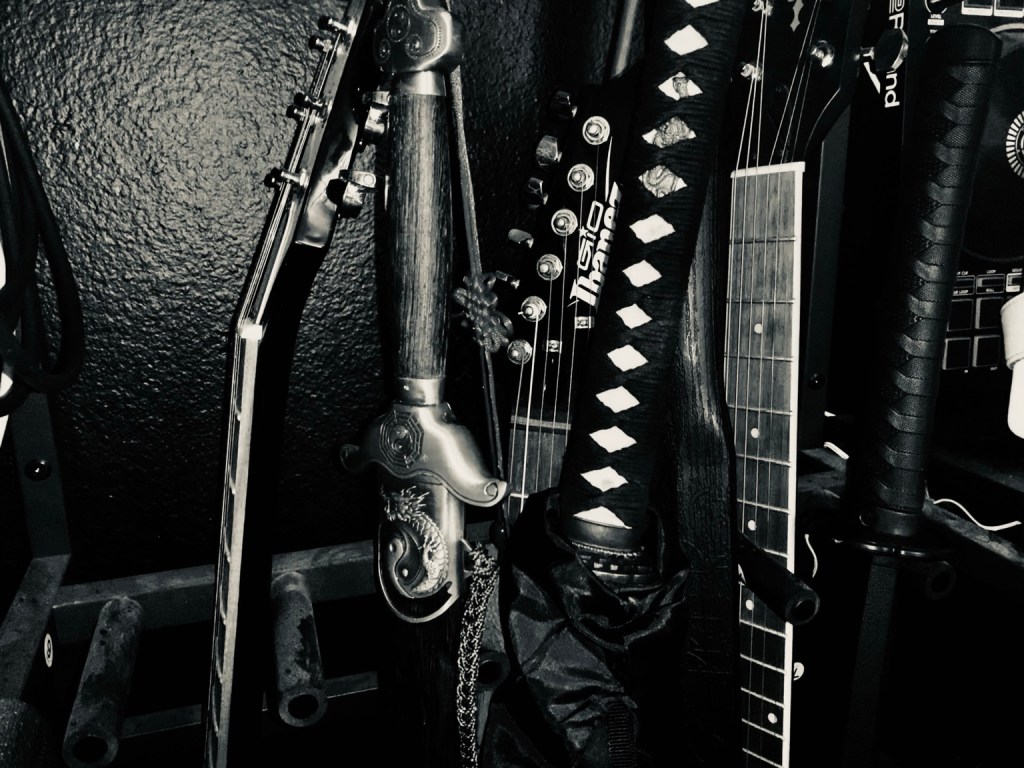
I keep swords in my office. Some steel, and others polypropylene, which has largely replaced the oak training weapons I once used. They are not there for drama. Mostly they exist because I like them, because years of practice have made the shape familiar, and because objects acquire histories when we carry them long enough.
Occasionally, while I am thinking through some problem, I will pick one up, and nothing elaborate happens. I test the weight. I feel how the balance settles into the hand. Rayskin and silk beneath my palm on one grip, oiled wood on another. The hand adjusts almost without instruction now, and I have learned to be slightly suspicious of how easily it does that.
Because sometimes I remember. Not merely the branches, but the moments before them. Those may be the more important memories.
The first time I held that katana, everything had felt right. The grip, the stance, the movement, and perhaps the imagined identity attached to it.
There had been no warning from inside the experience that something was wrong. Then the blade touched wood.
The second time, everything felt right for better reasons. The structure was sound, and the practice was real. The confidence had been earned honestly, over years, through exactly the kind of correction this essay recommends.
None of that spared the blade.
Years later, both of those still unsettle me, and the second more than the first. Certainty and correctness can feel remarkably similar before contact. But earned certainty and correctness feel identical, because everything that made the certainty trustworthy was true.
It was simply true about something else.
Taoism gives me language for one part of that memory: do not confuse force with alignment. Zen gives me another: let reality answer. Confucianism gives me the next obligation: when the answer exposes a flaw, practice differently.
And the second branch adds the one I did not want, which is that practicing differently is not a thing you can complete. The correction I earned became the assumption I could not see.
I did not learn any of that from books. A sword taught me, a tree confirmed it, and a second sword refused to let the lesson settle into something comfortable. That is often how the most durable instruction works. We build explanations afterward, but the body remembers first.
I do not remember every form I practiced. I do not remember every correction an instructor made. I could not reproduce every conversation that shaped the way I think now. But I remember the vibration in my fingertips. I remember expecting the blade to pass cleanly through the line I had chosen, and I remember the sound a straight sword makes when it finally gives up on being what I wanted it to be.
I remember the surprise of discovering that reality had no obligation to agree with me.
And perhaps that is enough. I do not need to distrust everything that feels right. I only need to remember that feeling right is not the end of the inquiry.
The world is full of branches: People. Consequences. Failures. Resistance. Evidence. Moments that refuse to conform to our preferred understanding of ourselves.
We can resent them. We can strike harder. We can decide that the problem must be weakness, because strength is easier to acquire than humility.
Or we can allow contact to become instruction.
That is the part I try to carry forward. Not the embarrassment of being wrong, but the usefulness of discovering it. Not suspicion of myself, but a willingness to look again.
Because once, the feeling was perfect before it became correct.
And then, later, it was correct – and still wrong. I had brought it to the wrong tree.








Leave a Reply