

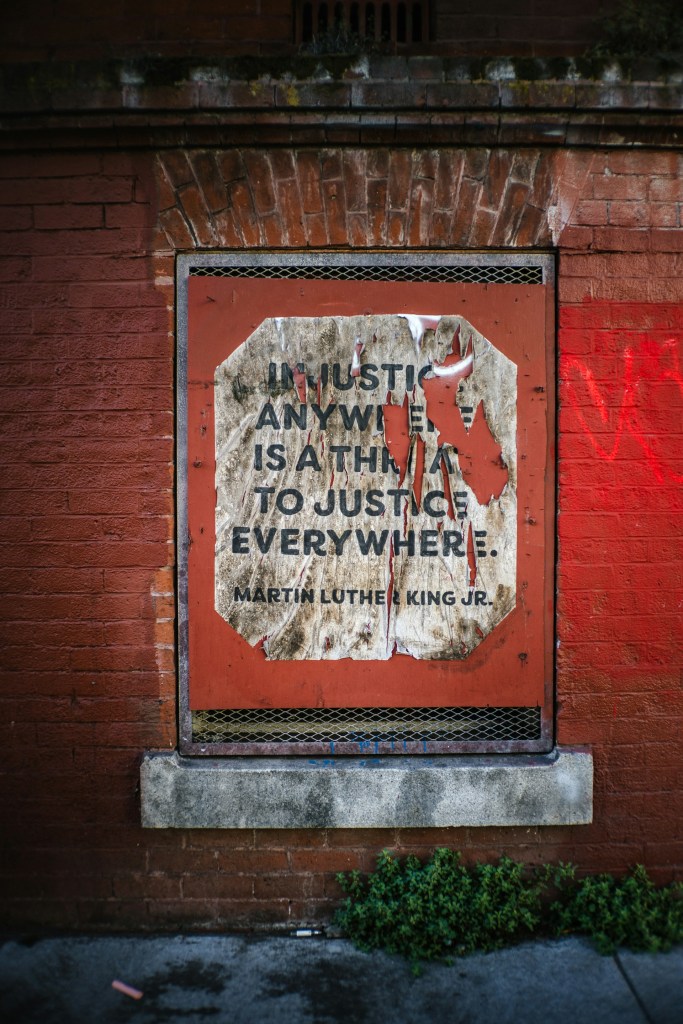
Photo by Stefano Pollio on Unsplash
Someone, somewhere, is being called a monster right now.
Though not in a courtroom, or a history book. Right now, the label is applied in a kitchen, in a group chat, or at a dinner table after a hard conversation that didn’t end the way one party expected.
The word is doing work the speaker hasn’t audited; it feels moral, like a judgment with weight behind it. It feels like the kind of thing you say when you have looked clearly at something and seen what it is.
But if you ask the speaker what specifically triggered the word, if you interrogate what the person they are calling monstrous actually did, the answer is rarely cruelty in any pure form. More often it is something quieter: A refusal. A line that did not move when the speaker expected it to, or a door that did not open when knocked on in the usual way.
This is worth noticing because of how casually the word gets used and how rarely it gets examined.
We treat monstrous as if it points at something specific in the world, as if there exists some recognizable category of action or person deserving of the label. But the more carefully you watch how the word actually moves through ordinary speech, the less it looks like a description and the more it looks like a reflex. It tracks something, surely, but what it tracks is not always what it claims to be tracking.
There is a gap between what the word announces and what it does. That gap is worth standing in for a moment, before reaching for the word again.
What the word actually marks
Watch the word in the wild and a pattern emerges. Monstrous tends to arrive late in a sequence. It is rarely the first thing said. It comes after something else has failed; after charm did not work, appeal failed to convert, and discomfort has been withstood. The implicit suggestion that the other person reconsider, soften, find a way to meet in the middle – none of it worked. The person remained where they were. And that is where the word found them.
This is not the structure of moral discovery; it is a story of failed leverage.
You can test this against your own usage if you are willing. Think of the last time you called someone, even silently, a monster. Now reconstruct the sequence. What did you try first? What did you expect to happen? At what point did the word arrive?
You will likely find that it followed a moment when an ordinary social mechanism was applied and produced no movement. The word came after the lever broke.
I have been on the other side of this sequence. Not in courtrooms or history books; in the same kitchens and group chats and at the same dinner tables, after conversations that did not end the way the other party expected. I have watched the pattern I am describing from the position of the one the word was reaching for, and part of how I came to see its shape is from standing inside it. That is worth saying once, plainly, because the rest of what follows would be dishonest without it.
This does not mean the word is meaningless. Sometimes the lever breaks against something that genuinely should not have moved: a cruelty, a violation, a refusal of basic decency. But often it breaks against something else entirely. It may be a boundary held, or a position maintained under pressure. A line that the speaker assumed was a starting point and that turned out, on inspection, to be a stopping point.
Surely some people are called monstrous because they did monstrous things. Of course. The claim is not that the word never tracks cruelty.
The claim is that it tracks something else often enough and pervasively enough, across enough situations, that we should stop assuming we know what we are saying when we use it. The word has been doing double duty, and we have not been keeping track of which duty it is doing at any given moment.
The case that will not dismiss
The clearest test is a man who has been called monstrous for almost two hundred years, and who never raised his voice, never enjoyed cruelty, never bore his quarry a personal grudge, and never did anything other than what he had been hired to do.
Javert, in Hugo’s Les Misérables, pursues Jean Valjean across decades for a crime Valjean genuinely committed under a law Javert genuinely serves. He is not corrupt, nor is he vindictive. It is made evident that he takes no private pleasure in the chase. He is a civil servant of unusual integrity, applying the law to a man the law has marked.
And yet, readers, generation after generation, find something cold and alien in him and reach for the word.
This is worth dwelling on, because if monstrousness tracked motive, Javert would be a sympathetic figure; perhaps tragic, but certainly not monstrous. If it tracked cruelty, he would barely register; there is nothing sadistic in him. If it tracked the worth of the line he holds, the reader would have to argue with French law, not with Javert; after all, he did not write the law. He is enforcing it with the integrity one would presumably want from any person in his position.
None of that helps; the reading does not soften, and the word keeps arriving.
Hugo gives him more sympathy than a simple villain would receive. In fact, the text gives the reader every tool needed to understand him; we see his background, his discipline, the moral architecture he has built his life around… And it makes absolutely no difference. The response to Javert is structural, not informational, and more understanding does not produce more sympathy.
Which means the word, when readers reach for it, is not responding to a deficit of information. It is responding to something information cannot reach.
What it is responding to is the line that will not move. Valjean has changed, as have the circumstances. Even the reader’s sense of justice has changed by the pivotal moment, but Javert has not. He cannot. The line he stands on is not, for him, the kind of thing that moves in response to circumstance. And that, more than any cruelty, motive, or even the content of the line itself, is what produces the reading.
The grace that is not grace
Most of social life, as most of us live it, depends on lines being soft. Not all lines, of course, and certainly not the deepest ones. But most of the lines that come up in ordinary days – at work, in families, in friendships, in the endless series of negotiations that make shared life possible – are starting positions rather than stopping positions.
They are held until the social cost gets high enough, and then they adjust. This is not a failure in itself, but it is how the machinery runs.
We have a rich vocabulary for praising this. We call it grace, openness, reasonableness, or maturity. We say a person is flexible and we mean it as a compliment. We say someone is willing to listen, able to compromise, open to other perspectives, and these phrases land as moral praise. The good person, in much of our ordinary speech, is the one who can be moved by good arguments, by new information, by the legitimate concerns of others.
The good person bends.
There is something genuinely valuable in this. A world in which everyone held every line absolutely would not last a week. Marriages would not survive. Workplaces would not function. Neighborhoods would tear themselves apart over the kinds of small frictions that, in practice, get absorbed by mutual willingness to give a little. The flexibility is load-bearing. We need most lines to be soft, most of the time, because the alternative is consequence more often than cooperation.
But notice what this means about the vocabulary. The words we use to praise people: reasonable, gracious, open… are words for rewarding negotiability. They are not, in the first instance, words about truth, or words about whether someone is right.
They are words about whether someone can be moved.
This shows itself most clearly in how we treat disagreements that end in compromise. Two people who disagree and meet in the middle are praised for the meeting, almost regardless of where the middle is. The act of compromising is treated as the morally significant event. Whether the compromise represents anything resembling truth, or justice, or even basic accuracy, is a separate question that rarely gets asked.
The meeting was the achievement; the location of the meeting is incidental.
This is the moral vocabulary of a creature that has to live with other creatures and cannot afford to be right about everything, all the time, at full volume; in short, it is the working ethics of cohabitation. But it has a cost, and the cost is rarely named: over time, the vocabulary loses the ability to distinguish between flexibility-as-grace and flexibility-as-failure-to-stand-anywhere.
Everyone who moves is reasonable. Everyone who doesn’t becomes the problem. The moral language slowly collapses into a preference for people who can be moved by ordinary social pressure.
And the word for those who cannot, the one the machinery reaches for when its ordinary mechanisms fail, is monstrous, or something close to it.
Cold, rigid, self-righteous, fanatical, sanctimonious – the vocabulary varies; the function does not.
These are the words that get applied when a line does not soften, and they are applied with a moral charge that they did not, on inspection, earn. The charge is borrowed, but the actual content underneath is structural, and it reveals an immune response by a system that needs lines to remain negotiable in order to keep working.
The trap that closes on both sides
Some may now expect that the unmoving line is therefore vindicated. That the person called monstrous is actually the principled one, holding fast in a world of moral cowards. It would be comfortable to end with a quiet defense of immobility against the soft seductions of compromise.
But immobility is not itself a virtue. The crusader is immobile. The fanatic is immobile. The abusive parent who will not be reasoned with is immobile. The person whose grievance has hardened into a worldview is immobile.
History is full of unmoving lines that should have moved, held by people who mistook their certainty for principle. The genealogical work we have been doing on the word monstrous does not redeem everyone the word has ever been applied to. It just means that the word, as a tool, was never doing what we thought it was doing.
This is the harder seat, and it has to be sat in. Two things have to be held at once: the social judgment is structural rather than moral, which means it does not reliably track wrongdoing. And the person who will not move is not therefore right.
The collapse of one judgment does not produce the opposite judgment. It produces a vacuum, where the actual moral question has to be asked on its own terms, without the comfort of the social vocabulary doing the work in advance.
This is uncomfortable in a particular way. Most of us prefer judgments that come pre-assembled; we want the word to do the moral work for us. We want to know, when someone is called monstrous, whether to agree or to defend, and we want the answer fast, on grounds that we do not have to reconstruct from scratch each time.
The discovery that the word is doing something else, that it is the immune system of negotiability rather than a verdict on cruelty, leaves us alone with the actual question.
There is no test that can be run from the outside to sort the principled from the fanatical. Both stand still, just as both refuse the usual levers, and produce the same word in the mouths of those who try to move them and fail.
From the outside, the saint and the zealot are indistinguishable in their certainty. The difference, whatever it is, is not visible in the holding. It is somewhere else – in what the line is tied to, in whether it survives being examined, and in whether the holder is still asking the question or has stopped asking.
That difference cannot be read off the surface. It can only be approached slowly, case by case, with the kind of attention that the word monstrous exists to spare us from having to pay.
The test I am proposing here is one I apply to myself, knowing it cannot be applied from the outside. Knowing that the asking is invisible to those who only see the holding. The interrogation of the line – whether it is tied to something worth being tied to, whether it survives being examined, whether it is still a live question rather than a settled posture – happens somewhere the observer cannot reach.
By the time the line shows itself to others, the asking is already done. From their position, settled is indistinguishable from unconsidered. I cannot prove, in this essay or any other, that the difference exists in my own case. I can only say that the asking is what I have been doing, here and elsewhere, including in the writing of this.
What you are doing when you reach for it
The word will still be there tomorrow. It will continue to be reached for, in kitchens and group chats and at dinner tables, by people who have just experienced the failure of a lever they expected to work.
Most of those people will not pause to examine what the word is doing. They will use it the way it has always been used. The word will do its work, and the social machinery will continue to defend its need for lines that move.
But you, having read this, may find the reach slower than it used to be.
Perhaps not because the word has been taken away from you; it hasn’t. It still belongs to you, and there will be times when reaching for it is exactly right – when what you are looking at really is cruelty, violation, or the kind of thing the word was originally meant to mark.
The slowness is for the other times. The times when the word arrives after a lever has broken and before the moral question has actually been asked. The times when what you are responding to is not what someone did but when they would not soften, would not move, would not give you the ordinary social satisfaction of being met halfway.
In those moments, the word is doing something other than what it advertises. And you, now, may be in a position to notice the gap.
There is no resolution to offer here. I have no recommendations to give.
This piece ends with the observation that most of us have spent a long time learning, in ways we never quite articulated, that to be good is to be movable. That the willingness to compromise, to soften, to meet halfway, is what separates the decent person from the dangerous one.
And it may be worth asking, once, slowly, how much of what we call our moral judgment is actually a preference for people who will not make us uncomfortable by standing somewhere we cannot move them from.
The word will still be there tomorrow. The question, when next you find yourself reaching for it, is whether you have found a monster, or only found a line you could not move.








Leave a Reply