

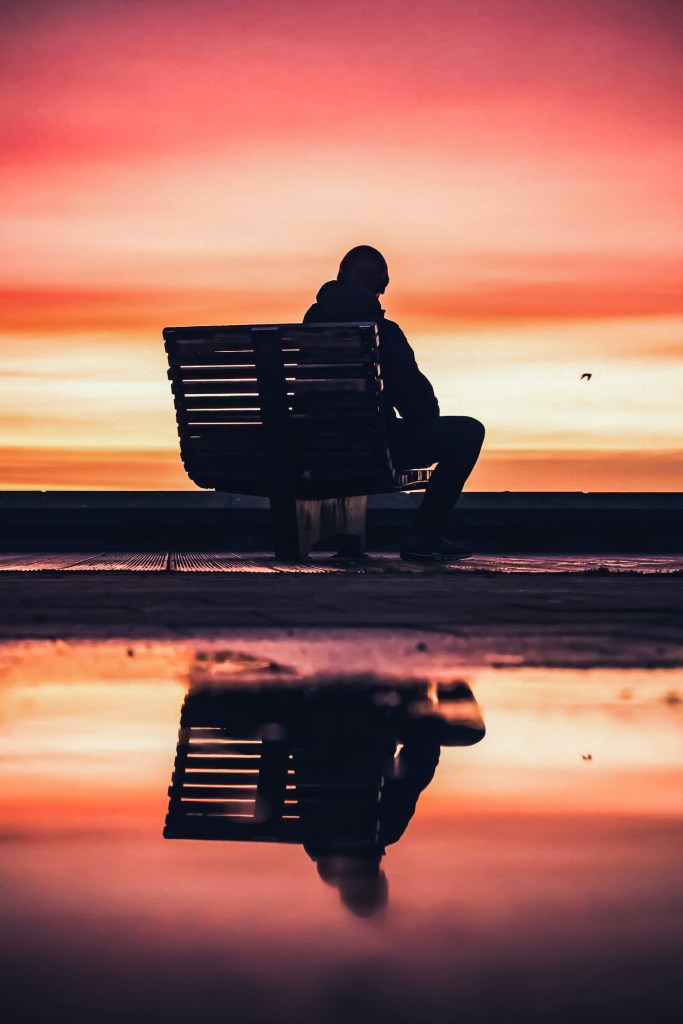
Photo by Yannick Pulver on Unsplash
This is the second post. The first was the memorial; the public acknowledgment that he was gone.
This one is different. This is what I carry forward.
I have spent years returning to philosophy when I am trying to understand what a life is for. So when I sat down to write what my father gave me, the form chose itself.
Marcus Aurelius opens Meditations with Book I: a catalogue of what he learned from each person who shaped him. His grandfather. His mother. His adoptive father. His teachers. He names them, and he names what each one gave him. The philosophy that made him famous comes after.
Before he tells you what he thinks, he tells you who he learned to think from.
I am not writing about an emperor’s tutor, but about my father. He was a man who held things privately, kept photographs in his home, hurt me sometimes, was hurt by me sometimes, and tried, across all of it, not to let any of it become anyone else’s burden.
What follows is not abstract. I learned it from contact with him.
These are the lessons I carry forward.
Love fiercely, even when it hurts.
His home was full of memory. Photographs on the walls, and objects that meant something. Gifts, keepsakes, and many things that had outlasted the people or the moments they came from. What struck me hardest were memories of things I’d thought I’d forgotten; high school photos of my sister and me on a shelf in the living room, photos from my wedding that I didn’t know had ever been printed, hung by the door. Books on the shelf that I, too, had read years ago.
I have never been sentimental in the same way. I do not surround myself with objects to remember people by. For a long time, I thought of his sentimentality as a kind of vulnerability. A willingness to be hurt by reminders, to keep wounds within reach. I may not change my ways, but I understand his differently now.
He chose to surround himself with the people he loved, even when the loving had become painful. Even when the people in the photographs had drifted, or were gone, or had become difficult to think about. He did not curate his memory to protect himself from it. He let it stay, in full.
I live in a world that often treats love as conditional, something to be measured against what it gives back. What he taught me, without ever saying it directly, is that love does not have to be justified by its return.
He rejected that by what he kept on his walls. The love he had for people was real whether or not it was currently being met. It had its own weight, and did not require ongoing transaction to remain valid.
He taught me to value the love I have for others as an end in itself, regardless of what is happening now.
Know your own value, and do not chase those who have forgotten it.
When I wrote the memorial, people came back. People I had not heard from in years. People who had not been in touch with him in just as long, or longer. They came out of the woodwork to grieve, to offer condolences, to tell me what he had meant to them.
In the conversations I had with him over the last few years, he had spoken of many of these same people. Most often, he remembered them warmly. The distance that had crept in had not soured the memory, and he bore them no ill will.
But he did not pursue them, either. He did not chase reciprocity, did not demand they explain their absence, and did not nurse resentment about the silence. He let the affection exist without ownership.
That is rare. The common reactions to being forgotten are loud: rewriting the history of the relationship to make the other person the villain, demanding validation, cultivating a slow-burning resentment, or trying to reclaim significance through pursuit.
He did none of those things. He held the warmth and released the expectation.
I think this is sometimes mistaken for Stoic detachment, but to him, it was anything but. Detachment would have meant the memories no longer mattered to him; they mattered. He spoke of these people with real affection. What he had achieved was something harder than detachment: he had separated the value of having known someone from the question of whether they were currently present. The first did not depend on the second.
What I learned from this is not to harden against people who leave. It is to know what you are worth, to give what you have to give, and to let the people who do not return that gift go without bitterness.
They get to keep the warmth. You do not have to keep chasing them to confirm it was real.
Emotion is not weakness.
For a long time, I treated feelings as a kind of failure. They did not help me move forward, and they did not solve problems. They interfered with the analysis I was trying to do, and analysis was what I trusted. Analysis could be checked against reality and refined; feelings could not.
My father did not treat feelings that way. He held them privately, most of the time. He did not perform them, did not demand others reorganize themselves around what he was feeling, and he did not weaponize them. But he never denied them either, and he never seemed to expect that others should suppress theirs. There was a quietness to how he carried emotion that I mistook, for years, for absence.
Through our talks, I’ve come to realize that it was never absence; he simply chose to contain them without denial.
I had to learn this against my own instincts. The tendency to treat emotion as noise, something to be filtered out so the signal could come through clearly, runs deep in me, and pervades the work I do, much of which is most successful when all possible human variation is removed.
What I came to understand from him is that emotion is not an obstacle to being human. It is part of what being human consists of.
Strength does not come from the absence of feeling. It arises from the willingness to feel something fully and then to act, with that feeling intact, in a way that is faithful to who you are. What you feel is your connection to the things that matter. To file it away as inefficiency, and look no further, is to file away the part of yourself that is actually in contact with the world.
He never said any of this to me. I learned it from talking to him, and from watching him carry things without pretending he wasn’t carrying them.
Pain does not grant license to hurt others.
This is the hardest one. It is hardest because it is where the conflict between us lives, and because the lesson did not come cleanly. It came through a long process of damage on both sides, distance, and eventually, much later than it should have, understanding.
We hurt each other. There is no honest version of this reflection that pretends otherwise. There were years of unresolved harm, things said and not said, decisions made out of anger that took a long time to soften. I do not want to sanctify him by editing that out, and I do not want to flatten myself by pretending I was only the wounded party.
We both did damage. We both carried it.
What changed was not that the harm became unreal. It was that compassion eventually arrived, and once it was there, the anger and the hurt had somewhere else to go.
Peace, for me, came from three things. The first was accepting that the past was imperfect and was going to stay imperfect. The second was understanding things about him that I had not understood at the time. And the third was refusing to confuse what he had wanted to happen with what actually did.
That last one was the hardest, and it is still the one I think about most. He did not always do what he wanted to do. He did not always become what he wanted to be. The gap between his intention and his action was real, and it had real consequences for me.
But collapsing that gap, pretending the consequences were the intention, would have been a falsification of who he actually was. He wanted, in many cases, the things I wanted. He just did not always get there. Acknowledging that does not erase what happened, but it let me see him more accurately.
Seeing him more accurately is what made compassion possible.
What he showed me, across all of this, is that hurting does not give you the right to hurt back. He had his own pain, I have come to know better how much of it, and he carried it without making it mine. Even when he failed at this, he was visibly trying.
The aspiration was real, and the aspiration is what I inherited. The correct response to pain is not the discharge of it onto someone else. It is honesty about what happened, compassion for the person who caused it, and the patience to wait for understanding to arrive.
What he gave me
If I look at these four lessons together, I see a pattern I did not see while he was alive. In each one, he chose the harder version of the work.
Loving people who had drifted away is harder than letting them go cleanly. Keeping photographs of people who hurt to look at is harder than putting them in a drawer. Feeling fully without performing the feeling is harder than either suppressing it or venting it. Containing pain so it does not become someone else’s burden is harder than discharging it.
He kept choosing the version that cost him more and asked less of others. He did not announce this, and he would not even frame it to himself this way. It was simply the disposition he had and the direction he leaned when the choice came up.
That is what I am carrying forward: a disposition toward the quieter, harder version of the work. The one that keeps the love intact and refuses to pass the pain along. The one that does not collapse the difference between what someone wanted to do and what they did.
I have a question I keep returning to in my writing: Qualis est homo qui non facit mundum meliorem? What is a man who does not make the world better?
I have given different answers to that question in different pieces. The answer I am giving today is this: a man can make the world better by finding a way, when he is hurt, not to make others bleed for it. By keeping love in the room even when it has nowhere obvious to go. By refusing, having been hurt, to let the hurt consume the story.
My father made the world better in ways most people will never see, because the work he did was the kind of work that does not announce itself. He did it in the photographs he kept, the silences he held, the resentments he refused to cultivate, the compassion that finally arrived between us.
I am writing this down because I want to make sure I do not lose it. And because Marcus was right: before you tell people what you think, you should honor those you learned to think from.






Leave a comment