
Author’s Note
This entry in the Tools series is more personal than the others. It doesn’t excavate systems of power so much as document what it costs to examine them up close, again and again, without looking away.
You’ll notice I draw heavily from martial thinkers—Musashi, the Stoics, the Daoists. That’s not ornamental. I chose them because they understood something modern life forgets: that clarity under pressure is not natural. It is forged. These were not idle philosophers; they were combatants. Musashi had his duels. The Stoics their empires. The Daoists their monasteries and martial lineages. Each knew how to witness destruction without being consumed by it. That discipline resonates with me, because much of my work becomes its own kind of battlefield.
To name atrocity without flinching—especially when the victims’ voices can no longer speak for themselves—demands a price in psychological peace. Neutral tone, when I use it, isn’t an absence of opinion. It’s a tool: a space for the reader’s judgment to grow, and a layer of protection for the writer who has learned to carry these histories with surgical precision. They are the nitrile gloves I wear when handling open wounds that never healed.
This piece is not the end of the road, and it is not a cry for empathy. It is a blueprint for how I approach the moral terrain I write about—how I observe a concept, turn it over in my hands, trace the evidence, feel the weight of its history, and understand the difference between seeing clearly and becoming what I study.
I wrote this to share the tools I’ve made—not because they’re perfect, but because they’ve worked so far, and because I need them. And maybe you do, too.
—Dom
Ignorance can feel like anesthesia: a hush over the nerves that lets daily life proceed untouched. I once envied people who could keep the veil drawn. But knowledge is a one‑way membrane. Once the outlines behind it sharpen, you cannot blur them back into comfort.
I never meant to become a collector of ghosts, yet they arrived. A residential‑school survivor whose eyes had already buried a sister. A week later, the soft‑spoken grief of a trans friend weighed down every paragraph I drafted on social “acceptance.” In 2020, a nine‑minute video showed a man pleading for breath under a knee, and any illusion that neutrality could be ethical disintegrated.
Data can summarize atrocity, but it cannot soften its texture. Spreadsheets do not absorb screams; citations do not close wounds. Horror is the body’s alarm that something sacred has been violated.
So the question becomes: how do we continue to look—and to live—without letting what we see warp us? Societies answer with laws, policies, punishments. We answer at the personal scale by forging tools of our own: instruments that steady the hand, clarify the sight, and keep the heart from ossifying.
This post is not a call to direct action; it is an assay. First comes the mapping. If we can learn to witness without turning to stone, perception will become the bedrock of judgment, and judgment can inform meaningful action. What follows is a manual for that first discipline, as I’ve come to practice it: the art of inner cartography.
Recommended Listening:
The Cartographer’s Curse
“Perceive that which cannot be seen with the eye.”
— Miyamoto Musashi
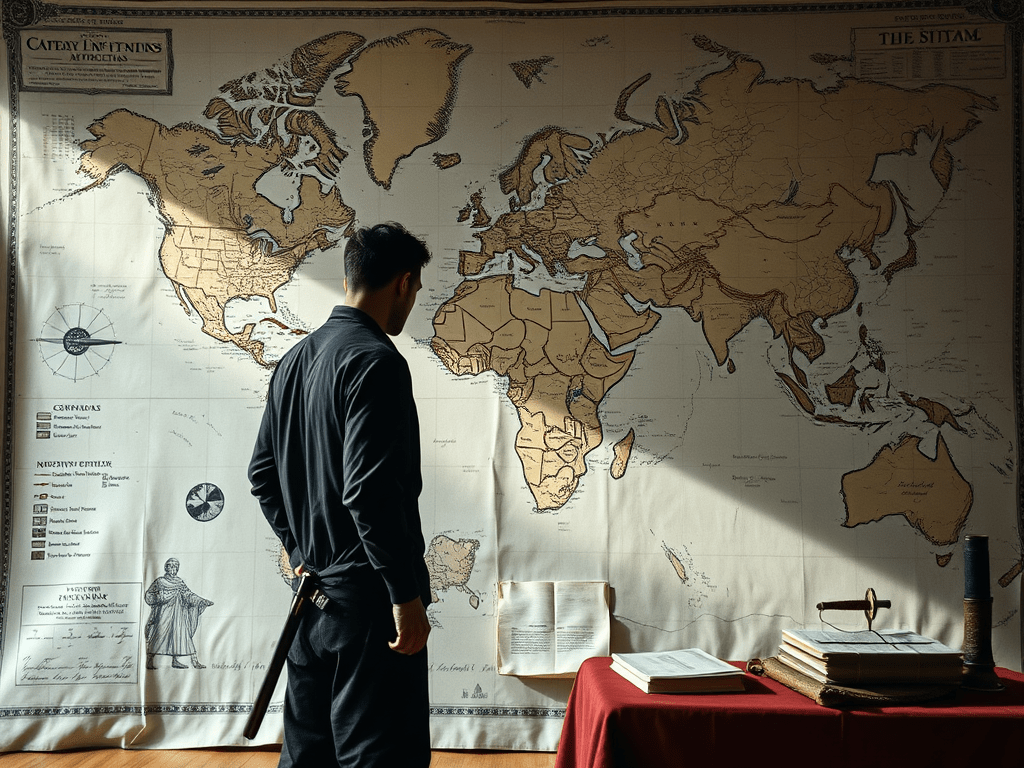
Pattern recognition feels like a super‑power—until you realize it’s permanent. Once you see systemic cruelty in a policy or exploitation woven into a supply chain, you cannot un‑see it. This is the Cartographer’s Curse: the cost of mapping hidden terrain is that you must live with the map.
Clarity can isolate. At a family dinner you catch the quiet racism in a casual joke and feel the table tilt. Colleagues share a feel‑good headline while you recall the buried study it contradicts. The world often prefers a pleasant lie to an inconvenient fact; those who insist on seeing clearly move through rooms like ghosts—present, yet out of phase.
Yet the same clarity that isolates can also connect. When shared, it becomes the first draft of a collective understanding.
But pattern recognition is also a bridge. When enough people see the same landscape, collective maps can guide change. Naming the pattern is the first step in breaking it.
Musashi’s counsel sets the first test: cultivate emotional discipline so the data does not devour you. The goal is not numbness but steadiness—the stance of a sword‑saint who watches every angle without freezing. Horror is allowed to register; it is not allowed to dictate the next blow.
First Contact: The Instinct to Flinch
Before philosophy arrives, biology speaks. Confronted with cruelty, the body fires: rage, sorrow, helplessness. Evolution taught us to flinch so we could choose: fight or flee.
These emotions are valid—but incomplete. History is littered with moral panics and performative outrage that burned hot and fizzled, leaving the problem intact. The aim is not suppression but transformation: enough pause to turn raw affect into useful force.
“Things have no hold on the soul. They stand there unmoving, outside it. Disturbance comes only from within—from our own perceptions.”
— Marcus Aurelius
If disturbance is born inside, strength can be forged there as well. Contemporary psychology agrees. A review of trauma‑exposed journalists found that deliberate processing—naming what was felt, when, and why—mitigated secondary trauma more effectively than avoidance.
So we breathe. We name. And we delay the swing of the blade until we know exactly what needs cutting.
Acknowledgment Without Acceptance
Witnessing is not complicity, though it can feel that way. We rush to act so we are not mistaken for the bystander who looked away. Yet premature action can harm as surely as apathy.
The discipline is to hold truth without needing to fix it immediately. Journaling is one sturdy container—decades of expressive‑writing studies show measurable gains in mental health when people spend even twenty minutes turning raw experience into words. Breath‑work, prayer, silent walks—anything that returns agency to the witness—serves the same purpose.
Daoism describes this internal posture as 無為 (wu wei), meaning “effortless action”—a state of moving in harmony with the world rather than forcing change. Think of replying, not reacting, to a tense email. In practice: do what must be done, no more, no less. The cartographer notes the cliff; bulldozers come later, if they come at all.
The Forge: Turning Pain into Tools
Pain unattended ferments into cynicism; pain refined becomes gear. After the pause we ask, What use can I make of what I now know? Musashi again: “Do nothing which is of no use.”
| Tool | Purpose | Practice |
|---|---|---|
| Compass (Empathy) | Keeps the map human‑scaled; reminds me why the work matters. | Revisit individual stories, not just aggregates. |
| Blade (Discernment) | Cuts through noise; separates signal from spectacle. | Habitual source‑checking; resist algorithmic echo. |
| Mirror (Accountability) | Exposes blind spots; prevents moral grand‑standing. | Ask, “Where am I complicit, and what have I benefited from that others paid for?” before assigning blame. |
| Map (Pattern Recognition) | Reveals terrain and traps; prevents rookie mistakes. | Diagram systems until causal chains are fully visible. |
Secondary‑trauma studies affirm this toolbox approach. Investigators who set boundaries, debrief with peers, and cultivate positive counter‑experiences report lower burnout and higher compassion satisfaction.
The blade is sharpest when kept clean—but only wisdom can guide the cut.
Integration: Carrying the Map Without Losing the Road
Integration is the daily journey—tools in hand, boots on the ground.
Maps matter only if we still walk the world. After hours immersed in data on forced labor, I close the laptop and notice the ordinary: my wife’s grin at a novel, my dog’s joy when the computer vacates my lap, the surreal skyline of a newly built VRChat world. Integration means letting reality remain larger than atrocity.
The task is to return—to work, to love, to play—not in denial, but in resilience. Social science calls it vicarious post‑traumatic growth: witnesses move from helplessness to meaning when awareness is translated into purposeful action. A donation, a call to a legislator, a meticulously researched article—small interventions that align with both compass and map.
Curiosity and conscience can lead us into the darkest corners of our shared history. These tools make the return possible. The mirror reminds us that change begins with us. The blade clarifies our targets. The map offers orientation. The compass tells us why we move at all. They do not erase pain, but they make it bearable—and bearable is enough to begin.
Will we see the end of the systems we oppose? Perhaps not. Musashi notes that victory is daily and private: today’s self versus yesterday’s. The Stoics add that outcomes are indifferent; virtue lies in the attempt. No single, cinematic moment will redeem the world, but every trend is sculpted by individual choices. Change yours, and the trend shifts—subtly, but undeniably.
Vigilance Without Venom
We live amid engineered outrage. Algorithms sell spectacle; pundits package panic. In that noise, the Compass and the Blade are survival gear. The compass keeps us oriented toward human dignity; the blade trims away distraction and deceit. Together they let us witness—fully, painfully, honestly—without surrendering to despair.
Clarity paired with compassion is not weakness. It is disciplined mercy. We refuse to look away, but we also refuse to let horror define every contour of the landscape. We hold the grief long enough to learn its lessons, then set it down and take one more step toward something better—something that will not repeat the tragedies.
Cartography is preparation, not the expedition itself. A map is an assay: a careful sampling that tells us what the mountain is made of, but it is not yet the smelter, the bridge, or the shelter we will build from its stone. Understanding is the preamble to doing; acknowledging what is does not in itself change what will be.
The next movements belong to you—incremental, imperfect, and tethered to reality:
- Test the compass in conversation: probe where empathy pulls, and where it falters.
- Whet the blade on a misleading headline: practice carving signal from spectacle.
- Hold the mirror when comfort tempts complicity: ask, Where am I benefiting?
- Consult the map before you spend, vote, hire, design, or create: trace the causal chain.
Each application darkens a contour line on the collective chart. There will be missteps; every explorer redraws coastlines. Treat error as data, not damnation. Adjust your heading, record your findings, share the updated map.
Will we see the summit in our lifetime? Perhaps not. But if enough of us walk with eyes open, the ground shifts beneath the systems that depend on blindness.
So carry your instruments lightly, but use them daily. This post has handed you a compass and a blade; the journey from assay to action now rests in your hands. In the next entry, we’ll begin testing these tools in the field—where judgment meets resistance, and clarity must prove its weight in motion.









Leave a comment