
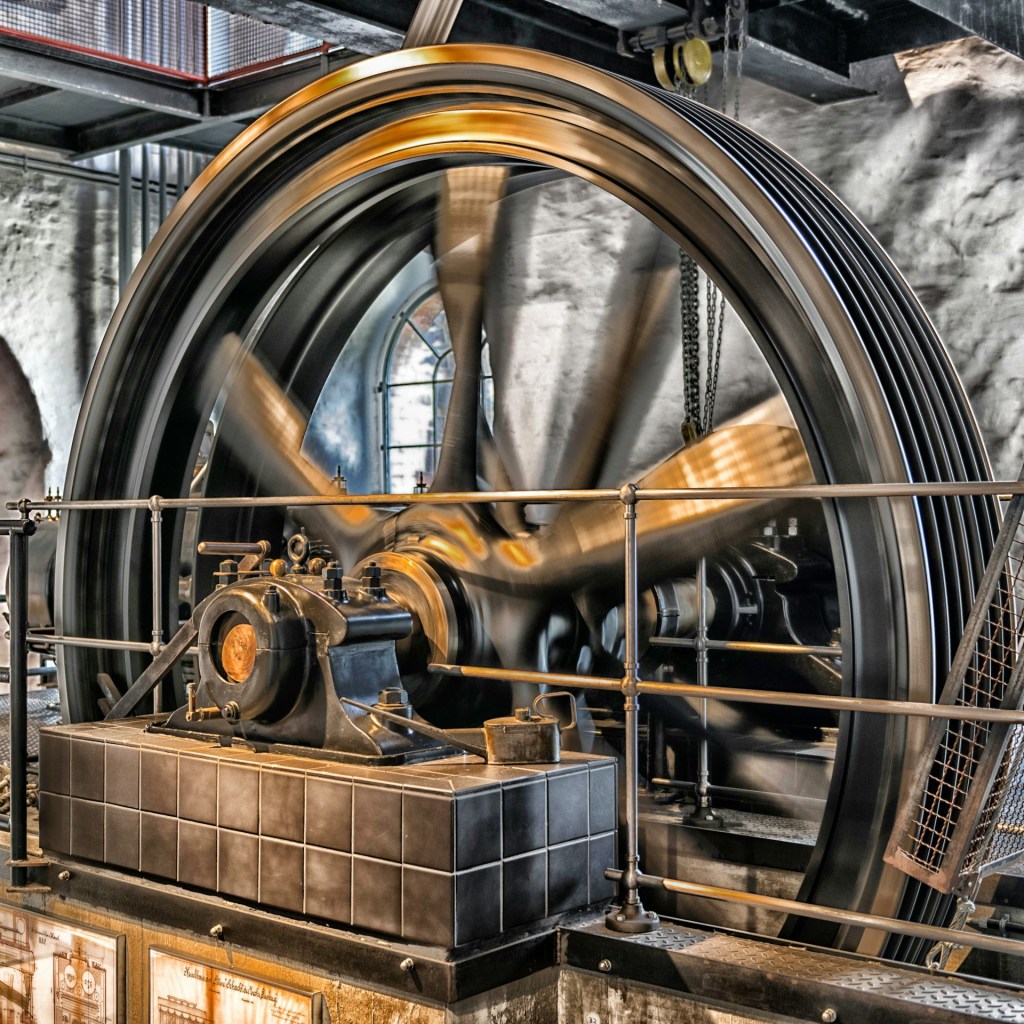
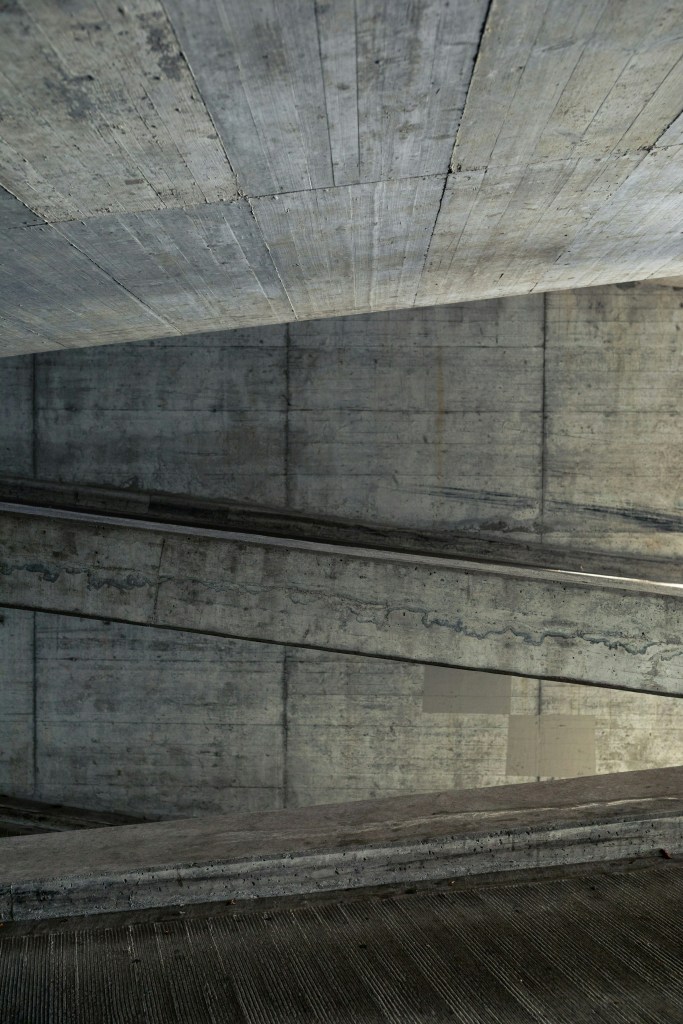
Photo by Wolfgang Weiser on Unsplash
It begins with a click.
Not loud or dramatic. Decisive.
A relay closes somewhere beneath the surface, and a low rotational thrum answers. One shaft turns, then another. A flywheel takes hold of its own inertia. Beneath a black pool of coolant, the machine finds its first stable rhythm. The liquid above it dimples, then smooths. Heat enters the system before motion is fully visible.
“Initial issue identified. Investigation in progress.”
Click.
A second coupling locks. The first retries run hot and fail. Torque moves laterally through the frame. Gear teeth meet under load. A narrow vibration travels outward and disappears into the casing. The RPMs rise by increments too small to frighten anyone watching from above. The surface remains nearly calm, bent only slightly at the edges where the rotational force begins to pull against the wall.
“Recovery actions have begun. Further updates to follow.”
Click.
Another shaft engages. Now the machine is committed.
Nonessential assemblies disengage with soft metallic certainty, one after another, freeing power for the central drive. Auxiliary motion ceases. Valves narrow. Flow is redirected. The coolant circulates harder now, sheeting over the spinning core in thin dark layers, carrying off the heat as quickly as it forms. Deep below the surface, pressure is no longer an event. It is architecture.
“Non-critical activity has been paused while critical restoration steps are prioritized.”
The flywheels are faster now. Fast enough that individual motion can no longer be perceived, only the effect of it: a pressure in the frame, a hum in the walls, a faint outward bow on the surface of the pool. Nothing breaks. Nothing spills. That is what the system is designed to prevent. The violence is not absent. It is governed.
A bearing warms. A belt tightens. Rotational force passes through the chassis in a steady, disciplined current. Every part of the mechanism exists now in relation to strain. Tolerance becomes purpose. Friction becomes temperature. Temperature becomes something that must be carried, not expressed.
“Leadership has been notified. Current estimate for the next update remains unchanged.”
The machine continues under physical argument.
What was first heard as a sound is now felt as environment. The thrum loses its edges. It ceases to announce itself as a separate thing and becomes the condition under which all other motion must occur. Additional gears engage downstream. Some hesitate. Some catch immediately. A few resist, shudder, and submit. Control rods descend in measured sequence, not to stop the machine, but to keep it from outrunning the shape of its own design.
The coolant trembles.
Not enough to disturb the illusion above. Only enough to suggest that stillness is being purchased.
“Manual intervention is in progress.”
The rotational mass is enormous.
Momentum compounds invisibly. A system already in motion requires less command than correction. The work is no longer to start the engine, but to steer it within acceptable limits while it runs near capacity. Heat blooms in hidden chambers. Pressure moves through sealed lines. The machine does not ask whether the load is fair. It only recalculates distribution.
Above the pool, there is only a dark reflective plane and the occasional widening ring where force touches form. Below, everything is negotiated in torque and momentum.
“Critical environments are being restored first. Dependent systems will follow.”
This is the misunderstanding.
Observers mistake the unbroken surface for serenity. They conflate containment with comfort, regulation with ease, and precision with peace. They see the surface hold its shape and assume the mechanism beneath it must be stable in the human sense of the word. But stability is not gentleness. Many systems are stable only because they are engineered to absorb enormous violence without visible distortion.
So it is here.
The frame holds. The couplings strain but do not shear. The circulation continues. Motion remains ordered. Nothing in the visible world suggests panic because panic would be inefficiency, and inefficiency would be heat.
“At this time, recovery remains on track.”
Then, at last, resistance drops.
One downstream gear catches cleanly. Another follows. The drag that had loaded the entire mechanism begins to release in increments. A tremor passes through the housing, lighter this time, almost uncertain. The RPMs hold for a moment longer, as if the machine itself does not yet trust the change. Then the spin-down sequence begins.
Not silence. Never that quickly.
First, the smaller shafts disengage. Their departure is felt as absence more than motion. Then the auxiliary belts lose tension. The flywheels continue on stored momentum, still powerful, still dangerous, but no longer accelerating. The coolant, robbed of the need to carry such disciplined force, begins to move differently. It no longer streams in obedient sheets. It sloshes. It lashes. It strikes the retaining wall in delayed waves, momentum becoming instability the moment control is no longer required.
“All critical services have been restored.”
The great wheels turn slower.
The hum separates again into individual sounds. Bearings whisper. Metal ticks as heat withdraws into the room. The surface, calm for so long by necessity, finally breaks into visible agitation. Ripples collide. Dark fluid climbs the edges and falls back on itself. What had seemed tranquil was never at rest. It was only held in useful motion.
“Issue resolved. Monitoring will continue.”
Only now, with the machine no longer requiring everything from itself at once, does the cost become legible in the aftermath.
Calm is not peace.
Calm is what the surface looks like when the mechanism underneath has accepted that it must run hot, fast, and without visible complaint until the threat passes.
Peace is something else entirely.
Naming the Mechanism
What the surface conceals is not emptiness, but compression.
In moments that carry consequence, calm is rarely the absence of feeling. More often, it is feeling under discipline. Fear is narrowed into vigilance. Frustration is routed into sequence. Urgency is stripped of its theatrical waste and made to serve cadence. From outside, this can look like steadiness. From within, it feels more like load-bearing. The stillness people admire is often the visible result of immense internal ordering.
That is the mechanism worth naming.
There comes a point in any serious situation when ambiguity can no longer be allowed to remain ambient. It has to be taken in hand. Sorted. Weighted. Converted into sequence before the surrounding system begins making decisions on its own. Information arrives incomplete, contradictory, and time-sensitive. Some of it matters immediately. Some of it only imitates importance. Some of it becomes dangerous precisely because no one recognized its timing soon enough. The work is not to know everything. The work is to distinguish quickly enough to matter.
From the inside, this has very little to do with quiet. The mind accelerates. It starts tracing dependencies, estimating radius, identifying what can drift and what must be stabilized before it carries force into the next failure point. Language often lags behind the process. Outwardly, though, the visible requirement remains composure. The mechanism cannot afford the luxury of display. It has to keep turning while it thinks.
That is why hesitation is heavier than it looks.
An unchecked process does not pause out of courtesy. The message not sent remains absent in the exact minute it was needed. The unstable component continues transferring strain while someone debates whether intervention would be excessive. Delay is not neutral simply because it is passive. It alters outcomes just as surely as action does. It only does so without the dignity of having chosen.
And that is the pivot. What begins as regulation becomes command.
Not command in the ornamental sense of rank, title, or distance, but in the harder sense of accepted ownership. Someone becomes the bearing surface. Someone takes in uncertainty, converts it into order, and accepts that the decision may later be judged by people who never had to carry that exact friction in real time. Their judgment may even be fair. By then, however, the metal has cooled. The rotation is over. Hindsight always speaks from outside the heat.
So the calm people praise is often misunderstood at the level of first appearance. A measured voice may be part of the containment system. Cadence may be structural. Clarity may be the audible sign that the machinery is already under load and holding. Beneath the surface, the flywheels are turning.
And once a person has learned to do this well, the danger changes. Others begin to confuse their regulation with limitless capacity. Competence invites additional load. Composure attracts dependence. The one who can convert chaos into sequence becomes the place where ambiguity gets sent, again and again, until calm stops being a response and hardens into a role.
That is when the mechanism is no longer just something a person uses. It becomes something they live inside.
Normalizing the Pattern
It is tempting to confine this mechanism to certain rooms.
Command centers. Emergency departments. Operations floors. Field tents. Places where consequence arrives fast, the margin for error is narrow, and everyone present already understands the price of delay. In such rooms, the pattern has names. It comes with roles, handoffs, escalation paths, and training. The machinery is expected there. When it engages, no one mistakes it for temperament.
But those rooms did not create the pattern. They only formalized it.
Most people encounter the same internal sequence long before they have language for it. They meet it in hospital corridors, in thinning budgets, in marriages under strain, in homes where one failure immediately begins loading three others. They meet it while raising children, caring for parents, managing illness, absorbing layoffs, carrying grief, or trying to keep one part of life from collapsing into the next. The setting changes. The structure does not.
That distinction matters, and it should be kept honest. A trauma team, a military command structure, and a parent deciding which bill can wait are not interchangeable scenes. Their authorities differ. Their velocities differ. Their consequences differ. Serious thought should not flatten them into the same moral or professional category.
And yet the underlying shape remains recognizable.
Whenever consequence begins to outpace comfort, the same sequence starts to form. Margin thins. Options narrow. Dependencies become visible. Triage enters, whether anyone wants to dignify it with the name or not. Something must be protected first. Something else must wait. Someone begins absorbing ambiguity and converting it into order before drift becomes damage. Sometimes that person is the most qualified one present. Sometimes it is simply the one who understands that indecision is also a decision, and usually a costly one.
This is one of the quieter disciplines of adult life.
Very little can be preserved all at once. In certain seasons, the work becomes almost entirely sequential: stabilize this, defer that, absorb this loss, prevent the next one, keep the whole arrangement from taking on more force than it can bear. There is nothing theatrical about it. Often there is nothing visible about it either. No title is conferred. No authority is announced. Still, command is taking place.
That is part of why the pattern is so often misread. Outside formal crisis settings, people rarely call it triage, regulation, or command. They call it responsibility. Caregiving. Leadership. Endurance. Making do. Holding it together. Continuing anyway. The names get softer as the burden gets more intimate.
And that softening conceals something dangerous.
What is common is often mistaken for natural. What is familiar is often treated as harmless. Because so many adults learn to live this way, we begin speaking as though it were simply maturity itself: carry more, absorb more, complain less, keep the surface level, and call that strength. But normalization is not the same thing as health. A pattern can be widespread and still be expensive. It can be ordinary and still be corrosive. Many people do not become calm because life is stable. They become calm because instability has lasted long enough to become procedure.
That is the escalation.
The mechanism is not rare, but it is cultural. It appears anywhere people are asked to preserve function without adequate margin. It becomes especially visible in those who are most reliable, because reliability attracts load; the competent become buffers and the composed become containers. The ones who can convert chaos into sequence become the unofficial shock absorbers for families, workplaces, relationships, and institutions that have quietly reorganized themselves around their capacity to endure.
By the time this is recognized, the pattern often feels less like an event than a life.
So yes, the flywheels do not always announce themselves. The coolant does not always look like coolant. Most surfaces that hold their shape under pressure will never be described in mechanical terms at all. But sooner or later, most people learn the same difficult truth: a still surface and a peaceful life are not the same condition, and a person who has become very good at carrying strain may already be living too close to the machinery.
The Baseline
One of the more common mistakes in watching someone hold shape under pressure is to mistake smoothness for spontaneity. Usually, it is the opposite.
What appears graceful in the moment is often stored structure being spent. The machine runs cleanly because something inside it was aligned long before the load arrived. Bearings were set. Tolerances were respected. Clearances were left where force might travel. Without that earlier alignment, motion does not remain motion for long. It becomes wear, heat, drift, and damage.
Crisis does not produce stability; it reveals what was already there.
In the moment itself, there is rarely time to invent anything new. When systems begin to fail, the mind does not build its principles from scratch. It reaches for what has already been settled deeply enough to survive compression. Action draws from earlier decisions about value, threshold, sacrifice, acceptable risk, and the point at which compliance becomes damage. The person who looks calm under pressure is rarely feeling less. More often, they are drawing against architecture built long before the pressure arrived.
That is why pressure is a poor setting for first principles.
When something begins to break, there is usually no time to construct an ethic equal to the event. Examined priorities can be enacted. Unexamined ones tend to dissolve into improvisation or denial. In that sense, composure is not an emotional state so much as a structural one. It is the visible edge of decisions that were made early enough to matter.
The same is true of dependencies.
In any working system, failure rarely remains local. A seized bearing becomes heat elsewhere. A slipping belt redistributes strain through the rest of the assembly. Human life is less precise than machinery, but the principle remains. Money touches time. Health touches work. Fatigue touches judgment. Fear touches speech. Strain moves. It transfers. It accumulates in places that did not initially appear connected to the original fault.
Those who understand this do not always prevent failure. They are simply better at preventing spread.
They know where drag will travel. They know which compromise will remain contained and which one will begin loading the next weak point. Coherence, in that sense, is rarely improvised. It reflects prior study of the system and a long familiarity with how force behaves once it enters it.
Values follow the same rule.
Crisis does not create them so much as reveal their order of precedence. Pressure strips away decorative preference. When margin disappears, what remains visible is whatever was foundational enough to govern action. Sometimes that revelation is admirable. Sometimes it is humiliating. Nearly always, it is clarifying.
Which is why preparedness is not the posture of a pessimist; it is the posture of someone who respects consequence.
Systems fail. Bodies fail. Plans fail. People fail. Refusing to imagine that reality offers no protection from its arrival. Anyone unwilling to consider breakdown will eventually be instructed by it at full scale. But those who have already considered thresholds, dependencies, and limits waste less motion when the mechanism engages.
They are not calmer because the moment is easier. They are calmer because the architecture was already there.
That difference matters more than it first appears. Because when pressure arrives, it does not create the person who will meet it. It only reveals them.
Mechanical Balance
Peace requires a stricter definition than stillness usually receives.
A surface can go quiet for many reasons. Some of them are healthy, others are merely inert. In any living system, motion is inevitable. Time keeps applying pressure. Wear continues. Interruptions arrive. Small imbalances accumulate unless something notices and corrects them. Visible calm, by itself, proves very little. A still surface may reflect good regulation. It may also reflect neglect, exhaustion, resignation, or drift that has not yet become expensive enough to force acknowledgment.
That confusion is easy because stagnation is quieter than strain.
It asks for less immediate courage. For a while, it can even resemble relief. But inertia does not hold a system together. Left unattended, it alters tolerances by increments small enough to excuse: one delayed repair, one deferred conversation, one compromised standard, one month of imbalance in the schedule, the budget, the body, the relationship. Nothing dramatic at first. Just a slow redistribution of force toward whatever point is least able to carry more.
That is how deterioration usually enters: as drift rather than spectacle.
Maintenance goes undone. Small corrections are postponed. Load concentrates where it should have been distributed, and by the time the damage is visible, much of the decisive work was lost in moments that seemed too minor to matter. Stable systems are more active than they appear, as their order must be renewed. Their balance must be kept against the quiet pressure of entropy.
A healthy mechanism does not avoid resistance.
It carries resistance without sending all of it into the same fracture line. It spreads load. It absorbs interruption. It preserves rhythm where rhythm can be preserved and uses boundaries to keep one disturbance from becoming general failure. That is the real distinction. The goal is not a life without friction. It is a life in which friction does not ignite every chamber at once.
That is where peace first separates itself from mere composure.
Composure can exist inside overload, but peace cannot. Composure can be the disciplined management of strain. Peace requires that strain not be constantly one interruption away from becoming threat. It depends on maintenance, distribution, and margin. It rests on structures that prevent every ordinary demand from arriving as crisis.
That is why the flywheel remains useful as an image.
Its apparent calm is inseparable from governed motion. Mishandle that stored force and it becomes damage. Support it well and it becomes continuity; it smooths transition, keeps demand from translating instantly into shock, and gives the rest of the system time to remain coherent while conditions change. The flywheel does not abolish force. It simply civilizes it.
Human beings need something similar.
Not immobility, or numbness. Not a rigidity so brittle that every interruption feels like violation. What helps is order: habits that can carry weight, boundaries that keep strain from concentrating too quickly, arrangements of time, obligation, energy, and care that make motion livable even when it is no longer easy. A workable life is not one in which nothing presses against us. It is one in which pressure does not immediately become emergency.
Peace belongs there.
Not in the fantasy of frictionlessness, but in a life whose forces are sufficiently understood, distributed, and maintained that motion no longer feels perpetually adjacent to damage. Such peace is quieter than crisis, but it is not inert. It is tuned. It is renewed. It is kept.
From a distance, that may resemble stillness. Up close, it is something harder won: a system ordered well enough to keep turning without having to survive itself.
Closing Return
That distinction is worth keeping.
Calm belongs first to the surface. It is what regulation looks like from outside: narrowed focus, controlled cadence, force held in usable form. It can be admirable, and it can be necessary. But by itself, it proves very little. Composure says something about management; it says far less about peace.
Peace runs deeper than that.
A level voice, a well-ordered room, a measured update, a life that appears to be functioning cleanly from a distance: none of these settles the question. They may indicate genuine stability. They may also be the visible edge of strain, exhaustion, suppression, or long-practiced containment. Surface and system can resemble one another for a while. They are not therefore the same.
That separation matters because usefulness can imitate health.
A person may remain calm because others still need something from them. A household may hold its shape because someone inside it is absorbing the shock quietly enough that the walls do not show it. An institution may appear orderly because its failures are being carried by people who have learned to convert overload into cadence. Some of the calmest things in the world are not at peace. They are only surviving by governed motion.
To see that clearly is not cynicism. It is accuracy.
It means becoming slower to envy appearances and slower to assume that what is well-contained is therefore well. It means asking, in others and in ourselves, what kind of mechanism is producing the visible calm, what it is costing, and whether that cost can be carried indefinitely without distortion elsewhere.
Because the greater danger is not merely misreading other people, but mistaking our own containment for health.
A person can become proud of endurance and still be organized entirely around emergency. A life can look disciplined while quietly orienting all of its structure toward surviving the next demand. Surfaces can be perfected for years while deeper maintenance goes undone. What is efficient in crisis can become deforming as a way of life.
So the image remains useful: the dark pool, the governed spin, the hidden flywheels, the surface that appears nearly still while immense forces move beneath it. It reminds us that visible calm may be the product of order, but also of compression, and that the two are not interchangeable.
Peace belongs to a different depth.
It appears where motion is no longer perpetually adjacent to threat. Where maintenance has not been indefinitely deferred. Where load is distributed well enough that function does not depend on one overheated bearing, one overtrained nervous system, or one exhausted will. From a distance, that may resemble calm.
Up close, it is something rarer: a life ordered well enough to keep turning without having to survive itself.





Leave a comment