
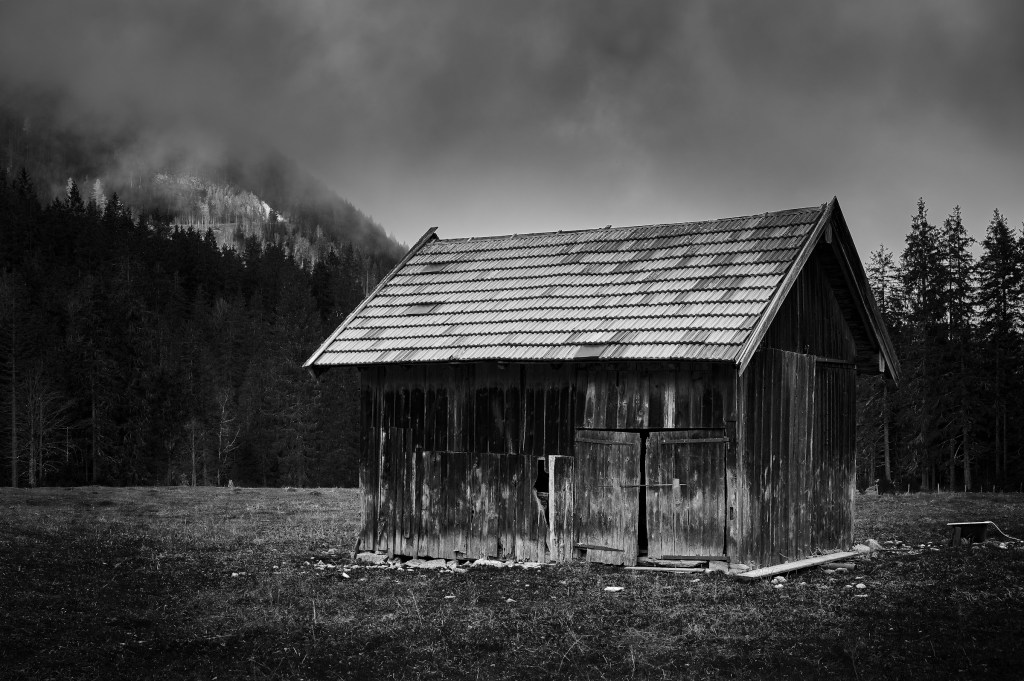
The village was offensive in its normalcy.
That was the first thing Geralt noticed. Smoke rose in lazy, silver ribbons against a slate sky. A dog napped in the damp earth near the well, one ear twitching at a fly. A woman hung linen behind a sagging fence, her movements rhythmic and practiced, humming a tune that had no beginning and no intent to end. The fields were lush. A deep, vibrant green that felt like a lie told to a dying man.
The alderman was waiting by the shrine. Three saints, carved from oak and smoothed by a century of desperate hands, stared out at nothing with sightless eyes.
“You actually came,” the alderman said. There was no relief in his voice. Only the dry, bitter taste of a man whose bluff had been called.
Geralt didn’t dismount. The leather of the saddle creaked, a loud, intrusive sound in the curated quiet of the square.
“Monster?” the witcher asked.
The alderman’s hand went to his beard, tugging at the grey strands. He didn’t look up. “Something takes the livestock. Goats, mostly. A few sheep. It’s… consistent.”
“Tracks?”
“None that stay.”
“Bodies?”
“We clear them quickly,” the man said, his voice tightening. “For the children. It’s not… they aren’t torn. Not like a wolf would do. They’re just wrong.”
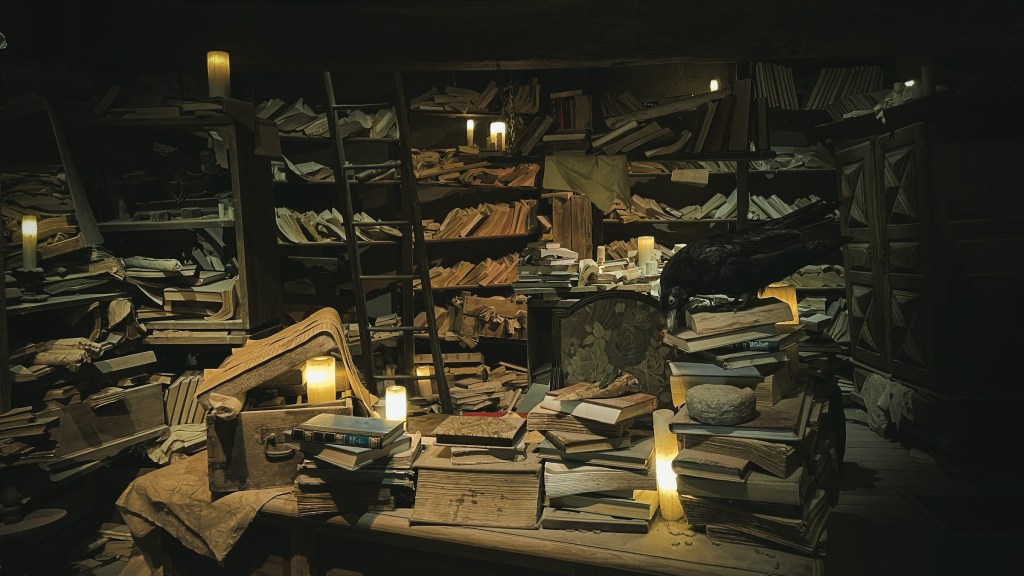
Geralt’s gaze drifted to the barn at the edge of the palisade. The wood was grey with age, but the heavy iron bolt on the door was new. It shone with a dull, oily light.
“Who else has seen it?” Geralt asked.
“No one,” the alderman snapped, a bit too fast. “We’re a quiet folk. We mind our business. We look at our own boots.”
Geralt nudged Roach forward. The villagers didn’t flee, but they didn’t watch. It was a choreographed avoidance. Doors closed with a soft, final thud. A man mending a wagon wheel turned his back, his shoulders rigid, as if by denying the witcher’s presence, he could deny the reality of the silver sword on his back. They weren’t afraid of the monster; they were afraid of the witness.
At the barn, the smell hit him before he reached the door.
It wasn’t the metallic tang of fresh blood or the sweet, heavy rot of a necrophage’s larder. It was the smell of old, sedimented terror. It was the scent of a creature that had stopped fighting because it realized the world had stopped listening.
Geralt dismounted and walked to the door. He didn’t draw his sword. He didn’t need to. His medallion hung against his chest, as cold and still as the saints on the post.
“No curse,” Geralt said, his voice flat. “No magic.”
The alderman stood a few paces back, his shadow long and thin in the dirt. “Then… what is it?”
“It’s not a monster,” Geralt replied. He didn’t open the door. He didn’t have to see the shape of the cruelty inside to know its pedigree.
The silence that followed was brittle.
“That’s not the answer we paid for,” the alderman said, his voice dropping to a low, dangerous hiss.
Geralt turned. The yellow of his eyes seemed to catch what little light remained in the sky. “You didn’t pay for an answer. You paid for a curtain. You wanted me to give this a name that wasn’t yours.”
The alderman’s jaw set. “We don’t need to know the details. We just need it to stop.”
Geralt looked past him, at the neat rows of houses and the quiet, orderly deception of the village. He saw the way the entire community had arranged itself, like a puzzle, around the hole where their conscience used to be.
“I can kill what hunts,” Geralt said. “I can’t kill what’s allowed.”
He walked back to Roach and grabbed the reins.
“The coin?” the alderman asked, a flicker of greed fighting through the shame. “You’re leaving it?”
Geralt paused, his foot in the stirrup. He looked at the man, really looked at him, until the alderman had to turn away.
“Keep it,” Geralt said. “Use it to buy more silence. You’re going to need a lot of it.”
He rode out. He didn’t look back at the barn, or the door that creaked open just a hair’s breadth to watch him go. The village remained exactly as it was: peaceful, productive, and utterly hollow.
The World We Can Stomach
We like to tell ourselves we live in an age of unprecedented awareness. Every injustice has a headline. Every conflict has a livestream. Every tragedy is documented, circulated, and filed away before the dust has finished falling.
That part is true.
What we avoid admitting is that available is not the same as absorbed. We are not starved for information; we are starved for the kind of attention that costs something. The kind that changes what we buy, who we reward, what we tolerate, what we’re willing to give up.
The modern world makes that kind of attention optional.
Our media ecosystem is an attention market, not a civic institution. It doesn’t ask what is most important; it asks what will be clicked, shared, argued over, and returned to. The result is not a grand conspiracy or a moral decline from some invented golden age. It’s simpler and colder than that: incentives select for brightness, novelty, and outrage; for stories that spike the pulse and vanish cleanly.
And whatever doesn’t spike (whatever is slow, structural, or unresolved) drifts out of view.
Suffering doesn’t disappear when it’s inconvenient. It gets moved. It’s pushed out past the edge of the feed, past the radius of polite conversation, past the places where it would complicate anyone’s self-image. The poor become a statistic. The displaced become a “situation.” The chronically ill become an inconvenience. Exploited labor becomes a supply chain. Policy casualties become the cost of doing business… And harm turns into background noise: present enough to be acknowledged, distant enough to be ignored.
You feel it in the small miracles we no longer call miracles: overnight shipping, cheap meat, a shirt that costs less than lunch; conveniences so frictionless they arrive without the story they required.
Most people aren’t cruel. We’re trained. The system reliably offers something easier than sustained moral attention: a quick flare of reaction, a clean opinion, a share button that feels like participation. We confuse being informed with being oriented toward truth, as if exposure were the same as responsibility; as if seeing a headline were the same as carrying what it implies.
Belonging sharpens the avoidance. Identity now travels through performance: the right vocabulary, the right symbols, the right enemies. Consensus becomes shelter and complexity becomes risk. Nuance is dangerous because it threatens the story that keeps the tribe coherent, and the tribe, unlike truth, can eject you.
So we learn a set of safe reflexes. We prefer problems with villains we don’t resemble. We prefer injustice that can be condemned without rearranging anything in our own lives. We prefer moral clarity that costs nothing.
This is the trade. Not exactly truth for lies, but truth for comfort. We select the version of reality we can endure without changing our habits, our loyalties, or our conveniences. We choose the world we can stomach.
Like the village that called the witcher, we are not ignorant of what happens at the edges of our lives. We know enough to lower our eyes, close our doors, and turn our backs. In a system built to reward brightness over depth, that lowering starts to feel natural, until it becomes indistinguishable from choice.
The Comfort of False Binaries
If the attention economy teaches us what to look at, ideology teaches us how to look once we get there.
Most people will tell you they don’t believe the world is divided into heroes and villains. Then they open their mouths about politics, institutions, movements, or nations and immediately sort everyone into exactly that: the good side and the bad side, the awake and the corrupt, or the enlightened and the irredeemable. It’s not that reality is mysterious so much as that complexity is expensive. It demands judgment without the comfort of a script.
False binaries offer a cheaper kind of clarity. They arrive wearing virtues as costumes: security vs humanity, order vs justice, freedom vs safety, as if choosing one automatically excuses whatever is done in its name.
They tell us where to stand, who to trust, and (most importantly) where responsibility does not belong. Once a side has been declared “ours,” moral labor gets outsourced to the collective: the party, the cause, the faith, or the institution. Harm committed in service of the group becomes necessary, exaggerated by enemies, or simply not seen. Harm suffered by those outside the group becomes deserved, inevitable, or self-inflicted.
We rarely call this laziness; often we even call it loyalty.
To admit wrongdoing on your own side is to risk exile from the tribe. It invites interrogation: What are you, really? Who are you helping? So most people learn a cleaner habit. We audit the other side with a microscope and excuse our own with fog. Their failures are proof of rot; ours are exceptions, misunderstandings, or the work of a few bad actors. We demand specificity from opponents and accept abstraction from allies.
This is where chosen blindness thrives: not in ignorance as such, but in selective attention. We do not refuse to see evil; we simply insist it must always sleep elsewhere.
The Witcher understands this instinct. Villages call him for monsters because monsters make accountability simple. A monster can be named, hunted, and killed. The tragic story ends cleanly and no neighbor has to be blamed. But when the harm is produced by ordinary people, whether by custom, by convenience, or by an arrangement everyone benefits from… there is no clean kill. There is only the unbearable possibility that the problem is not an intruder.
So we protect ourselves with sharp lines and loud certainty. We confuse certainty with virtue because certainty feels like safety. It keeps belonging intact. It keeps the world readable. It keeps the barn door closed.
The refusal to see harm on “our” side isn’t moral clarity; it’s a defense mechanism dressed in ethical language. And it works, often until the damage becomes too obvious to relocate, and we’re forced to consider the thought we’ve avoided from the start: maybe the monster speaks in words we recognize.
Where Blindness Becomes Policy
At the institutional level, blindness stops being a personal habit and becomes a design choice.
Most organizations don’t wake up and decide to be cruel. They decide to be efficient, predictable, and scalable. They reward consistency and the absence of friction, because friction is expensive and delay looks bad on a dashboard. The problem is that seeing clearly creates friction by default. It raises questions that slow momentum. It introduces costs that don’t fit the quarter. It demands someone attach their name to consequences that have previously been kept comfortably anonymous.
So systems learn to prefer not-seeing.
Metrics become the house language of morality. What can be measured is treated as real; what cannot is treated as noise. Human cost turns into variance. Harm becomes an externality. Suffering is recategorized as a “risk,” a “regrettable outcome,” a “known issue,” or something to be mitigated later… if later ever arrives. No one has to intend harm for harm to persist. It is enough that the numbers stay within tolerance.
Responsibility dilutes just as neatly. Job descriptions and org charts provide ethical armor: not my scope, not my lane, not my decision. A complaint becomes a ticket, the ticket becomes a queue, the queue becomes a KPI… and somewhere between “assigned” and “resolved,” the human who filed it disappears.
The problem exists, sure, but it belongs to another team, another department, another contractor, another layer of review. Each handoff makes the harm smaller, cleaner, and more abstract. By the time it reaches anyone with authority, it arrives as a sanitized summary with everything consequential reduced to bullet points.
Process finishes the job. Once a decision has been framed as policy or standard procedure, accountability becomes a ghost. Harm is no longer something people do; it is something that “happens” as a result of “the system.” To question it isn’t treated as moral attention, but as disruption: an emotional objection to a rational machine. The person who insists on looking becomes the problem.
This is how workplaces and institutions learn to live beside damage without naming it. Everyone can point to their step in the chain and say, truthfully, that they followed the rules. No one ever has to hold the whole chain in their hands at once.
Cruelty is optional. Participation is not.
Over time, this becomes cultural common sense: the way things are done, the cost of doing business, the price of stability. Most of us have played a role in it, benefited from it, and relied on it to keep life moving. And like the village with its barn just out of sight, institutions can remain orderly and respectable as long as no one insists on opening the door and standing in the smell.
Blindness, once normalized, stops feeling like avoidance. It feels like professionalism.
Habits of Avoidance
Eventually, the system doesn’t need to enforce blindness. We practice it without being asked.
Most people don’t wake up intending to be indifferent. What we develop instead are coping habits: small, reasonable adjustments that make life bearable inside an environment that is loud, relentless, and emotionally expensive. We curate what reaches us the way we curate noise. Not because we don’t care, but because caring without limit is unsustainable.
This is why doomscrolling and disengagement aren’t opposites. They’re sibling strategies. One overwhelms the nervous system until everything feels equally urgent and therefore equally meaningless. The other shuts the door and calls it peace. Both create the same outcome: distance between what we encounter and what we allow to matter.
“I don’t have the energy for that right now” is often true. Attention is finite, as is emotional bandwidth. The danger isn’t the sentence; it’s the way it becomes a setting. Avoidance, repeated often enough, stops feeling like avoidance and starts to feel like balance.
Personalization does the rest. The platforms notice what we linger on, what we skip, what we share, and what we start but don’t finish. They learn our tolerances and then build a world that fits them: a feed shaped less by reality than by what we can endure without discomfort. It’s more collaboration than censorship from above, and the outcome is a comfortable enclosure, assembled click by click.
Inside that enclosure, neutrality becomes plausible. If something never enters your view, or enters only as a fragment stripped of context and consequence, it feels reasonable to say it isn’t your problem. Silence can pose as humility and inattention can masquerade as restraint.
But the interface sells a quiet lie: that choosing not to look is the same as choosing not to participate.
Inattention is still a choice. It trains the borders of our concern. What we scroll past repeatedly becomes part of the scenery of our lives: absorbed without reflection, normalized without consent. Over time the cost shows up indirectly, as a narrowing sense of responsibility, a shrinking horizon of empathy, and a growing comfort with abstractions that keep real harm safely out of focus.
We like to imagine we live in the world. Most of the time, we live in the doorway; close enough to smell the truth, far enough to keep walking.
What the Interface Hides
When the interface is working, nothing feels urgent.
The systems beneath our daily comfort persist because they are concealed in the most effective way: by remaining distant, they don’t have to be invisible. They can remain fragmented, buffered from consequence by logistics, professional language, and the kind of plausible deniability that doesn’t require anyone to lie; only to focus on their own small piece.
Pull back one plank and the picture sharpens.
A product arrives clean and complete. The phone in your hand, the cheap shirt on your back, the next-day package on your porch; objects that show up as if they were made by nobody. How they got there is anything but.
Distance is not an accident of modern life; it is one of its greatest tools. Supply chains stretch across borders and jurisdictions because distance dissolves responsibility. Labor conditions become “vendor issues.” Pollution becomes “trade-offs.” Displaced communities become “stakeholders.” The human cost is recorded somewhere, in a report no customer will read and no executive will open on a day they want to sleep.
The price we pay at checkout is “accurate” only because it excludes what would make it intolerable.
Comfort depends on deferral. Waste is pushed downstream; geographically, politically, and morally. Risk is distributed across people who will never be in the room where decisions are made. Consequences are scheduled for later quarters, later administrations, or even later generations. Nothing here requires secrecy anymore. It requires only that the full picture never be assembled at once.
This isn’t a sermon about modern life in the abstract. It’s a description of structure: systems endure because their harms are spread thinly enough that no single moment forces reckoning. Each participant touches a fragment, and each fragment feels small. The whole remains conveniently out of frame.
In the Witcher’s village, the barn wasn’t hidden. Everyone knew where it was. They could smell it if they stood close enough. What they avoided wasn’t knowledge; it was the moment knowledge becomes obligation.
The monster was manageable. The truth was not.
Our world is built the same way, just scaled differently. The barn is everywhere and nowhere: across borders, behind interfaces, inside contracts, inside “standard procedure.” Sometimes the floorboard lifts in the form of an investigative report, a leaked photo, or a firsthand account that breaks through the feed long enough to make the air taste wrong. We don’t scroll past because we don’t believe it, but because it’s believable in a way that would require rearranging our lives.
So the structure holds, and the interface stays intact. And the cost keeps working quietly beneath it, as long as no one insists on seeing the whole picture.
Why We Choose Blindness
If blindness were only ignorance or malice, it would be easy to correct. Teach people, show them, and name the harm. Done.
But chosen blindness persists even when the facts are available, even when the footage is clear, even when the cost is admitted in plain language. That persistence tells us it isn’t a simple failure of information. It’s a strategy, often an unconscious one, for staying functional.
At the level of the mind, avoidance is not a glitch so much as a guardrail. Human attention was not built for endless crisis, endless suffering, or endless moral demand. When problems feel vast, distant, or insoluble, the psyche looks for a way to reduce load. The relief can look like numbness, distraction, or “I can’t deal with this right now.” Repeat that often enough and it becomes a stance instead of a moment.
Learned helplessness isn’t a dramatic surrender; it’s the quiet belief that seeing more will only increase pain, not agency.
Our reward systems don’t help. We are drawn to what is sharp and immediate: novelty, conflict, and emotional spikes. They feel like engagement because they feel like motion. Slower work like that required for accountability, repair, or reform rarely offers the same instant payoff. So attention gravitates toward what can be reacted to quickly, and away from what would require sustained effort. Over time, even sincere concern can curdle into fatigue: caring without leverage is exhausting, and exhaustion always looks for exits.
Social life adds pressure. Norms are taught less by rules than by repetition. What a group treats as normal, individuals learn to treat as tolerable. Belonging rewards alignment; deviation costs trust. Asking uncomfortable questions risks being marked as disloyal, dramatic, or naïve. Responsibility, meanwhile, diffuses across crowds and institutions until it belongs to no one in particular. When harm is collective, accountability becomes optional; no single person feels like the author of the outcome.
None of this is new. Moral philosophy has circled this territory for centuries. Kant’s insistence on using reason was never just an intellectual posture; it was a demand for agency. Arendt’s warning was sharper: evil does not need horns. It can be banal, thoughtless, carried out by ordinary people who never pause long enough to connect action to consequence. Even the Stoic distinction between what we can control and what we cannot can become a refuge if it’s used to excuse withdrawal rather than clarify responsibility.
Taken together, the pattern is ugly but comprehensible: blindness isn’t chosen because most people are monsters; it’s chosen because it is rewarded. It reduces friction, preserves belonging, and protects comfort. For a while, it even feels like sanity.
The cost doesn’t announce itself at first. It accumulates quietly in degraded systems, widened harm, and a shrinking sense of moral agency. By the time the consequences surface, they feel inevitable, as if they arrived on their own, disconnected from the small refusals that made them possible.
That is why the barn stays closed.
Not just because no one knows what’s inside, but because opening it would turn knowledge into obligation, and obligation would require a different way of living: less comfort, less certainty, far more honesty than most people are trained to endure.
The Mirror
The witcher is called because the village knows… if not everything, then enough.
Enough to whisper. Enough to avert their eyes in practiced unison. Enough to point toward the barn without ever quite looking at it. Their knowledge is not absent; it is managed: kept close enough to justify fear, kept distant enough to preserve routine. The call happens when discomfort finally crosses the threshold into the square, when what could be overlooked can no longer be comfortably ignored.
Geralt’s refusal is often read as detachment. It isn’t.
It’s recognition; he understands what the village is asking. They do not call his kind with a problem to be solved, but for responsibility to be removed. They want a name to be given to something that would otherwise implicate them. They need a monster they can hate, so they don’t have to look at what they’ve permitted.
He knows that killing it would restore sleep, not justice.
We like to imagine we are more advanced than that village. In truth, we are simply more efficient at distance. We have learned to distribute harm so widely, and partition it so finely, that no single barn ever needs to exist in one place. Suffering is broken into reports, routed through departments, scattered across borders, translated into policy language, buried in logistics, and buffered by interfaces. We do not deny that it happens. We arrange our lives so it never gathers in one place long enough to demand reckoning.
So the call is never made.
There is no moment of recognition sharp enough to force our hand. No smell strong enough to break through the feed. No threshold crossed that turns awareness into obligation. Instead there is smooth continuity: consumption, commentary, resignation, refresh. A life organized so carefully that certainty never becomes unavoidable.
This is the quiet achievement of modern blindness. Not that we have lost the ability to see, but that we have built a world where seeing clearly is rarely required.
The village remained exactly as it was.
So do we.




Leave a comment