
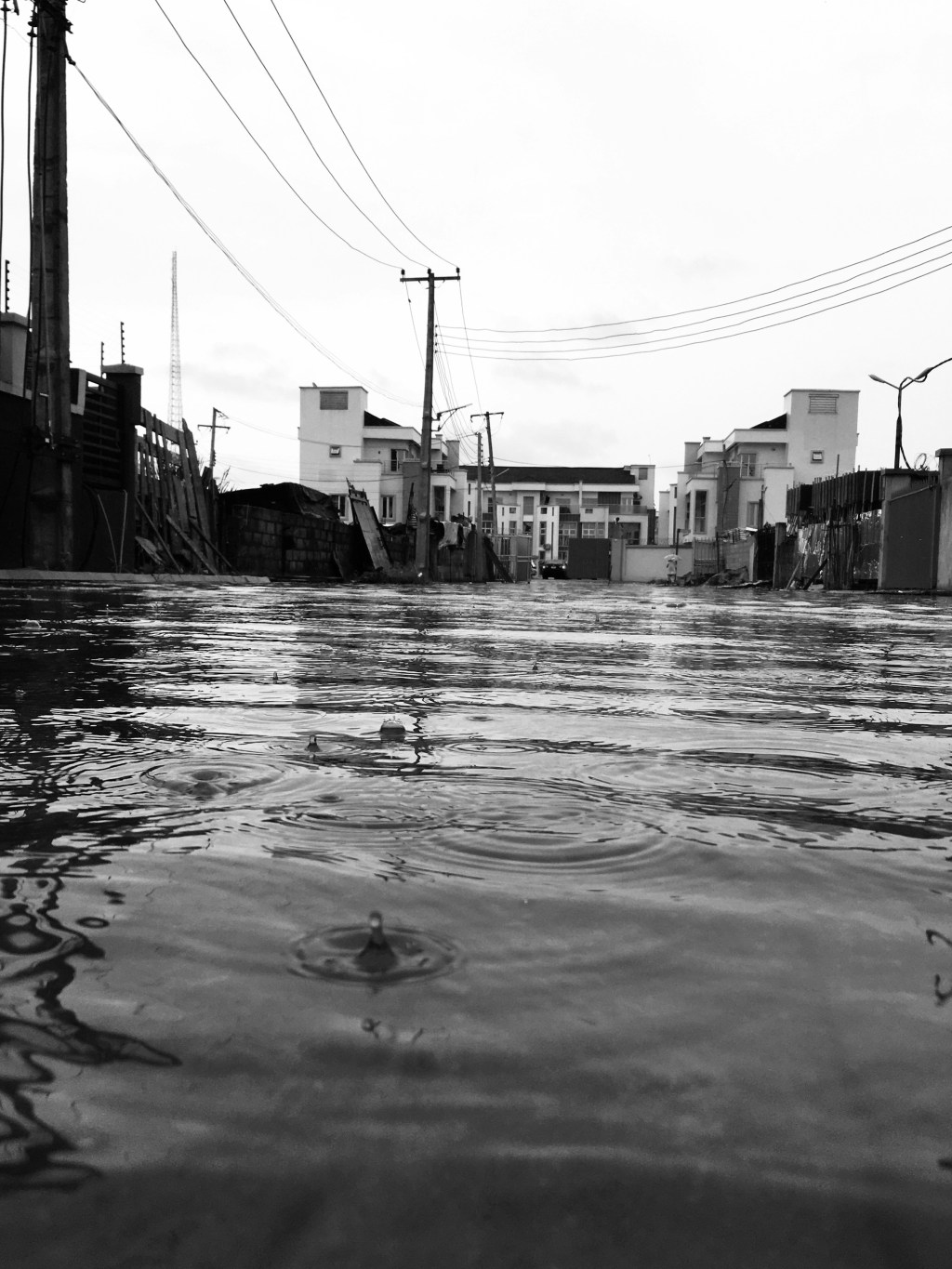
Photo by Francis Odeyemi on Unsplash
I hear the neighbors screaming over the sound of the rain on asphalt shingles above me, not quite enough to drown out the volume of the prayers that seem to notch up as the waters claim each new rung of the ladder. It’s a strange chorus, fear braided with hope, echoing through a neighborhood that was, until this morning, painfully ordinary.
The attic smells like old cardboard and insulation. Dust floats in the beam of my flashlight, slow and unhurried, as if it hasn’t yet received the memo that the rest of the house is being taken. Below me, something bangs loose against a wall. The sound rattles through the rafters like a pulse.
I keep glancing at the roof.
Not because it’s leaking. Not yet. Because I’m doing the math of desperation: how much plywood, how many nails, how long before the water climbs high enough that I’d have to cut my way out.
We didn’t move here recklessly. We compared schools. We ran the numbers. We read reviews. We checked crime rates and commute times and grocery store proximity. We bought insurance. We saved. We did everything a responsible person is supposed to do when building a life.
The floodplain was mentioned once. Buried in a disclosure form. A line item in a stack of documents so thick it might as well have been a book. A hundred‑year flood. Statistically unlikely. Nothing that needed to weigh on a Tuesday morning.
So we planted flowers. We finished the basement. We stored keepsakes in plastic bins that promised to be waterproof.
Enough.
The water touches the attic door now. I can hear it lapping against the wood, like something patient testing a boundary. It doesn’t rage. It doesn’t roar. It waits.
That’s the part people never understand about disasters. They aren’t dramatic until it’s too late. They are incremental. They are polite. They ask permission in inches.
I think about all the times I told myself that I was doing enough. Saving enough. Planning enough. Caring about the right things enough. I think about the little luxuries I defended because catastrophe was unlikely and comfort was here, and it felt earned.
The rain has been falling for three days.
I text my wife that I love her. She’s with her sister on higher ground. The signal is weak but it gets through. A small mercy. I don’t tell her about the roof. I don’t tell her that I’m measuring the distance between myself and the sky like it’s a ladder I might have to climb.
There is a particular terror that comes from realizing that your idea of safety was just an agreement you made with the past.
The world did not sign it.
The water creeps. The house groans. Somewhere nearby a car alarm howls until the battery dies, as if even the machines are learning what it means to be tired of screaming.
I think about all the things we never practiced losing.
Warmth. Electricity. Dry ground.
I think about how strange it is that we prepare obsessively for small, known inconveniences—flat tires, medical bills, late fees—but almost never for the possibility that the shape of our lives might simply be… wrong.
Wrong place. Wrong assumptions. Wrong enough.
If I have to cut my way out of this house, I will not do it cleanly. I will do it with whatever tool is closest, whatever strength remains. The roof will not care about my mortgage or my credit score or the fact that I was, by all reasonable measures, a prudent man.
It will only care about pressure; about wood straining and nails giving way. That’s what comfort never tells you. That it is not a shield, only a pause. That stability is not the absence of danger, only the quiet before it asks its next question.
The water presses harder. The ladder beneath my feet floats free.
I whisper a final prayer, not for rescue, but for clarity: that if I survive this, I will never again mistake stillness for safety.
The rain does not answer. It just keeps falling.
The Marketplace of “Enough”
If the floodplain is where our private lives quietly fail, the marketplace is where we learn to pretend nothing is wrong at all.
Modern society doesn’t reject the idea of “enough.” It sells it, packaged in gratitude, wrapped in modesty, and marketed as wisdom. We are told that wanting more is greedy, childish, or ungrateful.
And in the same breath, we are shown that what we have is already outdated. Someone else is richer. Someone else is happier. Someone else is more fulfilled, more admired, living a life more optimized.
Be content, we’re told. Also: you’re behind.
Advertising perfected this contradiction. It flatters us with the language of self-acceptance while quietly introducing new absences. You deserve this. You’ve earned it. But look: there’s a better version of what you already own. A slimmer one, a smarter one, or one with more admiration baked into the purchase. One that implies, politely (of course), that you are not quite whole yet.
Social media finished the job. We no longer compare possessions. We compare lives. Curated joy scrolls past like a ritual parade, each image implying that someone else has unlocked the formula for being okay. The result is a strange posture: publicly content, privately eroding.
“Enough” becomes a moral demand. Don’t complain. Don’t be difficult. Be grateful. You’re doing fine; just look at everyone else who has less.
But at the same time, “enough” becomes a consumer engine. You could be better. You could feel better. You could finally become the person the algorithm keeps suggesting you almost are, if you just make the right purchase, the right upgrade… the right change.
This is how “do your best” turns into quiet self-reproach. The target never holds still. It moves not because your life changed, but because your visibility did. So we learn to live in a narrow corridor between shame and aspiration. We do enough to avoid guilt, but never enough to quiet the echo of comparison. Enough to justify the life we’ve built, but not enough to settle fully into it.
This, too, is a kind of floodplain. A cultural terrain made unstable on purpose: where identity is measured against the loudest signals, satisfaction is always just out of frame. We build on top of these shifting metrics, convinced we are being careful, when really we are just being watched.
And like the homeowners by the river, most of us don’t notice the risk. We’re too busy decorating the basement.
The danger isn’t that society teaches us to be grateful. Gratitude can be grounding. The danger is that it couples gratitude with perpetual inadequacy, convincing us to call a fragile equilibrium “enough” while training us, quietly, to always want more.
So we live with the water just below the floorboards, trusting that the rain won’t last.
History is not so optimistic.
The Social Theater of Sufficiency
Culture tells us what to want. Groups teach us what we’re allowed to become. Families, classes, and communities don’t just echo the marketplace’s version of “enough.” They enforce it; quietly, repeatedly, and intimately.
They turn abstraction into boundary. Somewhere between childhood and adulthood, most of us learn the limits of acceptable ambition, acceptable risk, and acceptable deviation. We learn what a “good life” looks like here, wherever here is. More importantly, we learn what kind of life makes people nervous.
In families, it arrives as prudence. Be careful. Don’t get ahead of yourself. Don’t embarrass us. In some homes, “enough” means stability at any cost. In others, it means status. In still others, it means never wanting more than the people around you can afford to imagine.
The details shift, but the function is constant: ambition is shaped to preserve harmony.
Communities refine the mold. Neighborhoods, workplaces, churches, and friend groups all participate in quiet consensus about what counts as success, what counts as failure, and what counts as strange. We call it keeping up with the Joneses, but it’s really about staying within the emotional gravity of the people we need to stay recognizably human to.
Class imposes the final shape. It tells us how much safety is considered reasonable, how much risk is considered reckless, and how much aspiration is considered absurd. There are versions of “enough” we are not supposed to want. Others we are required to pursue, even when they hollow us out.
This is where “enough” stops being about sufficiency and becomes about survival. Not rocking the boat. Not drawing fire. Just staying legible to the people who get a say in whether we belong.
Outgrowing your group’s definition of enough is rarely framed as growth; instead, it reads as betrayal, arrogance, or instability. The person who wants more (more safety, more meaning, more freedom) is rarely praised. They are seen as a threat. Their wanting puts pressure on the shared story; it suggests the rules might not be sacred after all.
So people scale back their desires and call it realism. Or gratitude. Or adulthood. Sometimes, it’s all of those things.
Other times, it’s just fear; pressed into a suit and passed off as wisdom.
This is a floodplain too. A social terrain that looks solid because everyone is still standing on it, even as the water quietly rises. We build our lives on top of inherited expectations and definitions of “enough” that were never designed to distinguish long-term flourishing from short-term belonging.
The tragedy isn’t that we want to fit in. That’s human. The tragedy is how often we trade our future to stay recognizable in the present.
And by the time the water reaches the doorframe, it’s already too late to ask who decided where the house should stand.
The Personal Contract with Normalcy
By the time society and our circles are done shaping us, most of us arrive at a quiet, internal agreement: I am doing enough.
It sounds modest. Responsible. Even virtuous. More often than not, it isn’t chosen, so much as inherited. We tell ourselves familiar stories:
I save some money. I work hard. I care about the right things. I’m not reckless. I’m not irresponsible. Bad things happen, yes… but to other people. The unlucky. The careless. The dramatic. I live in the sensible middle, where disaster is a statistical outlier, not a personal threat.
This isn’t laziness. It’s something quieter: probability used as a shield against imagination.
We don’t say, this could never happen to me. Instead we settle on, it probably won’t. And in that small grammatical shift, entire futures vanish. The mind treats low likelihood as zero. Not because it’s logical, but because it’s easier to sleep that way.
So we plan for what we can imagine and tolerate; a broken appliance, a medical bill, or a brief layoff. We buy insurance. We build small cushions. We rehearse familiar inconveniences.
What we do not do, however, is prepare for the failures that have no script. That is the problem with black swans. They are not dangerous because they are rare. They are dangerous because we never invited them into the room.
So when the factory closes, or the market collapses, or the relationship ends, or the diagnosis arrives, it doesn’t feel like misfortune. It feels like betrayal.
We did everything right.
We were careful.
We were sensible.
We had been doing enough.
But enough, as we practiced it, was a stance built on a narrow future. One where the world behaved. This is how normalcy becomes a contract: As long as nothing breaks the script, I will remain the person I’ve learned how to be.
But the moment it does, everything we called stability is revealed to have been a fragile truce.
Like the house on the floodplain, our lives feel safe not because they are well-founded—
but because nothing has tested them yet. The water stays below the floorboards, and we take its silence as proof that it will never rise.
It is only when the ladder begins to float that we realize how much of our safety was built on the things we never dared to imagine.
The Mind’s Need for “Enough”
Beneath all of it; beneath culture, beneath class, beneath the stories we whisper to stay sane, there is something older at work: the nervous system, still trying to survive a world that disappeared millennia ago.
“Enough” is not just a word. It is a cognitive survival algorithm. The brain is not built to hold infinity. Uncertainty is metabolically expensive, and risk is exhausting. Endless open futures register as threat, not just intellectually, but at a biological level.
So the psyche does what it has always done when overwhelmed: It simplifies.
It builds foundations on routine thoughts: “This is normal”, “This is safe.”, “This is how things usually go.”
From that scaffolding, it builds a narrative. Tomorrow will look like today, next year will look like this year, and the floor will remain under our feet.
Then it builds identity; stories about who we are, what we can handle, and what kinds of disasters belong to other people.
None of this is about truth so much as simply staying calm. “Enough” is the lie the nervous system tells so it can stop scanning the horizon. Once something is labeled sufficient, the body can rest; the guard drops, energy is conserved, and sleep becomes possible once again.
This is why people cling to “enough” even after it stops sounding honest. To admit your savings might not hold, that your job might not last, that your relationship might not be safe, or that your body might not recover… is to tear open the contract your brain signed in exchange for peace.
It is to re-enter a state of vigilance it cannot afford to sustain. So we prefer the lie that lets us breathe. Initially, we mistake silence for safety. Then, we confuse stillness for stability. Eventually, we accept fragile equilibrium because it feels better than staring into the open sky of what might be.
In the attic, listening to the water rise, the mind would do anything for a gauge to rely on, some quiet meter that says: this is still within tolerance. This is still okay. This is still enough.
But when the signal doesn’t come, we are left alone with the raw fact of uncertainty, and the body begins to tremble like it remembers something we forgot.
That discomfort doesn’t make the danger disappear. It only makes us later to notice it. The mind’s need for “enough” is understandable. It is human. It is even merciful.
It is also why the water so often reaches the door before we begin to move.
The Ethics of Sufficiency
Psychology tells us why we cling to “enough.” Philosophy asks whether we should.
This is where classical Stoicism diverges from the soft promises of modern comfort culture. The Stoics didn’t romanticize suffering. But they did insist on something many of us now avoid:
That a person should be able to lose what they have without losing who they are.
Voluntary hardship (fasting, silence, cold, solitude) was not about punishment. It was a rehearsal for sovereignty. A way to remember that dignity is portable, and that identity does not require perfect conditions to remain intact.
When you know you can be cold, warmth becomes a preference, not a crutch.
When you know you can be hungry, abundance becomes a tool, not a leash.
This is the ethical fracture line: If you cannot lose it without collapsing, you do not possess it. It possesses you.
Unexamined “enough” is surrender, not security. It hands your agency to whatever happens to be holding you up at the moment. The version of “enough” we inherit is accommodation, but the version we choose, eyes open, is autonomy.
“Enough,” in this light, is not a finish line. It is a stance; a declaration of what you are willing to risk, and a quiet line drawn in your own hand between comfort and collapse.
What losses could you survive?
What disruptions would break you?
What truths would you still speak if they cost you belonging?
These are not academic questions. They are architectural ones. Because in the floodplain, this is the difference between a house built on habit and one built with knowledge of the river. The wise do not choose to ignore the rising water, they simply acknowledge that it has done so before, and refuse to pretend it won’t rise again.
Stability, when chosen, is a gift. Stability, when assumed, is a trap.
The ethical work of “enough” is to ensure the ground beneath you is something you chose, not just a patch of earth you happened to stand on before the sky changed.
The Monument You Stopped At
Every life has a place where growth paused in the name of “enough.” It doesn’t always look like giving up; often, it looks like arriving. It may begin with getting a job that pays well, or a relationship that mostly works…. A version of yourself that feels familiar, even if it no longer feels alive.
Most people don’t stop because they’re weak. They stop because, at some point, the balance between risk and reward tilted quietly toward comfort. And the water, at the time, was still low.
This is less about judgement and more about offering a mirror, but… Where did you stop?
Was it in your work, when the title became more comfortable than the questions? In your relationships, when routine replaced curiosity? Perhaps in your beliefs, when certainty began to feel safer than growth?
What did that stopping point buy you? Was it more rest? More predictability? Was it simply the calm dignity of being understood? … And what did it cost? Which possibilities? What measure of resilience? Did it cost the capacity to move when the ground shifts beneath you?
There is no universal formula for how much ambition to hold, how much safety to seek, or how much stillness to accept. Some people need stillness. Others need the current. Most need both, in seasons.
The mistake is not choosing a quiet place to stand. The mistake is forgetting that you chose it, or worse, believing you didn’t choose at all.
The most dangerous version of “enough” is not the modest one, or the cautious one. It’s usually not even the comfortable one. It’s the inherited one, the one you never tested; the one that calcified while you were busy being sensible.
We spend a lifetime paying for the illusion of dry ground. But the flood is asking the only question that matters now:
When the floorboards fail, do you know how to swim?
… and, one more, because restraint would have been my own version of enough:







Leave a comment