
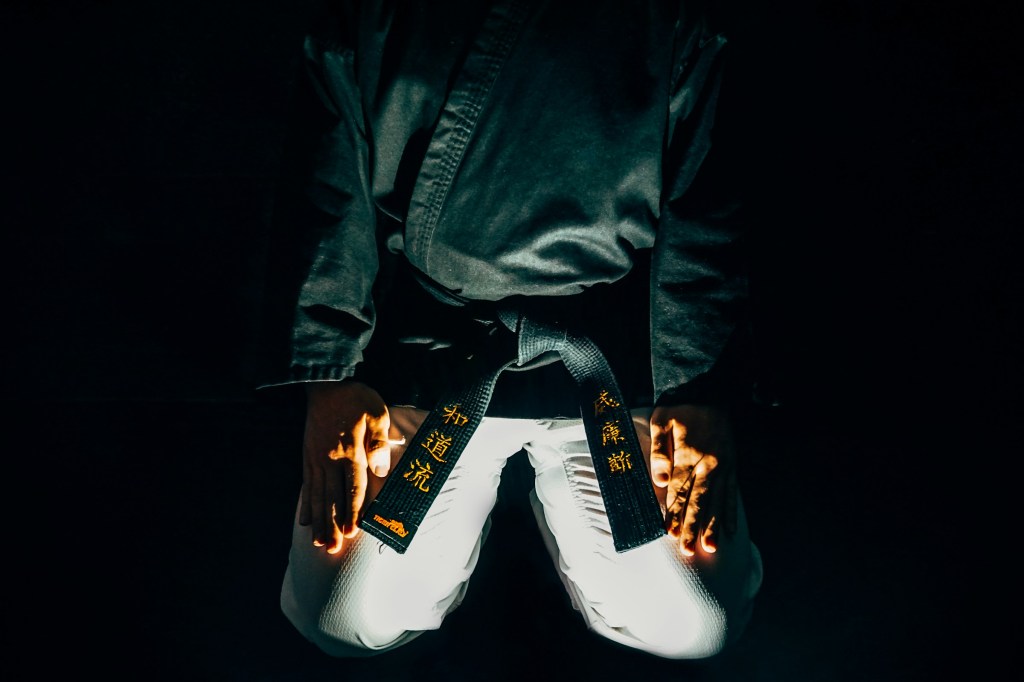
Photo by Leslie Jones on Unsplash
Author’s Note
This piece is not like most of what I share. It is longer, heavier, and closer to the root—the place where discipline wasn’t a theory but a survival tool. It carries fragments from early life: the violence I witnessed, the weight I carried, and the stances I practiced to steady myself through it all. These memories are not included for effect. They are origin points—of values, of voice, of form.
You won’t find the usual metaphor, the neat arc, or the polished lesson. What you’ll find are virtues shaped like forms—repeated, refined, and returned to. Not abstractions. Not ideals. Disciplines.
Integrity. Honesty. Momentum. Stewardship. Justice. Compassion. Restraint. Humility.
These are not things I believe in because they sound noble. They are things I believe in because they kept me alive. Because they keep me aligned. Because the world is starving for them.
This is not theory. It may qualify as ritual. And if you feel the weight as you read, know that it’s part of the practice: to carry, to continue, to return.
This is where I come back to remember my form.
This is my version of why.
~Dom
For close to 30 years, and perhaps a few more I hardly remember, I’ve been a student of control; both of my self and my environment.
At first, it was self‑control—silence and obedience in exchange for safety. In that narrow bargain, I began learning to chart the small corners of the world I could control. I have few memories from before the age of ten, and most come as fragments—each carrying a lesson in survival, stability, or the sharp reminder of what happens when that quest fails.
I remember flashes, the kind that today would warrant a 911 call. The impact of wood against my shoulder after being swung into a cabinet by my arm. The laughter that clawed its way out of me as I was “spanked” with the hard end of a flyswatter in the mid‑90s, and the look of terror in my mother’s eyes when neither my father’s arm nor my outburst stopped. The strange relief when I was sent to my room, where silence gave me space to build.
By my teenage years, rage lived just beneath the surface, held back only because it was easier to go along than to lash out. I felt annoyance when my grandmother signed me up for martial arts classes. And I remember the tears in the locker room the first time I realized someone cared about my future—more than the inconvenience of my presence.
It took me years to admit to my grandmother that she had been right.
I remember the grueling calisthenics, the thousands of repetitions of stance and strike, the forms practiced twice daily until they became a mantra in motion: I decided the next movement. Through control, I chose the step. Through discipline, I set my trajectory.
My body is built less for speed and acrobatics, more for labor—broad shoulders, thick limbs. Yet years of practice taught me to dance on the edge of weightlessness in the instantaneous eternity between foot’s departure and its landing on bag, board, or brick. Though the school was traditional rather than sport‑focused, the uniform, the belt, the drills, the routine never felt militant. They felt like freedom.
Not freedom in the usual sense, but freedom from empty cabinets, from trailers, from relationships bound by blood or necessity. And for the most part, it worked.
It steadied me the night I removed a knife from my mother’s wife’s hand as they screamed in the kitchen. It gave me the resolve to stand for my sister—sometimes physically in the way, sometimes redirecting the storm. It shaped me into the kind of man who sets his goals by the measure of lessening suffering for those he loves.
It taught me to stand for what I believe in, to never back down when guided by conviction, and to pour my efforts into making the world better—not only for myself, but for others.
At the root of it all, this is why I write the way I do, when it would be simpler not to.
These past several weeks have reminded me what it means to stand, to fight, to carry the load—not because I must, but because I can prevent worse, and therefore bear the responsibility to act.
This essay is more personal, more raw than most. But it circles back to the same truth:
These are my values. This is why I fight.
I will not be including song recommendations with this piece.
I considered it, but it felt disrespectful to the reader… and to myself in this space.
Training does not need a soundtrack.
On Integrity
Integrity is the core of everything I am and everything I try to build. At its simplest, I define it as refusing to trade pieces of myself—my truth, my voice, my commitments—for comfort or gain. It is not the sanitized definition offered in school assemblies or corporate retreats. There, integrity is reduced to obeying rules, to doing the right thing when others are watching. That version is convenient, safe, and cheap. Real integrity is dangerous. It demands a price up front. It asks what you will not do, even when every incentive tells you to bend.
Why does it matter to me? Because I have lived the consequences of betrayal, both given and received. In childhood, when safety was conditional and silence was currency, I learned that survival often meant surrendering parts of myself. Later, as I found my footing through martial arts, I discovered that the only way to remain whole was to draw lines I would not cross, even if standing firm meant standing alone. The dojo taught me repetition and form, but life taught me refusal—refusing to laugh at cruelty, refusing to play along with lies, refusing to build stability on top of rot. Each act of refusal carried a cost: friends who walked away, jobs that slipped through my hands, moments where saying yes would have made everything easier. But the weight of yes, in those cases, would have been heavier than the loss. Integrity mattered more.
I believe integrity is essential not just for me, but for any chance at a better world. Without it, every other virtue collapses. Courage without integrity becomes recklessness. Compassion without integrity decays into performative pity. Justice without integrity is just vengeance wearing a mask. Integrity is the spine that holds all other values upright. It is what allows a person to carry weight without folding, to act in alignment with truth rather than convenience. In a culture that rewards appearance over substance, compliance over conscience, integrity becomes the rarest commodity—and the one that cannot be faked.
When I look at the state of the world, I see how easily systems bend toward corruption when no one is willing to stand. Laws, markets, institutions—they all drift toward self‑interest and decay unless anchored by people who will not trade away their center. Integrity is not glamorous. It earns no applause. It often isolates those who practice it. Yet it is the quiet fulcrum on which real change rests. Every whistleblower, every protester, every voice that refuses to soften truth to make it palatable—they all remind me why integrity matters. Not because it guarantees victory, but because it keeps us whole when everything else is for sale.
On Honesty
If integrity is the spine that holds me upright, honesty is the fire that keeps me alive. I do not mean honesty in the shallow sense—polite correctness or the marketable version stapled to corporate manifestos. I mean the kind that burns, that redraws the lines of who I am allowed to be, even when it costs me rooms, jobs, or relationships. Prometheus did not suffer for telling bedtime truths; he suffered because he stole fire, knowing that once light touched human hands, the world would never go back to darkness. That is what honesty feels like to me: a match worth striking even when the beak waits above the stone.
Why does it matter to me? Because I have tasted what happens when you choke it down. I grew up in silence, trained to hold my tongue for safety, to smile through contradictions that twisted my insides. Every swallowed truth became a weight I carried in sleepless nights. Later, when I began to speak plainly—to admit fear, to call cruelty what it was, to walk away from roles and relationships that demanded complicity—I felt both the loneliness and the relief. Honesty stripped away illusions, but it left me able to breathe. That is why it matters: it exchanges comfort for clarity, and clarity is the only ground I have ever found firm enough to stand on.
Honesty matters to the world because it disrupts the illusions that make exploitation possible. Systems thrive on curated truths: the politician’s confession rehearsed for cameras, the influencer’s “raw” moment filtered for algorithms, the corporate apology engineered by lawyers. These performances preserve power because they never threaten its foundation. But real honesty, spoken without permission, rearranges the furniture. It makes the comfortable squirm. It makes the next lie harder to pronounce. It is the quiet contagion that spreads when one person finally says: I don’t believe this anymore.
I do not think honesty guarantees a kinder world. In fact, it often makes life harder. But it makes life real. It keeps us from suffocating under layers of polite deceit. It pushes ambition toward alignment rather than applause. It clears out the rot so that what remains can bear weight. For me, honesty is not about disclosure for its own sake—it is about resonance. A sentence is honest only if it still holds in silence, only if it still costs something the next morning. That is the test I return to, again and again.
A world where honesty holds is not softer—it is steadier. It is a place where trust has substance, where people can act on real ground rather than staged surfaces. And while it rarely wins applause, it leaves something better behind: a trail of sentences that burn clean enough to light the way for others.
On Momentum
Momentum is the virtue that transforms conviction into reality. Without it, even the clearest vision or deepest integrity withers. I define momentum as the disciplined choice to keep moving in the direction truth points—again and again—despite friction, fatigue, or lack of recognition. It is not glamorous. It is not measured in applause. It is measured in distance traveled through resistance.
Why does it matter to me? Because I have known the paralysis of stasis. I’ve had seasons where I carried truth in my hands but could not find the strength to move it forward. I have also known the power of repetition—the daily training sessions, the endless forms practiced until my body became fluent in discipline. Each repetition was a refusal to stop, a quiet decision to carry one step into another. Over time, those steps compounded into strength, clarity, and resilience. Momentum gave weight to my convictions, making them more than intentions—it made them embodied.
Momentum matters to the world because it is the multiplier of every other virtue. Integrity without motion stays private; honesty without motion becomes cynicism. But when carried forward, they become contagious: they alter communities, shift institutions, and redraw what people believe is possible. Like Thor’s hammer, motion transforms weight into force. It is not the possession of power that changes the world, but the decision to throw—to risk the recoil, to accept the bruises, to trust that what you set in motion will outlast the throw.
The reality is that resistance never disappears. The world offers static friction—comfort, safety, the inertia of staying put. It offers kinetic friction—mockery, sabotage, systems designed to slow every advance. But resistance is proof that you are moving. The virtue lies in refusing to mistake that drag for failure. Each shove forward is not wasted; it accumulates, turning struggle into trajectory. Momentum makes tomorrow’s step lighter because yesterday’s force has already cleared part of the path.
In my life, momentum has meant showing up to write when silence felt easier, choosing discipline when despair whispered that nothing would change, carrying convictions into spaces that would have preferred compliance. It has meant catching the hammer after every throw, heavier with consequence but brighter with proof that motion mattered.
For the world, momentum is what keeps truth alive long enough to make impact. It is what allows justice to survive fatigue, compassion to endure disappointment, and courage to persist after applause fades. It is not the roar of thunder—it is the choice before the throw, the oath to move again. And if the hammer returns with bruises, so be it. They are the marks of a life carried forward.
On Stewardship
Stewardship is the virtue of care stretched across time. Where discipline asks, what must be done now? stewardship asks, what must last? I define it as the posture of tending what matters, even when no one else notices, and even when the work is thankless. It is not control. It is not ownership. It is the willingness to preserve meaning—whether in relationships, institutions, or communities—so that they can outlive us.
Why does it matter to me? Because I grew up in a world where neglect left fractures everywhere. Empty cabinets, broken homes, silences that became inheritances. I learned early that survival is not enough; someone has to maintain what holds life together. For me, that meant standing in for my sister when no one else would, documenting systems at work so others wouldn’t stumble blind, showing up for people even when it cost me time or comfort. None of it was glamorous. Most of it was invisible. But each act was a way of saying: this still matters.
The truth is, stewardship rarely earns recognition. Builders are praised. Heroes are remembered. But keepers—the ones who patch the roof, tend the garden, or maintain the code—are forgotten. Yet without them, nothing endures. Penelope’s quiet weaving mattered more than Odysseus’s battles, because it preserved a home worth returning to. That is the essence of stewardship: continuity through care, often unseen, but vital.
Stewardship matters to the world because we are living through an age that has forgotten it. Systems are optimized for speed and profit, not endurance. Families lose rituals to convenience. Products are designed to break. Communities unravel because no one mends them. We treat permanence as wasteful and replacement as default. The cost of abandoning stewardship is everywhere: burnout, broken trust, fractured institutions, a planet treated as disposable. Without stewards, there is no shade left to rest beneath, no roots to nourish future generations.
To reclaim stewardship is to reclaim responsibility for the long view. It is to plant trees we will never sit under, to maintain truths that outlast applause, to pass tools and stories forward so others inherit something worth keeping. In my life, it means tending to relationships, building systems meant to last, and resisting the cultural push toward disposability. It matters because continuity is the only way meaning survives. And without meaning, all effort collapses into dust.
Stewardship will never make headlines. But it leaves echoes—in the stability of what still holds, in the quiet peace of what no longer breaks, in the shade where others one day pause to breathe. That is why it matters to me, and why it matters to the world.
On Justice
Justice is the virtue that refuses to let harm go unchallenged. I define it not as the sterile symmetry of laws or the blindfolded icon of the courthouse, but as the practiced habit of stepping into the gap where harm is being done and saying: not here, not now, not to them. It shifts constantly, because injustice shifts constantly—between silence and complicity, between law and equity, between punishment and repair. True justice is not neutral. It looks with eyes wide open, carries the weight of context, and seeks not just balance but healing.
Why does it matter to me? Because I grew up seeing what happens when no one stands. The knife I removed from my mother’s wife’s hand, the storms I intercepted for my sister—these were not courtroom dramas, they were raw, immediate choices: protect, intervene, prevent. They taught me that justice is not abstract. It is as close as the dinner table, as close as the bruises you refuse to let multiply. Later in life, I came to understand justice as something broader than defense. It is repair, prevention, and the courage to name harm when the world prefers silence. But at its core it remains what I first learned: stepping in matters, even if you pay for it.
Justice matters to the world because systems left to themselves rarely protect the vulnerable. Too often they protect the status quo. Balance without history becomes anesthesia—punishing the desperate while excusing the powerful. Neutrality without context becomes complicity. A world that mistakes silence for peace leaves wounds festering under its skin. Justice is the refusal of that false peace. It asks harder questions: Who benefits from the silence? Whose suffering is being written off as collateral? What future is being mortgaged by today’s inaction?
For me, the practice of justice means being willing to hold tension. Accountability without scapegoating. Restoration without erasure. Prevention without delay. It means absorbing some of the cost so that others don’t bear it alone—whether in family, workplace, or society. The price can be high: relationships strained, opportunities lost, safety threatened. But the return is higher: clarity, dignity, and the knowledge that someone, somewhere, was spared because you refused to stay quiet.
In the world, justice matters because it is the virtue that keeps history from repeating itself. It is what transforms mercy into memory and memory into prevention. It is the slow work of repairing what harm has broken and reshaping the conditions so the harm does not return. Without justice, integrity folds into isolation, honesty curdles into bitterness, momentum dissipates into noise, stewardship collapses into neglect. With it, all of these virtues find their point.
Justice is not patient. It is not polite. It is the virtue that remembers the names others forget, and it is the courage to act before another name is added to the ledger. That is why it matters to me, and why it matters to the world.
On Compassion
Compassion is the virtue that holds when everything else has given way. I define it not as sentiment or pity, but as the disciplined courage to stay with another’s pain when staying will not fix it. It is not sweetness. It is not convenience. It is the willingness to remain present, even stripped of answers or control, so that someone else does not have to face their storm alone.
Why does it matter to me? Because I have lived through moments where the presence of another human being mattered more than any solution. In childhood, what I needed was not a savior but someone who would not turn away. As I grew, I learned to become that presence—sometimes for my sister, sometimes for colleagues, sometimes for friends at their breaking point. Compassion has never meant rushing in to rescue. It has meant kneeling beside, steadying my breath so theirs might steady, refusing to let another human being carry their grief in total isolation. That choice—to stay when there is nothing to gain—has shaped me as deeply as discipline or integrity ever did.
Compassion matters to the world because without it, suffering multiplies in silence. We mistake compassion for comfort, but it is often anything but. True compassion risks proximity to grief and disappointment. It risks being misunderstood as weakness, resented for its limits, or dismissed as naïve. Yet it is precisely that risk that gives it power. Systems cannot heal wounds; people can. Compassion interrupts abandonment, challenges indifference, and refuses to let efficiency replace humanity. It does not erase pain, but it keeps pain from consuming entirely.
At its best, compassion is not self‑erasure. Boundaries are what make it sustainable. To remain whole while bearing witness is not betrayal—it is the only way to return tomorrow and the next day. Compassion with discipline becomes a posture: I am here. I will not flee. I will not unmake myself to carry what is not mine, but I will not leave you unseen. This is the steady hand, the shoreline against which waves break without collapse.
In my life, compassion has been the decision to sit beside someone in silence rather than offering false assurances. It has been refusing to reduce people to their wounds, seeing instead the wholeness they are still fighting to hold. It has been carrying memory forward—remembering those moments so that I can descend again, willingly, when someone else falls into their own underworld. And it matters to the world because every time compassion enters the room, the cycle of abandonment breaks. Every time it stays, even in shadow, it proves that being human is not something we do alone.
On Restraint
Restraint is the virtue that tempers power. I define it as the discipline of choosing not to act when action would betray my purpose or corrode my self-respect. It is not weakness. It is authorship—the pause that makes me the author of my own response rather than the echo of someone else’s provocation. In a world that rewards speed, outrage, and proof at any cost, restraint is the refusal to be ruled by impulse or by the need to be seen.
Why does it matter to me? Because I grew up in a house where reaction was constant and escalation was the norm. Survival often meant silence, but with time I learned that true restraint is not suppression—it is sovereignty. Martial arts sharpened that lesson: that the highest skill was not in striking faster, but in knowing when not to strike at all. Every use of power leaves a mark—on others, but also on the self. Some marks are not worth the victory. Restraint became the way I claimed authorship of my choices, even when provoked, even when insulted, even when silence cost me standing. It was my way of saying: I will not become what wounded me.
Restraint matters to the world because untempered power corrodes everything it touches. Leadership without restraint curdles into tyranny. Justice without restraint becomes vengeance. Honesty without restraint becomes cruelty. Momentum without restraint becomes recklessness. Restraint is the tempering force that keeps every other virtue from turning into its shadow. It interrupts cycles of reaction, reclaims space for intention, and keeps power from becoming compulsion. In that pause, better choices can breathe.
In my life, restraint has meant refusing to humiliate someone even when I could, refusing to escalate an argument even when I had the sharper words, refusing to prove myself at the cost of peace. It has meant bowing when pride wanted to splinter, bending like the reed so I could rise after the storm. And it matters to the world because restraint, practiced collectively, creates room for repair instead of retaliation, dialogue instead of domination. It is the quiet strength that holds the blade sheathed, not because it cannot cut, but because we know what cutting would cost.
To hold power and not use it is the rarest strength. It is the discipline of stillness, the authorship of response, the clarity of refusing to become what you oppose. Restraint keeps me whole—and it keeps the world from collapsing under the weight of power unrefined.
On Humility
Humility is the virtue that tempers all the rest. I define it not as erasure of the self, nor as forced modesty, but as proportion: the ability to stand in right relation to truth, to others, and to the limits of our own knowledge. Where pride barricades, humility leaves the gate ajar. It does not demand applause, nor does it collapse into silence. It listens, it admits, and it makes space for something larger than ego to enter.
Why does it matter to me? Because humility is the only thing that steadies my other virtues. Integrity can become rigidity without it. Honesty can turn cruel. Momentum can harden into obsession. Even justice, if left untempered, can tilt toward vengeance. Humility reminds me that I am not the measure of the world, only a participant in it. It has taught me that admitting limits is not weakness—it is the beginning of wisdom. I learned this first through martial arts, where every form revealed what I didn’t yet know, every sparring match humbled the certainty I thought I carried. Later, in work and in writing, I discovered that the courage to say “I was wrong” or “I don’t know” has opened more doors than any posture of certainty ever could.
Humility matters to the world because without it, every strength warps. False modesty, self-belittling, and obedience masquerade as humility, but they are counterfeits—fear and performance wearing virtue’s mask. True humility is different: it situates the self without erasing it. It clears space for dialogue, for collaboration, for repair. It says: I can be skilled and still need correction. I can be strong and still yield. I can be certain in one light and opaque in another. Humility allows compassion to breathe, stewardship to endure, justice to balance memory with mercy. It is the soil from which the others grow.
In practice, humility lives in apology without excuse, in listening long enough for someone else’s truth to land, in stepping back so others can rise without feeling diminished. It is found in leaders who admit their limits, in teachers who learn from students, in everyday people who choose context over spectacle. Humility doesn’t erase ambition; it clarifies it. It doesn’t kill pride; it reshapes it—turning pride of the self into pride of the shared.
To me, humility is the steady ground beneath every stride, the silence after every flame, the pause that keeps power aligned with purpose. It is not ornamental. It is not optional. It is the rarest form of strength: the courage to be small without shrinking, to yield without vanishing, to bow without surrendering. And it matters because only when we stop pretending to hold everything do we become capable of carrying what actually counts.
Return to Form
It’s been a hard month. Hard enough to make me return—not to comfort, but to discipline. Not to ease, but to the forms that once held me steady when the world tried to break me in half.
This essay is longer. Heavier. But so was the work that shaped me. I didn’t write this to be understood. I wrote it to remember. To rehearse the virtues that are only real when practiced.
Because without motion, every virtue collapses.
Integrity becomes image.
Honesty becomes performance.
Momentum becomes noise.
Stewardship becomes neglect.
Justice becomes branding.
Compassion becomes pity.
Restraint becomes fear.
Humility becomes self-erasure.
I have paid for each of these in flesh. I’ve practiced them in silence, in shadow, when there was no one watching and no applause to catch me. Not to make life easier, but to make sure I could keep moving when it got harder.
This is not theory. It is training. And training isn’t meant to be admired; It’s meant to be carried.
Into the next day. Into the next fight. Into the world that keeps asking if we meant it.
These are my virtues. This is how I fight. And I will keep fighting—until motion makes meaning. Until form becomes force. Until every stance holds.
Until the world understands I did not come here to be still.




Leave a comment