
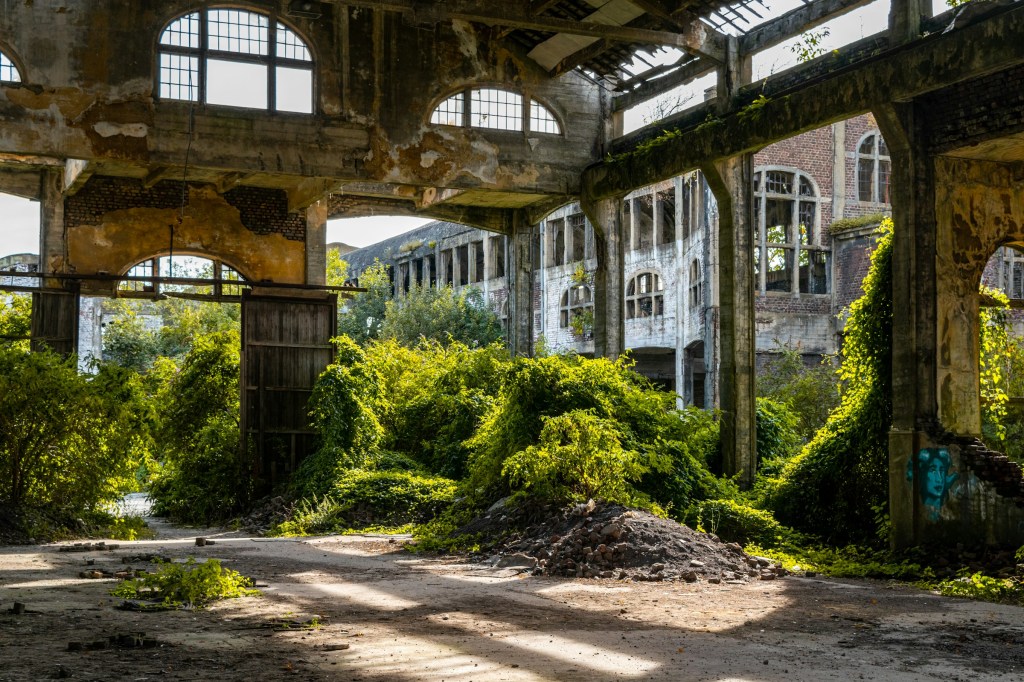
Photo by Cédric Dhaenens on Unsplash
The rain was soft that morning—the kind that never announces itself but quietly persuades you that everything is alive with motion. I ducked beneath the sagging marquee of what used to be a shopping center, phone in one pocket, flashlight in the other. Inside, the air was cool and earthy, like a forest floor after a storm. Vines snaked through ceiling cracks; moss cushioned broken tiles; a lone sparrow beat its wings where food‑court pop once echoed.
Places like this disarm me; they always have. They pull me out of the algorithmic bustle—out of calendars, KPIs, and the curated selves we exchange like business cards. Here, in the slow hush of neglect, the world practices a radical honesty: every flake of peeling paint, every rusted bolt a footnote in the essay entropy keeps writing whether we read it or not.
That honesty is what hooks me—not the gloom, but the candor. Philosophers from Heraclitus to the Zen poets insist that permanence is an illusion, that the river is never the same twice. Yet most days we pretend otherwise—stacking goals, accruing stuff, polishing our digital reflections. Standing in any of the many places best described as what they used to be, the lesson isn’t an abstract aphorism; it has texture, scent, acoustics. Impermanence becomes tangible.
Oddly, the recognition often feels less like loss and more like… permission. If the mall, church, or house can crumble gracefully, maybe our plans, identities, and anxieties can soften too. Decay isn’t just an ending; it’s an invitation—to breathe in the present, to see value in the incomplete, to acknowledge that life, like building, is always under revision.
That quiet realization is the seed of this post. We’re not here to glorify ruin porn or celebrate collapse. We’re here to listen for the insights hiding in the cracks—to ask what beauty reveals itself only when the neon burns out.
Recommended Listening:
The Aesthetic of Collapse
If you’ve ever slipped through a chain‑link fence to wander an abandoned factory or even scrolled through “ruin porn” hashtags at 2 a.m., you know the tug I’m talking about. It’s not just curiosity or the thrill of trespass—it’s a pulse that says, Look closely; something true lives here. The tiled floor is cracked like riverbeds in drought, yet every fracture sketches a map of time, pressure, and neglect. In these places we aren’t mere spectators; we’re archeologists of the immediate past, reading the sediment of other people’s Tuesdays.
Philosophers from the Japanese concept of wabi‑sabi to the Stoics’ memento mori remind us that beauty and impermanence are conjoined twins. Wabi‑sabi prizes the unsymmetrical, the weathered, the unfinished—because those qualities whisper life happened here. Likewise, in the art of kintsugi, broken pottery is repaired with veins of gold, not to hide the break, but to exalt it. A shattered thing isn’t ruined; it’s re‑contextualized.
Modern physics joins the chorus. The second law of thermodynamics—entropy always increases—sounds clinical until you witness rust gnawing at steel or drywall surrendering to mold. These aren’t failures of maintenance; they’re physics in slow motion, the universe announcing its preference for disorder. To find beauty here is not nihilism; it’s honest attendance to reality.
And maybe that honesty is why derelict spaces feel like a palate cleanser after the hyper‑curated feed of modern life. Branding promises longevity; warranties swear permanence; quarterly growth charts pretend the arrow only points up.
Ruins call that bluff. They say, Everything your credit card bought will someday look like me.
Far from depressing, the reminder can be liberating: if nothing lasts, then perfectionism loses its leverage, and we’re free to appreciate the present, scars and scuffs included.
So the aesthetic of collapse isn’t just cracked marble and invasive ivy—it’s a lens that refocuses our values. It prepares us to drop the performance and, in the next breath, ask what authenticity might sound like once the applause dies down.
The Rejection of Performance
Scroll any social feed and you’ll see life rendered as theater: morning‑routine reels with product links, humble‑brags disguised as gratitude posts, LinkedIn essays that read like résumés in drag. Even offline, we smooth edges for the personal brand, the quarterly review, the first date, even the neighbor whose name we keep forgetting, but whose habit of picking the mint from our planter boxes we never will. Sociologist Erving Goffman called this the presentation of self—front‑stage personas we polish for an assumed audience.
The trouble is that the stage lights never dim anymore. Phones glow bedside. Metrics update in real time. Somewhere, a camera is always rolling—externally or in the echo chamber of our own expectations. Kierkegaard warned of “the despair of not willing to be oneself,” and you can feel that despair humming beneath modern hustle culture, the low‑grade background hum of anxiety that maybe the avatar is living more convincingly than the flesh.
Enter the ruin. Step across the threshold of a collapsed theater—ironically, the literal stage is gone—and the script evaporates. No managers, no followers, no algorithmic applause. Just naked architecture and your unfiltered reactions. It’s amazing how quickly the shoulders drop when there’s no potential for likes.
Inside these spaces, authenticity isn’t a virtue you strive for; it’s an environmental condition. Like oxygen at sea level, it just is. You’re free to feel bored, awed, frightened, or indifferent—truly, honestly—no need to hashtag the emotion. The peeling wallpaper doesn’t care about your elevator pitch.
There’s a psychological unburdening here. Studies on impostor syndrome show that chronic self‑monitoring drains cognitive resources, leaving us exhausted yet restless. Ruins short‑circuit that loop. With no script to memorize, the mind can idle, wander, invent. The silence isn’t empty; it’s capacitive—ready to be filled by thoughts that aren’t double-checked and pre‑approved for public reaction.
Ultimately, the rejection of performance isn’t an edict to quit your job or delete your accounts; it’s an invitation to remember that the theater is optional. When we practice stepping off‑stage—whether by wandering an abandoned mall or simply sitting screenless on the porch—we recover a sliver of agency. We relearn what it feels like to exist without auditioning.
And once you’ve tasted that relief, the idea of constant noise starts to lose its grip, which brings us—naturally—to the next layer of quiet.
The Silence After the Noise
Every morning the phone detonates; it usually begins with an alarm, but never without alerts: news digests, calendar nudges, app badges begging for attention. By breakfast we’ve already processed more stimuli than a person in the 19th century faced all day. Neurologists call it “sensory load.” Philosophers as far back as Blaise Pascal simply called it distraction—the centrifugal force that keeps us from knowing ourselves.
Silence, then, is not the absence of sound; it’s the absence of demands. When a shopping mall goes dark, the background hum of HVAC, fluorescent ballast, and looping muzak dies with it. What’s left is what acoustic ecologist Gordon Hempton calls the music of the wild: a leaking skylight dripping, pigeons fluttering, our own pulse pressing in our ears. The transition is jarring only until you realize the static you considered normal was the real intruder.
Across cultures, humans have treated silence as an active ingredient in insight—Buddhism’s noble silence, Christian monastic Great Silence, the desert retreats of the Desert Fathers, Thoreau’s cabin at Walden Pond. Contemporary MRI studies add a modern footnote: two hours of quiet can stimulate hippocampal growth in mice, suggesting that stillness literally builds memory space. In other words, the mind blooms where noise recedes.
This isn’t ascetic escapism. I’m not advocating a literal return to caves or even dial‑up Internet (which was exceptionally un-quiet, now that I think about it). But ruins demonstrate a principle tech detox gurus try to monetize: when the external volume drops, the internal signal strengthens. Ideas arrive unprompted. Emotions we shelved for “later” wander back, asking to be named. Sometimes what surfaces is uncomfortable—grief, regret, boredom. Yet even that discomfort is data, a guidepost to what we’ve ignored while sprinting from ping to ping.
Silence also re‑sizes problems. The email backlog that felt existential under fluorescent buzz looks small under a gray, open sky. Stoic philosopher Epictetus advised visualizing the cosmic scale to shrink petty anxieties; abandoned lots offer the same perspective without the metaphysics. Standing amid fallen drop ceiling panels, we’re reminded that empires—and inboxes—both crumble, and life continues anyway.
Of course, quiet isn’t profitable. Attention is the commodity of late capitalism, and silence produces nothing to sell. Which leads naturally to our next realization: when the noise fades, the market’s value system falters, and another set of priorities emerges from the dust.
The Inversion of Value
My Grandfather once showed me a rust‑stained wrench he’d found when clearing out an old portion of the power plant he worked at for a refit. The area had been shuttered decades earlier—used for storage—but the tool felt oddly precious; less like scrap metal, more like a fossil of labor. In the marketplace that birthed it, the wrench’s worth was its utility: tighten bolts, keep the pipes sealed and the valves open, keep the pressure even. Once something new came along, production halted, its sticker price dropped to zero. And yet in his palm, the ruined wrench carried a weight no spreadsheet could capture: proof of hands, of sweat, of time.
Economists distinguish use value from exchange value; philosopher Karl Marx argued that capitalism inflates the latter until we forget the former. Ruins flip that script. When the exchange rate hits zero, we finally notice intrinsic qualities—texture, history, story. Thorstein Veblen’s “conspicuous consumption” loses its audience here; nobody flexes inside a condemned warehouse. The only currency accepted is attention.
This recalibration exposes the limits of a growth‑centric worldview. A cracked vinyl seat in a derelict diner won’t boost GDP, but it might remind you of late‑night coffees with someone you loved. A moss‑eaten billboard sells nothing now, but it sells honesty about time passing, and markets changing. By stripping objects of market utility, decay somehow returns them to the realm of meaning.
Psychologists Daniel Kahneman and Amos Tversky showed that humans misprice experiences—overvaluing acquisition, undervaluing reflection. Again, ruins correct the bias. They’re immersive tutorials in negative capability—Keats’s term for tolerating uncertainty without grasping for quick answers. You can’t “optimize” a collapsing roof; you can only witness it and feel whatever stirs.
And that pause has social implications. Consumer culture tells us speed equals success, efficiency equals virtue. Yet every spiritual tradition worth its salt—from Taoist wu wei to the Catholic sabbath—carves out sanctuaries of un‑productivity. Abandoned places incarnate the same lesson secularly: life is not a KPI. Sometimes the highest good is to do nothing but notice.
There is, of course, no quarterly report for moss growth. No influencer deal for patina. But maybe that’s the point. When value escapes the ledger, we’re free to ask deeper questions: What endures when utility ends? Who are we without the scoreboard? Those questions nudge us toward the final, unavoidable valuation—the one we make when confronted with mortality itself.
Death as a Mirror, Not a Monster
One late evening I climbed onto the splintered roof of an abandoned house just outside town. The chimney had collapsed years earlier, loose bricks splayed across the ground like fallen leaves. From that perch I could see an entire neighborhood slouching toward woods, city lights invoking a glow on the horizon: sagging porches, graffiti‑tattooed walls, trees sprouting from within an old chicken coop. It looked less like a tragedy and more like a time‑lapse of the universe reclaiming its materials—matter falling gently back into pattern. I felt a shiver, but it wasn’t dread; it was recognition.
Philosopher Martin Heidegger called this Being‑toward‑death: the idea that an authentic life requires turning to face mortality rather than skirting it. Long before him, Montaigne wrote that “to philosophize is to learn to die,” and the Buddhist practice of maranasati (mindfulness of death) teaches monks to meditate in charnel grounds, surrounded by decay. Across cultures, grappling with finitude isn’t a morbid preoccupation—it’s a catalyst for clarity.
Modern psychology echoes the ancients. Terror Management Theory suggests that our awareness of death subconsciously drives much of human behavior—from consumerism to nationalism—as a buffer against existential dread. But when ruins place mortality in plain sight, the buffering strategy falters. You can’t cover a rust‑eaten beam with retail therapy. Instead, you’re invited—gently, insistently—to integrate the fact of endings into the fabric of your day‑to‑day consciousness.
That integration can birth gratitude. Neuroscience studies on memento mori practices show spikes in activity within the medial prefrontal cortex—an area linked to value assessment and empathy. By contemplating death, we paradoxically heighten appreciation for life: the warmth of a shared joke, the tang of black coffee, the violet smear of twilight on broken glass. Perhaps because the supply of time is known to be limited, the demand for its appreciation increases. Regardless of causality, impermanence sharpens the senses.
It also steels courage. When you accept that all roles, possessions, and reputations will eventually crumble—just like that old house—the fear of ridicule or failure loosens its grip. Stoic emperor Marcus Aurelius put it bluntly: “Do not act as if you will live ten thousand years.” Ruins remind us that we won’t—and that truth can liberate us to act with urgency and integrity now.
So death, encountered through decay, functions less as a monster hiding under the bed and more as a mirror held to our ambitions, pettiness, and tenderness. It asks: If you, too, are a temporary structure, what will you house while you stand?
Finding Peace in the Breakdown
Step back to that rain‑slick atrium where our journey began: green growth piercing concrete at the seams, skylight shards turning clouds into fractured mosaics. What felt at first like a tomb of retail optimism now reads like a living syllabus in five chapters—collapse, authenticity, silence, value, mortality—each lesson etched in rust and rainwater.
We learned that cracks can be invitations, that silence can be nourishing, that worth survives its price tag, and that death, when faced squarely, can lend appreciation rather than terror to our days. None of these insights require ruins to hold value—but ruins amplify them, turning whispers into acoustics you can feel in your ribs.
So what do we carry back into the neon glare of functioning society? Perhaps a new calibration:
- To see polish without confusing it for permanence.
- To pause the performance long enough to remember the actor underneath.
- To curate pockets of quiet where thought can ripen off‑grid.
- To measure success not only by growth curves but by the stories objects and people accrue when no one is watching.
- To live as stewards, not owners—temporary custodians making space for whatever comes next.
If a dead mall can teach gratitude, if an abandoned home can fortify courage, then we, too, can recycle our endings into beginnings. Beauty in the ruins isn’t a paradox; it’s a promise: everything breaks, and everything broken opens—seed pods, geodes, human hearts.
May we meet our own fractures with the same porous grace, letting light and new growth in. May we build, yes, but also un-build—clearing room for quiet truths to take root. And when the next structure—physical or conceptual—inevitably buckles, may we stand amid the dust, unafraid, and whisper, I understand.
Because somewhere beyond the crash and the echo, the world is already writing its next chapter—and it’s inviting us to read, annotate, and, if we’re brave, contribute.





Leave a comment