
Author’s Note
This piece is a departure from the “Tools” series—but not because it abandons tools. It’s about the hands that hold them, the soil they rest in, and the slow, sacred work of keeping systems alive after the blueprints fade.
It began with Yggdrasil. A tree that holds worlds not because it’s magical, but because it’s maintained—daily, quietly, with care no one claps for. That image stuck with me. Because I’ve seen too many systems collapse under their own brilliance, too many communities built without space for repair, too many leaders who praise resilience while cutting maintenance budgets.
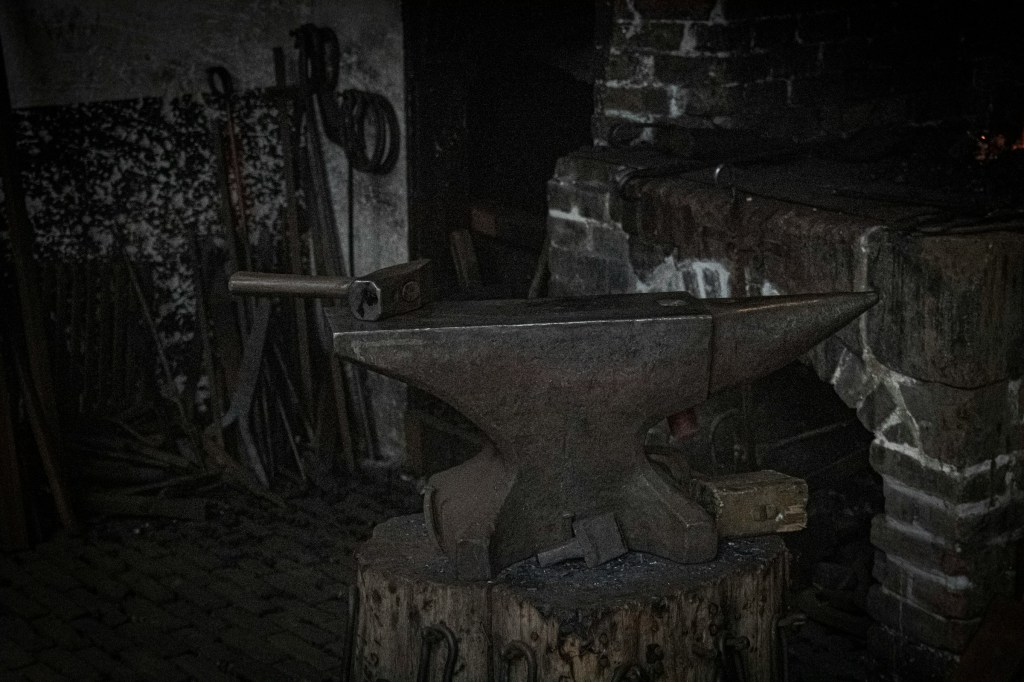
This essay is about infrastructure, yes. About code and cities and water. But also about people. The ones who document the pipeline, patch the cracked stone, and check in on the quiet friend before burnout takes root. The ones who brace the canopy so the rest of us can stand in the shade.
It’s longer than most articles I write. That’s intentional. Sustainability doesn’t arrive in a sprint. It has to stand—on roots.
So I offer this not as a lecture, but a ladder. Climb as far as you like. Just don’t forget to look down and see who’s been holding it steady the whole time.
~Dom
Before gods built halls of gold or giants raised mountains of bone, there was the tree.
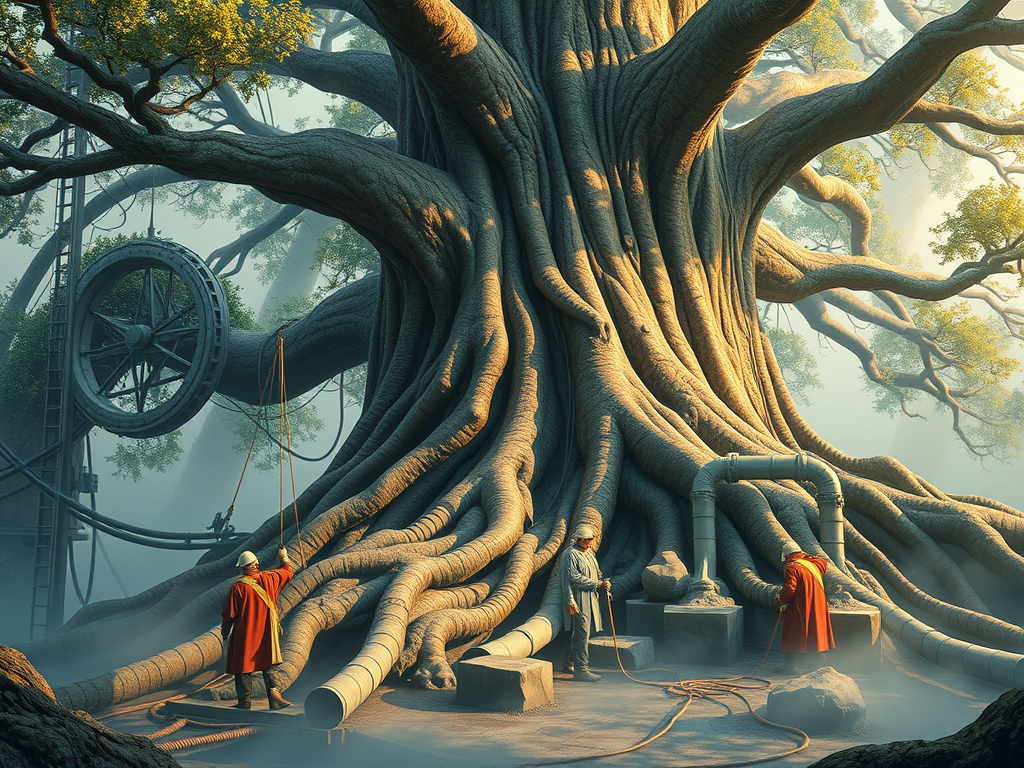
Yggdrasil, the great ash. Its branches crown the heavens and cradle the nine worlds in their shade. Its trunk runs through the middle of all things—binding sky, soil, and shadow with roots as deep as time is long. The ancients say it was not planted, but revealed—not born, but remembered—as if the world had always been waiting for something to hold it steady.
Three roots stretch outward.
One drinks from Urðarbrunnr, the Well of Fate, where the Norns—Urðr, Verðandi, and Skuld—carve runes into the bark and into the bones of men. They draw water from the well each morning and smear it across the roots like ointment, whispering the stories that will come true because they are spoken.
Another root coils into Mímisbrunnr, where the god Mímir’s head waits with sightless wisdom. Even Odin—Allfather, Wanderer, Lord of the Gallows—gave up an eye for a sip of that dark water. Knowledge has always had a cost, and the roots remember every debt.
The third root reaches toward the ice-frost realm of Niflheim, where the serpent Níðhöggr gnaws forever at the base. Others call him malice. Decay. The quiet certainty that even the sturdiest structures wear thin. And still, the tree holds.
Not because it is unchallenged—but because it is needed.
Its bark is scraped by the antlers of Dáinn, Dvalinn, Duneyrr, and Duraþrór, the four stags who nibble at its leaves. A squirrel named Ratatoskr runs messages—half-truths and taunts—between the serpent below and the eagle who watches from above. The gods themselves meet daily beneath the boughs, at Urðarbrunnr, to pass judgment and bind what must not be loosed.
Even at Ragnarök, when the sky splits and the sea boils, the tree does not fall. It trembles. It screams. But it does not break.
Because Yggdrasil is not only ash and sap and root. It is promise. It is design. It is a structure meant not for beauty, but for burden.
And still, it needs tending.
Even gods, even giants, even the wisest need its roots to hold.
And it holds because someone chooses to care for what they may never see flower.
This is how the world continues:
Not through conquest, nor brilliance, nor prophecy alone—
But through the quiet, sacred work of maintenance.
Recommended Listening:
Blueprints in Bark: Infrastructure as an Act of Faith
Ancient builders understood that true permanence begins long before the cornerstone is set. Consider the Roman aqueducts—Aqua Marcia plunging fifty‑seven miles from the Anio valley, or Pont du Gard leaping a river gorge with such precision that two millennia of floods have yet to dislodge a single arch. They were not erected for quarterly acclaim; they were stone declarations that water belongs where people live, no matter how many ridgelines stand in the way.
Look farther east and the same mindset surfaces in wildly different terrain. Persian engineers drove qanats beneath desert mountains so cold water could glide—unseen, unspoiled—into parched oases hundreds of miles away. In the Andes, Inca masons terraced entire mountainsides, stitching roads that still cling to granite spines too steep for today’s asphalt to survive. Europe’s medieval masons quarried and hauled limestone across kingdoms to raise cathedrals whose spires they would never live to see. A mason laying the crypt floor of Chartres in 1194 could die knowing her granddaughter might carve the keystone that finally closed the western rose window.
What bound these disparate projects was an ethic the Roman architect Vitruvius condensed into three Latin words: firmitas, utilitas, venustas—firmness, usefulness, beauty. Utility alone was never enough; firmness ensured a structure would serve remote futures, and beauty compelled communities to maintain what they inherited. “We build for our children’s children,” wrote the Chinese hydraulic engineer Li Bing while diverting the Min River in 256 BCE—a project that irrigates Sichuan to this day.
Compare that horizon to our present, where steel rises faster than approvals for the sewer mains beneath it, and housing tracts precede the transit lines that might one day save them from gridlock. We pave impermeable parking lots, then budget storm‑drain fixes as ‘future enhancements.’ Data centers bloom in deserts, leasing water they have not yet located. Each decision mortgages tomorrow against the interest rate of right now, betting that someone else will refinance the debt when pipes burst or reservoirs vanish.
Convenience is the new cardinal virtue. Shorter supply chains are celebrated—until a single blockage strands medicine on the wrong side of an ocean. ‘Move fast and break things’ plays well to investors who plan to exit before the warranty expires. But broken things still need to be used by someone, somewhere, after the flashbulbs fade.
Our ancestors dragged marble across continents because they believed some ideas deserved to outlast rulers. We can’t drag limestone forever, but we can reclaim the impulse—to design infrastructures whose collapse is unthinkable, not inevitable. That begins with budgets that account for the full century‑long life‑cycle, with building codes that reward adaptive reuse over demolition, and with leadership metrics that track generational resilience alongside quarterly returns. If a project cannot stand unaided fifty years past its ribbon‑cutting, perhaps it is not worth the ribbon.
The canopy may glitter in sunlight, but the root determines whether the next storm topples it. Civilization advances when ambition is yoked to patience—when we ask, at every blueprint and policy draft, whether the grandchildren of our grandchildren will thank us or sue us.
The Shared Spine: How Commons Bear Civilization’s Load
When Venice chose to tame its lagoon rather than retreat from it, the decision was not merely aesthetic. Redirected rivers, stone‑lined canals, and millions of hidden oak piles formed a hydrologic operating system that still buffers the city against flood and drought. The engineering was communal by necessity: no single palace could afford the labor; only the republic could mobilize stonemasons, carpenters, and tax revenues over generations. The payoff is measured in centuries of uninterrupted trade, freshwater cisterns set beneath public squares, and a civic identity literally anchored in shared infrastructure.
Across Europe the medieval piazza or Marktplatz served a similar ecological function. These voids were wind tunnels that scoured smoke from coal hearths, catch‑basins that absorbed stormwater before it reached narrow lanes, and marketplaces where grain prices equalized across social strata. They scaled gracefully: as populations swelled, stalls simply radiated farther from the wellhead, and drainage channels deepened rather than relocated. The space invited maintenance because the entire neighborhood felt its absence when a fountain clogged or a flagstone cracked.
Rome’s Colosseum, often cited for spectacle, was also a masterclass in civic logistics. An encircling ring of public latrines, fed by aqueduct water and flushed by the Cloaca Maxima, kept disease at bay even when ninety thousand people gathered beneath the velarium. The very brutality staged inside paradoxically depended on—and showcased—the reliability of Rome’s sewers, water pressure, and shade‑casting rigging. The message was clear: our common works can absorb almost any load.
These projects remind us that a city’s sustainability is inseparable from the resilience of its shared spaces. The commons absorbs shocks that any one household cannot: tidal surges, crop failures, heatwaves. Design it well and the whole system flexes instead of fractures. Neglect it and every private garden, no matter how manicured, begins to brown at the edges.
Modern development often reverses the order. Housing tracts rise before transit lines; office parks unroll carpets of asphalt that shunt rainfall into overwhelmed sewers; “pocket parks” substitute for the cooling mass of an elm‑lined boulevard. Fences proliferate, not to protect resources but to privatize views. Each boundary forces a redundant miniature infrastructure—backyard pools where one municipal pool might suffice; diesel generators where a hardened grid could have served. The environment pays twice: once in duplicated hardware, again in lost ecological buffering.
Reclaiming the commons is therefore not nostalgia; it is a scalability strategy. Riverwalks that double as floodplains store excess water for entire districts. Green roofs open to tenants cool whole blocks and relieve HVAC demand. Broadband cooperatives lower barriers for future tele‑work without each household stringing its own costly fiber.
Where a “Keep Off the Grass” sign throttles potential, a well‑placed bench—unfenced, unmonetized—multiplies it. Every act of open access invites maintenance because more eyes notice decay, more hands feel ownership, and more budgets justify repair. Shared resources, like shared stories, gather caretakers.
A sustainable community, then, is not one that hoards but one that invests—in shade trees whose canopies will cool great‑grandchildren, in plazas dimensioned for yet‑unimagined festivals, in waterways dredged not just for present commerce but for sea levels still rising. The commons is the buffer that allows private dreams to flourish without cannibalizing tomorrow’s capacity.
Design for it, and scalability ceases to be a scramble; it becomes the city’s native language.
Digital Foundations: Coding for the Centuries
When Margaret Hamilton’s team stitched Apollo guidance software out of rope memory, every bit literally required a needle and thread. That constraint enforced a discipline modern developers can scarcely imagine: code had to justify every gram launched into orbit. Half a century later the same rigor keeps Voyager 1 whispering across twenty‑four billion kilometers, its eight‑track computers still executing routines last flashed in 1977. Longevity, not velocity, was the measure of greatness.
Early network architects thought similarly. TCP/IP’s creators chose openness over optimization so that a packet from a 1983 mainframe could still converse with a 2025 smartphone. Unix, born at Bell Labs in 1969, achieved immortality by being small enough to port across processors no one had yet designed. These systems scaled because their authors wrote with the humility of farmers planting orchards—expecting another generation to harvest fruit.
Somewhere between dial‑up and dopamine loops, that horizon shrank. Product cycles narrowed to quarters; user loyalty became a metric for extraction, not stewardship. We cheer a new social platform’s rapid user ascent, only to groan when its API deprecates six months later and the digital bridges we built collapse into 404 rubble. Technical debt, once an accounting tool for future investment, now resembles payday lending: code sprinted into production under non‑extendable deadlines, to be “refactored later” by teams that have already rotated to the next disruption.
The externalities mirror our physical missteps. Every redundant microservice spins up servers that guzzle electricity; every abandoned SaaS locks petabytes of irreplaceable records behind log‑in screens destined for shutdown notices. The landfill now receives not only cracked screens but orphaned software that renders still‑functioning devices unusable. Plastics photodegrade; firmware obsolesces.
Reclaiming sustainability in tech does not mean retreating to punched cards. It means reviving the Apollo mindset—treat bits as scarce, attention as sacred, energy as expensive, and maintenance as mandatory. Concretely that looks like:
- Open standards over proprietary lock‑in. Standards bodies may move slowly, but slow movement is precisely what preserves optionality for future tools.
- Readable code over clever code. If a junior cannot debug it after a sleepless on‑call shift, it is not resilient infrastructure.
- Dependency diets. Every library imported today becomes a supply‑chain liability tomorrow; slim builds reduce both attack surface and cognitive load.
- Energy budgeting. Algorithms can be profiled for watts the way bridges are rated for tonnage; if the load is excessive, redesign before deployment.
- Fund the maintainers. The open‑source maintainer patching a critical library at midnight is performing the digital equivalent of inspecting a levee before the storm. Pay them.
These practices are less about elegance than about future capacity—ensuring that the next wave of builders can extend rather than replace what we hand them. A sustainable stack is one where decommissioning a service is as deliberate as launching it, where migration paths are mapped before feature flags flip, where data can outlive its first application and serve an unimagined second.
The reward mirrors what Roman aqueducts secured for their cities: a dependable flow—this time of information—stable enough that civilization can layer culture, commerce, and creativity atop it without dreading the midnight pager.
Digital stone may be invisible, but it still cracks. Lay it well, grout it with documentation, and the bridge will carry caravans of future code we will never see.
Load-Bearing Minds: Maintenance at the Human Scale
Aristotle argued that ethos is not a speech but a habit—“We are what we repeatedly do; excellence, therefore, is not an act but a habit.” The same is true of resilience. A mind cracks less from single shocks than from the hairline stresses we ignore each ordinary Tuesday. Burnout, Christina Maslach reminds us, is a mismatch of demand and resource sustained until identity itself corrodes. Vacation brochures sell sand as antidote, yet one week of beach cannot repay fifty-one weeks of cumulative overdraft.
Long‑arc sustainability begins by treating the psyche the way Rome treated its aqueducts: continuous flow, constant inspection, spare parts on‑hand. Psychology offers blueprints. Self‑determination theory shows that autonomy, competence, and relatedness are not luxuries but structural beams. When any beam is sawed short—by micro‑managers, skill stagnation, or social isolation—the roof sags regardless of how many scented candles burn beneath it.
Philosophy adds the calibration tools. The Stoics prescribe premeditatio malorum—a morning rehearsal of potential setbacks—to immunize against panic and clarify priorities before the market bell rings. Viktor Frankl reframes adversity as material for meaning, insisting that “those who have a why can bear almost any how.” Combined, they convert hardship from corrosive brine into a mineral bath that tempers steel.
Practical applications scale down to minutes, not retreats:
- Daily threshold rituals. Marcus Aurelius began most dawns listing virtues he planned to practice; modern workers might open laptops only after writing a two‑sentence intention for the day. The action costs thirty seconds yet orients ten hours.
- Scheduled micro‑sabbaticals. Neuroscience shows the default‑mode network restores during idle wander. A twenty‑minute walk, phone left behind, renews focus more reliably than a spa weekend followed by an inbox avalanche.
- Boundaries as architecture. Epictetus urged students to “know what is yours and what is not.” In practice that means watering your own garden of commitments before volunteering to landscape someone else’s crisis. Say yes sparingly so that each remains a sustainable promise.
- Meaningful redundancy. Systems engineers replicate data; relationships should replicate support. Two friends on speed‑dial, a therapist on retainer, and an emergency savings account form a psychological RAID array. The point is not paranoia but graceful degradation.
Contrast this scaffolding with the modern self‑care bazaar: $300 bathrobes, productivity apps that gamify rest into yet another leaderboard, corporate “wellness days” scheduled precisely when quarterly reports allow a lull. These are emotional payday loans—temporary liquidity at usurious interest. True upkeep is quieter and cheaper: sleep disciplined enough to be boring, conversation deep enough to recalibrate shame, hobbies unmonetized by side‑hustle culture.
A mind maintained this way becomes a load‑bearing column for the wider structure. It can mentor without envy, refuse without guilt, and think beyond the tyranny of the urgent. The reward is not bliss but bandwidth—spare cognitive cycles to notice the colleague fraying at their edge, to read the long report instead of the summary, to imagine a seventy‑year design horizon and mean it.
Sustainability at every other scale—civic, communal, technological—rests here. A leader who never exits scarcity mindset will under‑fund maintenance; a developer numbed by chronic exhaustion will choose the brittle shortcut; a citizen deprived of belonging will fence off the commons. Healthy roots, by contrast, feed the canopy with patience.
So attend to them daily, not episodically. Stock the spare parts: rest, purpose, connection. Replace the gasket now, before the leak. Future selves—and future civilizations—are downstream of that flow.
The Keepers of Continuity: Invisible Hands, Indispensable Acts
Civilizations pivot on a handful of quiet virtues—humility, foresight, patience, solidarity—yet we rarely chisel their names onto public monuments. They surface in myth because story is the only architecture wide enough to house them. Yggdrasil’s guardians are not kings or conquerors; they are functionaries of continuity: the Norns with their ladles of well‑water, Ratatoskr relaying warnings up and down the trunk, unnamed gods tightening cosmic lashings before dawn. Their distinction is not divinity but orientation. They face the roots, not the applause.
Our century has its own pantheon of mostly invisible tenders. They are the wastewater technicians who track pathogens so cities can brace for outbreaks days before hospitals fill. They are community advocates who turn a flood‑prone lot into a wetland buffer instead of a luxury cul‑de‑sac. They are high‑school librarians guiding first‑generation students through scholarship forms, and junior developers who spend Friday deleting dead code rather than shipping a flashy but brittle feature. Philosopher Martha Nussbaum calls this productive love—the deliberate choice to invest skill where reward is slow, silent, or never credited.
Why do such acts matter? Because any system robust enough to shelter the many must be stitched by the many. Humility keeps expertise from calcifying into gatekeeping. Foresight stretches design horizons beyond quarterly earnings. Patience slows tempo so maintenance can outpace entropy. Solidarity guarantees that when one root withers, adjacent roots channel nutrients instead of hoarding them. Remove even one virtue and the loop falters: knowledge hoards, timelines compress, empathy fractures, and maintenance budgets evaporate in the glare of vanity projects.
These tenders rarely hold formal power, yet they wield leverage the way a trellis guides vines—by supplying structure exactly where growth would otherwise collapse under its own weight. Their questions—Is it safe? Is it just? Will it last?—slow frenetic sprints long enough for wisdom to catch up. Within that pause, future options multiply, much like a single brick buttress can redistribute stress along an entire cathedral wall.
If sustainability has a moral center, it is located in these overlooked choices: the decision to fix what others forgot, to teach what others guard, to design for strangers never met. Each gesture thickens the trunk of the world tree, rings widening imperceptibly until, decades later, someone leans against bark sturdy enough to bear an unexpected storm.
To celebrate them is not sentimentality; it is strategic clarity. Any blueprint that ignores the tenders who will keep it alive is not a plan but a fantasy. So honor them in budgets, in timelines, in policies. Pay the maintainer before the marketer, the caregiver before the influencer, the inspector before the iconographer. Because what lasts is what someone loves enough to return to, wrench in hand, long after the ribbon is cut and the cameras are gone.
The Ring in the Trunk: Why the Tree Still Stands
Stand beneath the boughs again. Feel the low tremor of Yggdrasil as wind pulls at its crown and serpents worry its roots. The vibration is not weakness; it is life moving through structure. Every ring in the trunk records winters survived, summers stored, and storms endured because someone—god or gardener—made yesterday’s decision to mend a scar instead of ignoring it.
Our projects, our cities, our own nervous systems are saplings by comparison, yet the law is the same: stability is dynamic care, not static perfection. Pipes corrode, code bit‑rots, resolve frays, and yet continuity remains possible when each of us plays the role of unseen tender. We carry water to whatever root we touch—sometimes a data table, sometimes a riverbank, sometimes a tired friend—and trust that the canopy many never meet will photosynthesize that gift into shelter.
The return on that trust is exponential. An aqueduct delivers water but also generations of poets who drink its clarity. A well‑commented function saves a junior developer’s evening, and the rested mind writes tools that spare thousands more. A park kept open after dusk hosts the conversation that births the next civic idea. Maintenance is not after‑work; it is the seedbed of every future flourish we claim to admire.
So ask, before shutting the toolbox or closing the laptop tonight: What minor act today prevents a fracture a century hence? Patch the gutter, document the API, apologize first. None will trend, yet all will echo. They are the quiet runes the Norns still carve on mortal bark, the spells that make tomorrow possible.
Yggdrasil endures not because it is invincible, but because it is cared for continuously. Let that be our design criterion, our leadership metric, our personal ethic—whatever scale we inhabit. If the branch above us groans, we brace it. If the root below us thirsts, we shoulder the bucket. Legacy is nothing more—and certainly nothing less—than this ongoing relay of stewardship.
When the next Ragnarök comes, the tree may shudder. But if we have tended well, it will not break. The worlds it holds—including ours—will still find shade, drink, and direction. And when our names have faded, the rings will quietly widen, recording the years we chose to keep the promise alive.
Tend the roots. Trust the canopy. Leave a trunk thicker than you found it. And if your tools rattle in the storm, good. It means you’re holding the root no one else noticed.
Tend it anyway.







Leave a comment