Author’s Note
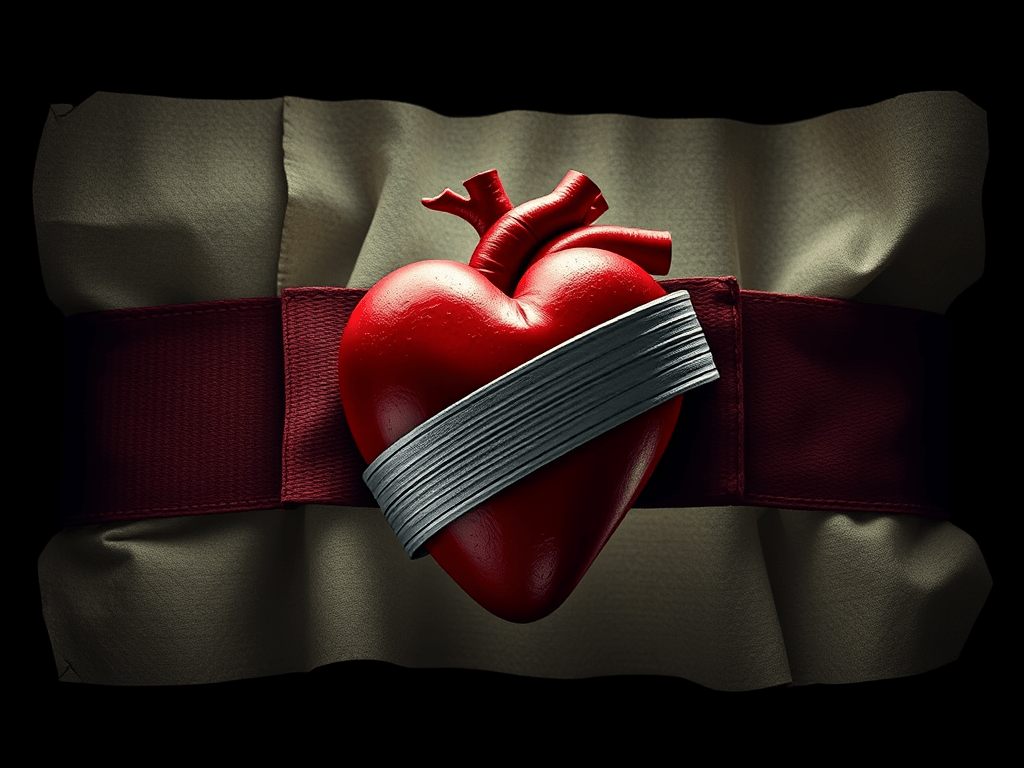
Wrap the strap around the limb a couple inches closer to the heart. Pull hard on the strap. Insert the windlass and twist. Keep twisting until the spurts stop. Note the time. Mark the patient’s forehead ‘TK’. Tell the medics the time the tourniquet was applied immediately on arrival.
This article is part of my sub‑series on my own tools. As you can guess, this one isn’t about craftsmanship or preparation; this one is less drafting table or hammer, and more psychological tourniquet. Even less than usual, I make no promise that this read will be a light one. Or that it’ll have a happy ending. Instead, as always, I offer truth.
This one may not resonate with everyone. It’s not designed to. You don’t need my permission to skip this one, in whole or in part, but… even if your wounds are not the same, the tools may still serve.
In The Cartographer’s Curse I told you how I look at the world, picking out pieces to reconstruct the pattern. In The Silence and the Strike I described how I choose my stance on a topic, ensuring that my foundation is steady before acting. In The Mirror and the Pattern I spoke about how the perpetrator is rarely the root of the problem, and more often a scapegoat for the system that put them there. Those are a lens, a ruler, a periscope. This isn’t.
This isn’t a toolkit. It’s triage. If you’ve made it this far in the series, you already know how to see clearly, how to choose your position, and how to stand firm. This article is what happens when clarity doesn’t save you. When judgment costs you. When the mental bleeding won’t stop, and the work has to continue anyway.
It’s not advice. It’s what’s left when the advice fails. When the empathy you want to inspire in the world demands its due.
~Dom
Hemorrhage — The First Cut Is Personal
They say ignorance is bliss. But they’ve forgotten the rest of the sentence.
Ignorance is bliss because understanding is death. Not literal death, but the death of safety, of the comforting illusion that the world is fair, that effort equals outcome, that harm is the exception and not the rule.
For me, the most relevant recent example is finding out that my mother had cheated on her wife, taking a cruise with a man and leaving her behind. That one act should have been enough. But it wasn’t. It rippled through my memories like a bridge collapsing into a lake.
I’d seen it—even taken her side—in situations that now seemed similar. With her previous wife. With other family members. With my own father. It wasn’t until I drew the boundary I could no longer cross—quietly, but irrevocably: this, I will not condone—that the other stories drifted in like smoke under the door of a burning house. Flowers received at work from someone else while my father worked swing shift. I remembered the stories. The way victimhood became a performance. How it made the rest of us walk on eggshells.
I thought I understood who she was. I thought I had context. But context is just a more elegant form of denial when you’re standing in front of a pattern you’ve spent most of your life justifying.
When I finally cut the cord—no dramatics, just a quiet choice to support the victim—the stories came. Like rot surfacing through drywall. Years of lies, laced into my memories. It wasn’t one betrayal. It was a curriculum.
Contagion — Rot Through the Walls
Not all examples must be personal. Many know the public version of this psychic laceration. Anyone who has read the diary of Anne Frank, studied the memorials at Auschwitz, heard the stories of survivors of the Rwandan genocide… then watched the leaders of a nation call people wearing swastikas “good people.” Watched the same “vermin” language that lubricated the Holocaust become the “immigrants eating pets” throughout political rhetoric. Watched the country they volunteered to serve discard soldiers because they were born in a body that felt like a misshapen cage for the soul.
What you learn, eventually, is that history doesn’t repeat itself because people forget. It repeats because people remember selectively. Because repetition profits someone.
Genocide doesn’t begin with hate. It begins with tolerating the first lie because it’s too awkward to argue at dinner.
Sometimes it’s not even rhetoric. Sometimes it’s a shrug. A neighbor saying, “That’s just how things are.”
Shock — The Death of Refuge
Once you understand—truly understand—that some systems have always been rigged in someone else’s favor, kindness can be treated like weakness, and cruelty can be policy, something in you dies.
Not innocence, exactly. Something older. Deeper. The belief that you are safe if you just do what you’ve always been told was right.
Understanding doesn’t merely widen your field of vision; it’s a controlled detonation of the walls you mistook for shelter. Your muscles learn the lesson first—jaw clenched, shoulders high, sleep fractured into tactical naps. Coffee becomes camouflage. A laugh in the next room sounds like a breach—too sudden, too bright, like joy has forgotten to check for casualties.
Instinct bargains: work harder, be nicer, recite the rules twice over—anything to coax the floorboards back into place. Shock is discovering the game was rigged before you drew breath, and the dealer is still smiling.
What follows is often retreat. Some dive into workload, some into prayer, some into the soft static of a screen. But the doorway to refuge locks from the outside. The myths demand your complicity; the moment you name the lie, they exile you.
Exile issues its own paperwork: grief for the self who believed, rage at the institutions that prospered on that ignorance, and an echoing vacancy where naïveté once padded the nerves. You carry these stamps across your posture—visible only to those who crossed the same border.
Shock, then, is not a moment. It’s a new climate, thin‑aired and bracing, where you learn to breathe without illusions. Only after the lungs adjust does movement resume—and even then, every step begins in caution, calibrated for cracks no one else acknowledges.
Bearing Load — Carrying What Was Not Yours
There are days when I carry things that were never mine to hold.
A sentence overheard. A statistic I can’t forget. A moment in someone else’s life that tears open something in mine. And while the people around me laugh, scroll, or pray it away, I sit still—dissecting, reframing, anchoring.
I’ve felt the universe tremble around me in visceral outrage at the wrongful death of men I’ve never known, shed tears over the treatment of people I never served with… and some I have. I’ve mourned loved ones silently, from a distance, because I thought they deserved to be remembered not by their decline, but by the strength they once embodied after years of effort—capable, clear‑eyed, and whole.
Through it all, stillness. Normally that of a river, but when times get hard, the surface locks in place with icy control.
That stillness is not peace. It’s containment. I’ve broken that stillness. Once. Maybe twice. It wasn’t loud. It was worse. I was articulate, ice‑cold, unblinking. And I watched someone I loved look back at me with fear.
That’s when I understood: stillness isn’t just survival. It’s the firewall between grief and cruelty. And it terrified me. Not their fear—but how justified it was.
Eventually, you realize strength alone isn’t enough. You need structure. Not just for yourself—but to ensure the damage doesn’t spread.
Splints and Tourniquets—Philosophy Under Pressure
I lean on philosophy because without a structure to anchor my thoughts, I’d break. Maybe not in a way that leads to a diagnosis, a prescription, or mandatory counseling, but perhaps I’d give up, finally acquiescing to the whispers of pop culture about how it’s not so bad, really. I’ve seen it in my own family—the still-alive, but not quite living that fills the gap left in a man’s life when he loses the family and home he built.
That’s why I study moral philosophy. Not to sound impressive at dinner parties—I don’t attend them. Not to build some ivory tower of detached intellect. But because I need a structure that won’t collapse under pressure.
Marcus Aurelius bore the fate of an empire. And still, he wrote to himself—not as emperor, but as man. “You have power over your mind—not outside events. Realize this, and you will find strength.” He wasn’t writing that to inspire us. He was writing it because it was the only way he could get through the day.
How can the thoughts of a writer weigh as heavily as the fate of an empire? They shouldn’t. But when you understand systems, cycles, violence, and indifference… when you see their traces in every conversation and ripple in every silence… the weight doesn’t scale with your role. It scales with your sight.
A passing comment can haunt you like a prophecy. A loved one’s apathy can echo louder than a riot. A single act of restraint—of choosing not to scream when every part of you wants to—can be more exhausting than a full day’s labor.
So I reach for tools. I build frameworks. Not to escape the weight, but to carry it.
I don’t lean on philosophy because I’m wise—I lean on it because I’d break without it. Stoicism isn’t a shield. It’s a splint. Kantian ethics aren’t lofty—they’re the only rules I’ve found that don’t buckle under betrayal.
“Act only according to that maxim whereby you can at the same time will that it should become a universal law.” Not because the world will honor it, but because you must. Because without that principle, the slow erosion of your empathy and integrity becomes inevitable.
Isolation — The High Cost of Sight
Not every day feels this heavy. But the weight never really leaves. It just shifts. And you learn to move differently.
Understanding isolates. Not because others are cruel, but because they are comfortable. The more you see, the more alone you become. The more you notice, the more silent you must be.
The great joke is that nothing about you looks different. You still show up on time, answer messages, laugh when the timing calls for it. But inside, the ground rules have changed. Small talk is a foreign language; every sentence you could say is freighted with caveats and footnotes. So you keep it sealed. People congratulate your calm without realizing they’re praising a blast door.
Conversations turn into minefields. Someone mentions “both sides” and you feel the click under your boot—knowing a single corrective word could level the room. You smile, shift your weight, and step off, leaving the pressure unexploded. Precision disguised as politeness.
Isolation is expensive. Friendship thins to quarterly check‑ins; socializing becomes translation work you’re too tired to perform. Even pleasure mutates—books become autopsies, news a catalog of preventable wounds. You start grading art on how gently it places its truths.
Physically, the toll accrues: jaw like rebar, breath caught high in the chest, sleep patrolled by half‑remembered statistics. You ration empathy the way field medics ration morphine—enough to keep going, never enough to run dry. Never spent where Motrin will suffice.
And still, the silence is choice. A discipline. You hold it because revelation without remedy is cruelty, and you refuse to weaponize what you know. The world has enough tragedy, and too few trying to help avoid it. There is no medal for that restraint, but there is a cost for breaking it—the happiness of those closest to you.
Yet nothing built for pressure lasts forever. Hairline fractures appear: a snapped patience in the grocery line, a too‑sharp reply to an innocent question. That’s the warning light—framework fatigue. Ignore it too long, and you’ll realize too late—you’ve been walking on broken beams. When the edges of containment start to curl, you either reinforce the structure or watch it collapse.
Only then does the pulse of some distant cadence reach you—faint, but steady. It promises a rhythm you can step back into, if you can just make it through the breach.
Return of Rhythm—Structure as Survival
This isn’t a call to arms. I’m not asking anyone to wake up or seek to see the things I write about. That choice is personal. Quiet. Irreversible. And if you’ve read this far, chances are you already carry the weight I’m naming.
It’s a manual. For those of us who learned—too early or too often—that clarity has a cost, and that endurance is a form of resistance.
I’m not offering solutions. I’m naming tools. Because structure isn’t just a comfort; it’s a lifeline. And when the bleeding starts—metaphorical or otherwise—you don’t reach for comfort. You reach for what works.
I don’t hold these thoughts because I am wise. I hold them because without them, I couldn’t move. Because sometimes survival isn’t about strength, or resolve, or righteousness—it’s about scaffolding. A framework that can hold shape when nothing else will.
Philosophy isn’t armor. It’s what keeps you upright when the hit already landed. A habit of return. A framework that turns the obstacle into movement when the path is worth traveling, a reminder that morality and ethics aren’t situationally negotiable—they’re universal. A reminder that your way through life is defined by your choices—not just the loud ones. All of them. A structure that speaks back to despair—not with platitudes, but with presence.
And I guess that’s what this is. Presence.
If you’re reading this and nodding in silence—this page is yours. Not because it fixes anything. But because it proves you’re not the only one still standing. Still noticing. Still choosing the difficult path on purpose.
The tourniquet is a brutal tool. No one romanticizes it. It’s ugly. It hurts. But in the moment it matters most, it doesn’t need to be pretty. It needs to be ready.
And when it is—when you’ve trained enough to use it calmly, when you recognize the signs before collapse—it stops the bleed. It saves the limb. It keeps the story going.
That’s what structure is. What philosophy can be.
Not salvation. But return.
Not clarity without pain—but movement despite it.
Still breathing. Still walking.
Still able to love, and be loved, even when the lights flicker.
Because the world needs those who see. Who search. Who steady themselves on principle. Who shift the system—even if just by a fraction. Enough to change its course.




Leave a comment