
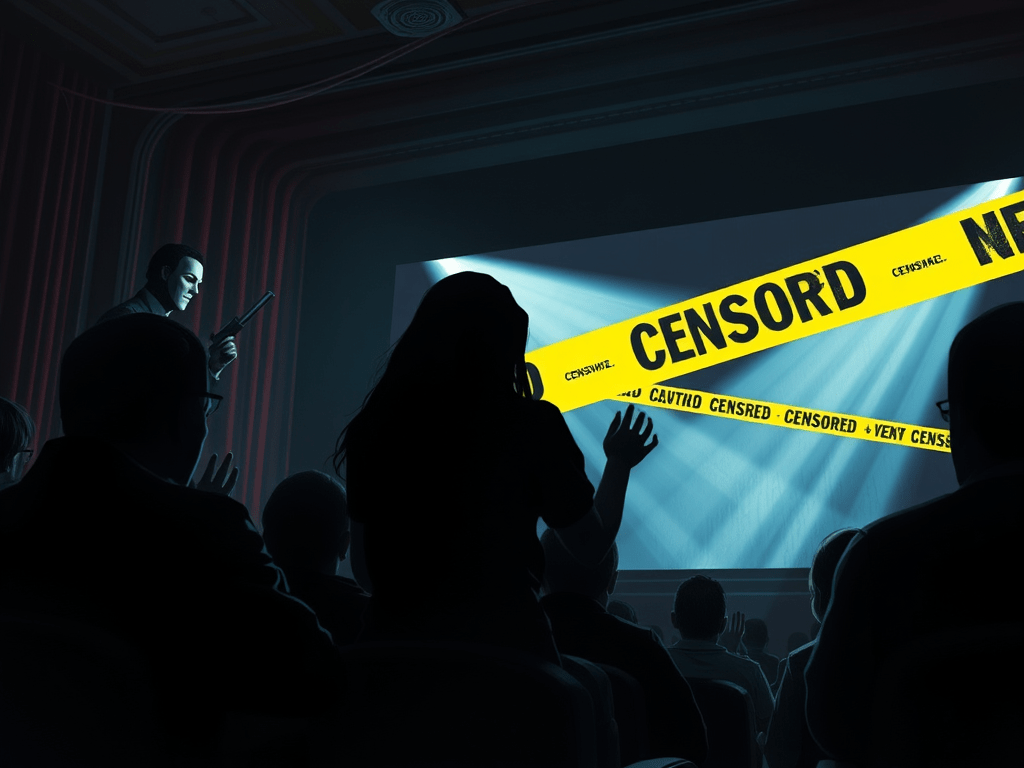
Note from the author:
I’ll admit, the featured image doesn’t quite capture the full weight of what follows—but let’s be honest, anything that did would probably stir up a whole different kind of trouble.
We’re here for the discourse, not the shock value.
~Dom
Imagine a new horror film that promises all the macabre fun fans crave: think Scream for a modern audience. There’s a masked killer stalking teenage victims through empty hallways and shadowy basements. Tension skyrockets as footsteps creak behind locked doors, the camera lingers on each quivering breath, and chase scenes lead to inevitable bloodshed. It’s brutal, it’s explicit, and it’s undeniably entertaining for those who love the genre. The protagonists are as attractive as they are resourceful; in the end, the survivors outwit the killer. Horror fans walk away satisfied, critics roll their eyes at its reliance on tropes, and the box office happily counts the receipts—until a disgruntled parent files a complaint.
Interestingly, this complaint has nothing to do with the multiple stabbings that saturate the screen in dark red, nor with the all-too-real depiction of an intruder smashing through suburban safety. It’s not about the psychological terror or the disturbing sense of violation caused by home invasion. Instead, it’s aimed at a few accidental frames depicting a female character’s exposed breast. One brief moment—perhaps a fraction of a second in an otherwise splatter-filled film—sparks outrage. The rumors swirl of an “indecent” shot, a moral blemish tarnishing the entire production. The film suddenly faces a stricter rating, slashed marketing support, and a shortened run in theaters. A debate erupts: Why would a single, momentary glimpse of a woman’s nipple be deemed more harmful or morally corrupting than watching that same woman’s gruesome on-screen death?
Of course, some chalk it up to another “Karen” losing her mind over “inappropriate content,” while others join the outcry, brandishing statements about preserving community standards. The result? The film that once carried an R rating is reclassified as “Adults Only,” prompting certain theaters to remove it from their listings. The producers and fans are left reeling in confusion. If you didn’t laugh at the absurdity, you might cry in frustration. After all, isn’t it bizarre that a naked breast—something half the population possesses—should trigger more censorship than a series of graphic murders?
That question, in itself, uncovers a deep cultural sickness, one that reeks of hypocrisy. In a society that claims to value the sanctity of life, it’s telling how swiftly we look away from violence while wagging our collective finger at sex, nudity, and the human body. It’s a bizarre tightrope to walk, to insist that blood and gore belong in a teenager’s late-night movie lineup, but a nipple belongs under lock and key. And so we begin, with a jarring truth: in the realm of public outrage and moral policing, the line between “acceptable” and “obscene” is drawn not by ethics but by discomfort, taboo, and a well-worn fear of the naked flesh.
“Everything in the world is about sex except sex. Sex is about power.”
– Oscar Wilde
Recommended Listening:
The Concept of Obscenity
To understand this twisted dynamic, we have to grapple with the idea of obscenity itself. At its core, obscenity is supposed to describe material that offends the prevalent sexual morality of the time—and yet, it’s never been quite that simple. Historically, the term is slippery, subjective, and perpetually molded to serve those in power. The ancient Romans had laws governing “obscene” acts on stage; medieval religious authorities would brand certain images and texts as heretical or obscene to keep order within their flocks. Over centuries, societies of every shape and structure have stoked fear around anything deemed “impure” or “unholy,” all in the name of preserving certain moral codes.
But moral codes are fluid, shaped by cultural, political, and religious contexts. In Turkey, for instance, the legal system has provisions where films or expressions considered to be encouraging obscenity can be heavily penalized. Meanwhile, in the United States, the Federal Communications Commission has its own guidelines that famously pounce on “wardrobe malfunctions” during live broadcasts. Entire congressional panels are convened if a pop star’s costume slips for a half-second on primetime TV. At the same time, though, you can watch a cop show featuring a half-dozen criminals shot down in cold blood without an eyebrow raised.
Dig deeper, and you’ll find legal definitions that hinge on phrases like “prurient interest,” “community standards,” and “lack of serious value.” That last phrase—lack of serious value—gives ample room for subjectivity. Whose standards? Whose value? Even film ratings reflect these murky waters: violence often seems to slide by with a PG-13 rating as long as there isn’t too much blood, but frontal nudity almost always demands a bump up to R or beyond. We’re dealing with unwritten laws about what’s “dangerous” to society, what’s “corrupting” to youth—and it all points to a bizarre equation that frequently lumps sexual expression under the label of moral crisis while letting violence pass as standard entertainment.
The result is a longstanding pattern of moralistic hand-wringing over body parts and sexual acts, even as the same gatekeepers turn a blind eye—or perhaps even profit from—scenes of death, torture, and brutality. We collectively accept that seeing someone’s head blown off is mere spectacle, but a brief glimpse of naked flesh must be a moral contamination. If our definitions of obscenity truly aim to protect innocence, then the lines drawn by these definitions end up painting a very hypocritical picture of what our culture deems normal.
Cultural Priorities – Sex vs. Violence
This discrepancy finds its clearest stage in Western pop culture. Tune in to any late-night TV lineup, and you’ll witness a cavalcade of gunfights, stabbings, explosions, and corpses. A single episode of certain primetime dramas can tally a higher body count than entire family trees. Yet, try to air a single shot of a woman’s breast—an anatomically ordinary body part—and you risk being fined, censored, or at the very least chastised by a chorus of outraged voices.
Consider how normalized violence is. Ultimate Fighting Championship (UFC) matches, for example, display two individuals in a cage, beating each other bloody. This is not only legal but widely celebrated. Bars host watch parties, and entire families might cheer for their favorite fighters. Meanwhile, on the same day, a social media platform might take down a photograph of a woman breastfeeding her child because it’s considered “inappropriate” or “sexual content.” Think about that for a second: publicly adored cage fights between consenting adults are fine, while a mother providing nourishment to her baby faces digital censorship.
This cultural priority extends to how we shame sex workers, especially women who use platforms like OnlyFans to make a living. Their choice to capitalize on nudity or sexual content is swiftly judged as morally decrepit. They are told they’re “asking for trouble,” or demeaning themselves for money. Meanwhile, very few people apply the same condemnation toward corporations profiting from bombs, ammunition, or private prisons. A woman who sells photos of her body online is ironically considered more scandalous than a company manufacturing firearms used in real-world acts of violence.
These contrasts underscore the dissonance between what we claim to be outraged about and what we actively ignore. We say we want to protect children from the “harmful effects” of sexual content, but we’ll simultaneously line up to watch big-budget films that glorify warfare and
mass carnage. Yet we panic when that same child might catch a glimpse of a breast. That, in a nutshell, is the twisted paradox at the heart of our modern psyche: we treat violence as normal background noise but treat nudity—or female sexuality in particular—as a moral crisis. The end result is a society that’s deeply uncomfortable with bodies but at ease with bloodshed.
Power and Control – Who Benefits from Defining ‘Obscene’?
To unravel this paradox, we have to examine who actually gains from labeling certain things as obscene. On the surface, it might appear to be about morality or protecting children, but dig further, and you’ll often find it’s about control. Historically, moral and cultural norms have been policed by institutions that benefit from setting rigid boundaries on what’s acceptable. Religious bodies, governments, and major media conglomerates all have a vested interest in dictating how we perceive and talk about sex and nudity. By painting them as taboo, these institutions maintain a sort of cultural gatekeeping: they decide which bodies can be displayed, in what context, and to what extent.
When you sexualize and then demonize female bodies, you lay the groundwork for a culture that both fetishizes and punishes women. A perfect example is the phenomenon of slut-shaming: while advertisements and entertainment industries openly capitalize on hypersexualized images of women, the second a woman claims ownership of her body—by dressing a certain way, modeling on certain platforms, or simply breastfeeding in public—she’s condemned for her so-called immodesty. This double standard ensures that societal power structures remain intact: those who benefit from female objectification (such as certain industries) are free to do so, while women who claim autonomy face condemnation or legal barriers.
As I wrote in Slutty When She Says It, female sexuality becomes obscene not when it’s displayed—but when it’s owned. The moment a woman claims authorship over her body, her narrative, her exposure, the system recoils—not because of what’s shown, but because of who controls the frame.
The notion of obscenity thus becomes a convenient tool. It’s wielded to keep certain narratives in check: sex is policed and pathologized, while violence is trivialized or hailed as heroic. Consider how mainstream media packages war footage as something courageous, often sanitizing the bloodshed, but censors images that might display the raw horror of combat—particularly anything sexual or emotionally raw that might spark too much empathy. If our culture truly reckoned with the personal, bodily impact of violence, if we saw war not as a film set but as a brutal, body-shredding event, public opinion might shift dramatically. But as long as we remain desensitized to the actual bloodshed and remain hyper-focused on a fleeting glimpse of a bare breast, powerful entities can justify their agendas with minimal public outcry.
The Absurdity of Exposure
We circle back to the question, the one that rattled us from the start: why is a body part considered obscene when violence isn’t? It’s not just about squeamishness; there’s something deeper at play. Our collective comfort with brutal imagery—and our collective discomfort with nudity—reveals our skewed relationship with the human form. Where once the naked body might have been celebrated as a symbol of fertility, health, or art (think ancient Greek sculptures or Renaissance paintings), modern sensibilities often reduce it to something shameful or pornographic, especially if it’s a female body outside the context of male desire.
If you consider the human body as something natural, it stops being inherently obscene. Nudity is just that—nudity. We all come into this world exposed, and for a great deal of human history, that wasn’t a scandal. The taboo we’ve erected around the female form in particular is tied to centuries of patriarchal norms, religious doctrines, and cultural taboos that insisted on covering the feminine to maintain a kind of social order. The breast is one of the most paradoxical examples: it is both sexualized and policed, revered in private fantasies but reviled if shown in a public, non-sexual context like breastfeeding.
Yet, dismemberment, mutilation, and torture, when mediated by screens or justified by some narrative of heroism or necessity, arouse only moderate concern. Perhaps one reason is that moral panic shifts responsibility. With nudity, we blame the individual for “choosing to display themselves.” With violence, we blame the villain in the story, not the depiction of violence itself. And so we learn to see violence as a narrative device or spectacle rather than something that challenges our moral frameworks. This pattern allows us to keep the show on the road—to relish gore as cinematic entertainment while continuing to punish and shame the bodies we see as deviant or “too exposed.”
If nudity, especially female nudity, threatened no one, why are we so ready to treat it as a social pollutant? Ultimately, we fear the freedom it represents—an autonomy of the self, a reclamation of sexuality, a refusal to be confined by cultural norms. The real offense isn’t the body; it’s the threat of that body existing on its own terms. Hence, it’s policed, hidden, punished, and labeled obscene, while violence gets a pass as “just the way the world is.” There’s an unspoken consensus that tolerating violence is more socially acceptable than tolerating a woman’s independence and agency over her own body.
Final Note – The Real Obscenity
When we zoom out, what’s truly obscene is how we’ve normalized bloodletting while stigmatizing something as universal as the human form. We accept the nightly parade of violence on our screens, in our news cycles, and on our social feeds, then pretend that a single nipple or sex-positive expression could corrupt the youth. Meanwhile, children are born into a world where active shooter drills are a fact of life in schools—an unsettling reality that too many of us seem numb to. We talk about safeguarding innocence, yet we’ve let the baseline for terror become alarmingly high.
Ultimately, it’s not just about the hypocrisy; it’s about the kind of world we’re shaping. If we taught kids that a naked body is natural—and that violence is the real horror—maybe we’d raise generations who see conflict as an aberration rather than entertainment. Perhaps we’d have fewer children growing up to internalize shame about their bodies and more adults willing to stand against harm. Maybe the next time a horror flick hits the big screen, we’d debate its gruesome glorification of violence more than whether someone flashed a bit too much skin. And perhaps we’d have fewer real horrors to confront in our neighborhoods and schools because we’d be less tolerant of violence in any form.
A naked breast in a slasher film is not what’s destroying societal fabric. Our collective apathy toward suffering—our readiness to accept brutality as standard viewing—does far more damage. But our culture doesn’t like to hear that. It’s easier to rally around moral outrage over a “wardrobe malfunction” than to grapple with systemic violence or the global arms trade. It’s simpler to point a finger at an OnlyFans model than to confront the twisted morality that lets corporate or government machinery churn out instruments of death, then calls it “job creation.”
Calling out this hypocrisy doesn’t mean we should glorify sex in all contexts or dismiss genuine concerns about explicit content. It does mean we need to break the cycle of equating nudity with depravity while glorifying brutality as entertainment. We can do better, but only if we dare to see clearly: it’s not the bare breast on the screen that’s obscene; it’s the normalization of lives being snuffed out, fictional or otherwise, to the cheers of an audience. Our real obscenity is a stubborn refusal to confront what violence does to humanity.
So the next time you spot someone clutching their pearls over a “wardrobe slip,” ask them which is more obscene: the fleeting image of a naked human body, or a culture so habituated to bloodshed that we treat violence as trivial? That question might just jolt us out of our collective stupor—if only for a moment—and force us to reconcile the moral duplicity we’ve happily ignored. Because until we do, we’ll keep living in a world where a woman’s nipple—barely on screen for a blink—can spark more outrage than the systematic portrayal and acceptance of her violent end. And that, in itself, is the greatest horror story of all.
So… Tell me – which is more obscene? The body some of us are born with, or the violence we’ve come to celebrate?
P.S. – If you want more of my thoughts on how society polices, censors, and contorts female sexuality — especially when women dare to claim it on their own terms — check out “Slutty when she says it”. Same general angle, different spotlight.








Leave a comment