
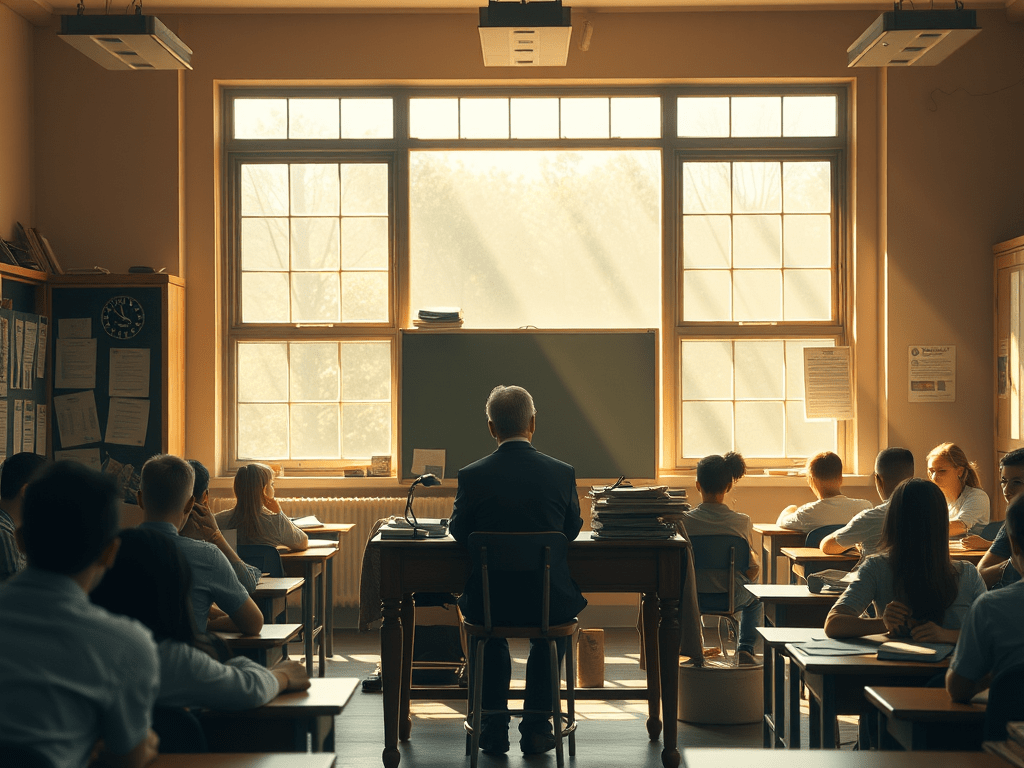
Author’s Note — To the Real Teachers Who May Read This:
I know what follows may feel unfair.
It doesn’t speak to the handful of students whose lives were genuinely changed by a concept that opened their minds. It doesn’t acknowledge how any education at all can be better than none — or the joy of seeing a family’s first graduate walk across the stage. It doesn’t celebrate the spirit of the work you chose to do, even though it’s long been known that teaching, in a very literal sense, hardly pays.
There are teachers who make a real difference — and every one I’ve known dreamed of doing so, even just once. But there are many more who no longer hold that dream, having sacrificed it on the altar of responsibility, funding requirements, bills, survival.
I’ll never forget my high school psychology teacher: how he discussed ideas while grading papers over lunch, letting a few of us practice guitar and bass in the corner of his room. He encouraged debate, demanded that we ask why something was accepted — and I’ll always respect him for it. But he was the exception, not the rule.
Most teachers seem to begin with the best of intentions. But they too are eventually worn down, reshaped to fit the system they were meant to elevate. I see that. I see you.
So if you’re still out there — craving those rare moments to spark something real, to reach someone who needs it — thank you. The world needs you more than ever. And though the sacrifices you make by staying present, engaged, and hopeful may be overwhelmingly undervalued, they are vital to any hope of progress.
~Dom
I used to hear stories about classrooms the way some people talk about enchanted gardens — places where insight blooms and curiosity runs wild. Teachers, we were told, opened doors for our imaginations. Textbooks promised everything from the secrets of ancient civilizations to the mysteries of quantum physics. If you listened long enough, you’d believe school was the grandest stage for a mind to blossom.
That was the myth — the “Lie of Learning.” I call it that because the reality turned out to be far more mundane, and at times downright bleak. For most children, school is about learning to toe the line, quite literally. Line up here, wait for the bell there, fill in the right bubbles, don’t ask too many of the wrong questions. Meanwhile, test scores are touted as the grand measure of a student’s “intelligence,” even though what they mostly measure is how calmly one can regurgitate a narrow slice of content under time pressure.
I remember the day the illusion cracked for me: my question to the teacher was genuine, driven by curiosity that lit up my entire brain, but it was dismissed as a “waste of class time.” After class, the teacher—busy, overworked, genuinely sympathetic—admitted there was no space in the curriculum for tangents. “I’m sorry,” she said, “but we have to stick to the plan.” In that moment, I understood the unspoken rules. The system we all grew up admiring had less to do with discovery and more to do with sticking to someone else’s checklist. That realization didn’t just break my heart; it provoked a quiet anger I’ve never quite shaken.
Recommended Listening:
The Blueprint of Obedience
When you step back and observe, the school day is almost militaristic in its structure: regimented schedules, shrieking bells, rows of desks lined up like factory stations. Permission slips for bathrooms and hall passes for the hallway. Strict rubrics, standard lessons, regimented steps. At first glance, it seems benign, even necessary: how else do you keep order among a few dozen students?
But the deeper question is: Is order the real goal? Historically, this design isn’t a random set of choices. Critics like John Taylor Gatto and Ivan Illich pointed out that mass schooling was deeply influenced by 19th-century industrial models. Factories needed a workforce that arrived on time, obeyed signals, and produced consistent output. Schools, in turn, were patterned to instill these habits early on. The bells you hear in hallways? They’re the echoes of an industrial era, ringing to condition children for shift work.
Of course, not every teacher sets out to crush curiosity, and not every administrator is a covert disciple of industrial control. Most are conscientious people doing the best they can within a behemoth that prioritizes efficiency over exploration. Still, the architecture stands. It trains children to see knowledge as something doled out in tidy packages. Look but don’t stray. Question, but only within the bounds of the curriculum. This system, with its tidy rows and fixed schedules, starts to reveal its deeper intent: to produce people who can handle monotonous tasks without rebelling.
If genuine education were the primary aim, we’d see flexibility, we’d see project-based exploration. We’d see questions welcomed, not relegated to the final five minutes of class or strictly bound to the text of the lesson plan. Instead, we see the architecture of obedience. And it runs so deep that many of us can barely envision another way.
Scantrons and Shackles
Nothing crystallizes this culture of controlled learning more than standardized tests. They’ve become the holy grail of modern schooling: entire curricula revolve around acing them, districts receive funding based on them, and teachers’ futures can hinge on how well their students fill in bubbles. The premise seems logical enough: Let’s measure academic performance uniformly, so nobody slips through the cracks.
Yet it doesn’t take much to see the cracks in that logic. Tests rarely assess real-world critical thinking; they’re mostly about how well a student can memorize information and maintain composure under artificial constraints. Paulo Freire, in his “banking concept of education,” argued that simply depositing information into students and then withdrawing it via tests was no path to true understanding. Real learning requires dialogue, questioning, and a willingness to grapple with ambiguity. Standardized tests have no room for ambiguity. They want the single correct answer, chosen from a handful of carefully scripted options.
Worse, entire school years can be consumed by test prep — practice exams, drilling, endless reviews of the same limited material. Students learn to associate achievement with not stepping out of line, not thinking outside the box, and not challenging the premise of the question itself. It’s one giant exercise in brand management: if the school’s “numbers” look good, the system is supposedly a success. But what does success look like in the real world? Employees and citizens who can adapt, create, and question are far more valuable than those who can just fill in a bubble. Yet the test, ironically, becomes the ends rather than the means.
We end up with bright kids who know how to pass tests but can’t connect ideas across subjects or entertain opposing viewpoints. The tragedy isn’t that they lack aptitude; it’s that they’ve been taught to see knowledge as an inert commodity. Fill in the bubble, move on. No wonder curiosity starts to wither by the time they reach adulthood.
The Private School Escape Hatch
All of this might be more tolerable if we were truly “in this together.” But there’s a twist that’s hard to ignore: the very people who shape these standard-driven policies often send their own children to private schools that operate under an entirely different paradigm. Smaller classes, flexible curricula, access to arts and extracurriculars that public schools often can’t afford — it’s a radically more nurturing environment. In these private settings, critical thinking, open discussions, and creative risk-taking are encouraged because resources aren’t strangled by the standardized test demands.
I remember being stunned when I heard about a friend’s private high school. Students lounged in beanbags discussing literature, the teacher facilitating or challenging rather than dictating. They had time for debate, for cross-pollinating ideas between literature and philosophy, math and science; history, even taught as a current understanding rather than static fact. Meanwhile, back in my public school? We had to ask permission to use the restroom. And ‘advanced’ usually meant more homework, not deeper exploration. To call the difference stark is an understatement.
There’s a reason the children of politicians and education reformers rarely see the inside of a public-school test-prep room. They know how limiting that environment can be and opt out. It’s not just resources. It’s philosophy.
One system trains the masses to follow; the other trains the few to lead, and if that feels like an indictment of our values, that’s because it is.
The Purpose Beneath It All
So why does the public system remain this way if so many people realize how counterproductive it can be? Ask John Dewey, who once said democracy requires an informed and critically minded citizenry. The flipside is equally true: an obedient electorate is far more convenient for those in power. Well-structured mass education, with its tests, schedules, and hierarchical environment, ensures the majority learns to cooperate with minimal resistance.
The cogs of society need employees who will show up, do their tasks, and obey authority. They need consumers who obey trends without asking why. By focusing on rote memorization and compliance, schools effectively sort children into “productive” lanes. Those who excel in test-taking become tomorrow’s knowledge workers, often continuing the cycle without challenging its deeper flaws. Those who rebel or don’t fit find themselves sidelined, never fully engaging with what genuine education could be.
Some might argue this is all an accidental byproduct of a big, unwieldy system. But consider how consistently it’s replicated across districts and decades. The sense of design is hard to ignore. Critics like Illich pointed out that any institution, once it becomes large enough, usually serves its own perpetuation first. Public education is no different. It’s not merely about shaping minds for good; it’s also about maintaining the status quo. And it does so with remarkable efficiency.
When the Outcome Is Intentional
Fast-forward to adulthood, and we see the aftermath. We have entire generations who can recite states and capitals but lack the capacity to parse nuanced arguments. We see voting patterns swayed by slogans rather than informed debate. We see misinformation running rampant online, easily shared by those who never learned how to critically evaluate sources. It’s easy to call it a tragedy of incompetence, but that glosses over how systematically this outcome aligns with maintaining control.
If you raise citizens who aren’t comfortable questioning authority, you reduce friction in governance and commerce. If you produce employees who can follow instructions and not probe too deeply into policies or motives, corporate life hums along with fewer disruptions. This “trained ignorance,” as some educators put it, is the perfect breeding ground for passive acceptance. People aren’t even aware they’re being directed because they’ve never been taught to see beyond the illusions.
I wish I could say I learned my most significant intellectual lessons in the classroom. In truth, most of that learning happened outside official school walls — in late-night discussions, in reading authors and thinkers who contradicted the textbooks, in exploring ideas that the standardized curriculum never touched. School laid a foundation, yes, but it was a foundation built to keep me within a known blueprint. Only by stepping beyond its outlines did I realize how big the world of ideas could be.
The Hidden Curriculum
Here’s the chilling part: the system isn’t technically broken. It functions precisely as it was designed to function, producing predictable outputs and measured docility. And in many ways, we collectively choose to keep it running because it keeps society orderly. The kicker, of course, is that the wealthier you are, the more likely you’ll avoid the shackles of this uniformity. You’ll pay for smaller class sizes, progressive pedagogies, ample resources, and teachers who can cater to curiosity instead of simply preparing for the next exam.
That means everyone else — the vast majority — gets funneled through the factory, emerging with just enough skills to stay afloat but not enough to overturn the system. If that sounds haunting, that’s because it is. We’ve known since Dewey, Freire, and Gatto that an emancipatory education model is possible — an approach that values critical thinking, personal growth, real-world application, and collaborative learning. Yet the broader framework hasn’t budged much.
Which leaves us with uncomfortable questions: Did you know we could’ve done better? Did you ever suspect that the system’s failings were by design, rather than some unfortunate oversight? And if so, why didn’t we make those transformative changes?
I ask these questions not just as a critic but as someone who lived through the hidden curriculum — the subtext that taught me to wait for a bell, to respect instructions over intuition, to treat knowledge like a commodity. Escaping it took years, and I still feel echoes of that conditioning. The truly unsettling realization is that there is another path, and many have chosen it. They have money, power, and networks that shield them from the educational model they impose on everyone else.
Maybe it’s easier for them to sleep at night, thinking the system is “the best we can do.” But for those of us who’ve felt the sting of shallow lessons and stifled wonder, we know better. We know the gap between what’s promised and what’s delivered. We know the difference between producing obedience and fostering genuine intellect. And that knowledge alone can be a spark — if we let it be.
Because in the end, we can’t call the system broken. It’s working all too well. The question is whether we’re finally ready to break it ourselves and replace it with something that actually honors the mind and the spirit of every child who walks into a classroom. If that notion haunts you, good. It means there’s a part of you still alive to possibility. Let that part keep you awake. Let it ask harder questions. Let it demand answers that don’t fit neatly into standardized bubbles. Let it remember that we once believed school was about learning how to think — and it still could be, if we found the will to make it so.
If you’ve ever wondered why school felt smaller than your mind, now you know; instead of a gateway to new worlds of knowledge, it’s a tunnel to a predestined outcome. If you’ve ever felt something sacred dying as it was contorted into a multiple choice worksheet, now you know what was broken and made to fit.
The system isn’t broken — it’s functioning perfectly. Just not for us.
We were promised a key to the world. They gave us a hammer instead — perhaps its best use is to break down the walls of the tunnel that was never really a path to success.





Leave a comment