
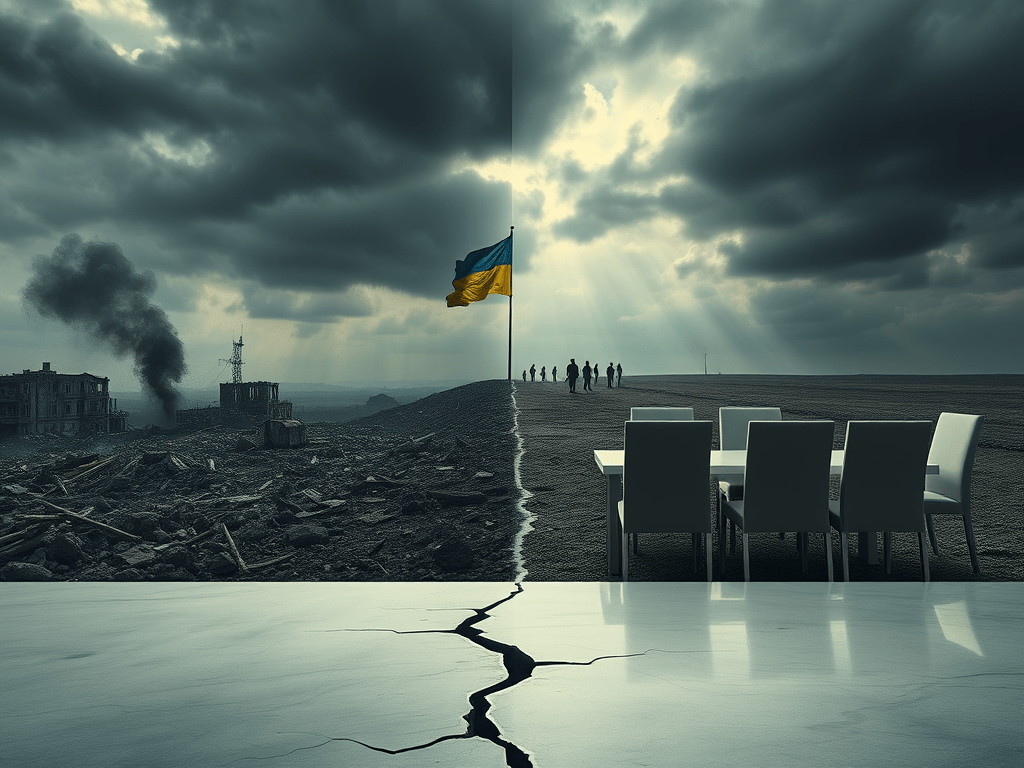
“The sad truth is that most evil is done by people who never make up their minds to be good or evil.”
— Hannah Arendt
The Comfort of Compromise
In 1938, British Prime Minister Neville Chamberlain returned from Munich triumphantly waving a piece of paper that promised “peace for our time.” The diplomatic agreement with Adolf Hitler was hailed by some as a triumph of rational compromise. Chamberlain himself believed that by staying above the fray—refusing to provoke Germany further and instead seeking “the middle ground”—he had averted catastrophe. What followed, however, was the rapid unraveling of that compromise and the onset of a war more devastating than anyone could have imagined. In hindsight, the so-called middle ground was not the birthplace of truth and peace; it was the breeding ground of disaster, granting the aggressor time and legitimacy to press onward with brutal designs.
There is a dangerous comfort in believing that truth always lives in the middle. That in any conflict, both sides are flawed, and the wise, moral response is to stay neutral—to listen calmly, weigh the grievances, and avoid taking a side. But not every war is a misunderstanding. Not every aggressor deserves a seat at the table. When one side chooses violence and the other chooses to survive it, splitting the difference doesn’t bring peace—it brings erosion. Of boundaries, of justice, of human lives. In the war between Russia and Ukraine, we are witnessing not just bombs and tanks, but the consequences of false balance. And we have to ask: what is the cost of pretending fairness where none exists?
This article explores that cost, peeling back the layers of a phenomenon often labeled “both-sides-ism” or “false equivalence.” We will look at how compromise can become toxic when one side systematically exploits it. We will consider how Ukraine’s fight sheds light on deeper ethical and philosophical truths about neutrality, aggression, and moral responsibility. Finally, we will ask what it really means to stand on the side of peace—and why, at times, true peace can only be forged by taking a decisive stand rather than seeking shelter in the safe illusions of the middle.
Recommended Listening:
The Strategy of Creeping Aggression
Human nature is drawn to compromise; it seems quintessentially rational and fair. If two people have a dispute, the civilized impulse is to guide them toward a mutually acceptable solution. Yet this impulse becomes deeply problematic when one party’s goal is not coexistence but conquest. Compromise in those scenarios is a strategic tool for the aggressor, not a step toward genuine peace. Consider the fictional (yet all-too-realistic) military concept: “We take your dirt.”
In this scenario, an aggressor finds small, seemingly inconsequential points of conflict and demands the other side concede them in the name of avoiding war. Each time the defenders yield “just a bit of ground,” hoping to preserve peace, the aggressor gains exactly what was requested. Over time, these micro-concessions accumulate until the aggressor holds an overwhelming advantage. By then, the defenders have lost not only territory but morale, having conceded for so long that they are forced to negotiate from a position of weakness.
This is the logic behind creeping aggression: to make constant, incremental gains that are small enough to avoid triggering a massive response, yet collectively significant enough to shift the landscape entirely. When these aggressions are met with the perpetual call to “meet in the middle,” there is a perverse victory for the side that advanced first. Eventually, the “middle” rests on new terrain—one forcibly taken from the other side.
In real-world contexts, the same principle manifests. Gerrymandering in politics can be seen as a bloodless form of territorial expansion, where electoral maps are carefully, incrementally re-drawn to bolster power for one faction. In the debate over abortion rights, concessions on medical accessibility and bodily autonomy may begin with seemingly small restrictions—waiting periods, certain parental notifications—and extend into sweeping limitations that gut fundamental freedoms. In each case, the pleas for moderation and compromise become stepping stones for creeping aggression. The supposed middle ground is never static; it migrates in lockstep with an unrelenting push.
Ukraine and the Costs of Principle
These dynamics become starkly evident in the Russia–Ukraine conflict. Since 2014, when Russia annexed Crimea, there have been relentless calls for Ukraine to negotiate, to concede territory, and to meet in the middle for the sake of peace. Yet the uncomfortable reality is that Russia’s position is far from moderate. Russia’s pattern of aggression—first covertly supporting separatists in Donbas, then openly invading in 2022—reveals an expansionist design that has little regard for Ukraine’s sovereignty.
It is not simply a matter of two equally matched rivals squabbling over disputed land. It is an aggressor forcing itself upon another nation, systematically dismantling its infrastructure, occupying its cities, and displacing its civilians. The story told so often by media outlets or foreign policymakers—of the two sides needing to “calm down” and find common ground—ignores the unambiguous fact that Russia moved into Ukraine, not the other way around.
Against this backdrop, calls for compromise often mask appeasement. When international actors press for negotiations that effectively reward Russia’s aggression, they cloak the move in moral ambiguity, as though the only rational stance is the diplomatic one. But if the aggressor retains the land it has taken by force, if it leaves behind shattered towns and millions of uprooted lives, then any “peace” codified in such negotiations is inherently unfair. It effectively condones the initial act of invasion. A ceasefire might pause the bloodshed, but it would also legitimize the land grabs.
Beyond the tangible loss of territory, one must consider the intangible costs to principle. If Ukraine is strong-armed into relinquishing large portions of its sovereignty, then the principle of national self-determination is eroded. The message sent to the global community is that might does indeed make right, and that a strategic calculus of who is more powerful or more influential takes precedence over moral or ethical considerations. This is the dangerously seductive outcome of false balance: it dilutes accountability and nurtures further acts of aggression. As the creeping strategy continues, the moral condemnation of invasion is overshadowed by a hollow, so-called “peace.”
The Lie of Equal Blame
Central to the myth of the middle ground is the insistence on equal blame. We see this phenomenon not just in wars between nations but also in domestic conflicts—be they social, political, or cultural. A classic tactic in public discourse is to claim that for every wrongdoing or inflammatory statement by one group, the other group is doing something equally problematic. This ensures a veneer of impartiality, which often resonates with observers who want to feel above the fray.
Yet when we apply scrutiny, this logic quickly collapses. “If a protester shatters a window in reaction to police brutality, and the media calls both actions equally ‘escalation,’ we’ve already lost the thread of justice. The superficial analysis lumps the protester’s act of property destruction into the same moral category as police brutality that claims human lives. The call for “both sides to calm down” fails to account for the deeper power structures at work—structures that place the protester in a position of reaction, and the system in a position of authority.
In Ukraine, the reality is similarly stark. A single missile launched at a Ukrainian apartment complex is not balanced by accusations that Ukraine has occasionally targeted military sites in Russian-held territories. One side is on the defensive, seeking to reclaim its internationally recognized borders; the other side is on the offensive, claiming it has the right to reshape the map to its advantage. Yet the media’s yearning for even-handed coverage often leads to headlines that read: “Both Sides Accused of Escalating Tensions.” The moral imbalance vanishes under the flattening label of “hostilities,” implying an equal measure of aggression, as though both parties share the same ambitions and responsibilities.
This is not to say that Ukraine or any defending entity is incapable of wrongdoing. Humans are flawed, and wars inevitably produce actions and responses open to criticism. But equivalence is a distortion when it forgets where aggression originated, who violated sovereignty first, and who stands to benefit from indefinite “negotiations” that leave them in possession of someone else’s land. False balance thrives on these oversimplifications. It shifts focus from the initial violation to a superficial sense of “ongoing conflict,” absolving the aggressor of accountability and casting blame equally.
Real Neutrality vs. Moral Cowardice
The question then arises: what does neutrality actually look like in situations of blatant aggression? Is there any virtuous path for the individual or institution that truly seeks to remain neutral?
First, we must distinguish between objective analysis and moral equivocation. A person committed to objective analysis examines the complexities of the conflict, acknowledges the historical context, tracks power imbalances, and considers each party’s stated objectives. This process can reveal that one side, by initiating force, bears disproportionate responsibility for the crisis. A morally centered neutral stance would then involve condemning that aggression and supporting the restoration of rightful boundaries while providing humanitarian assistance impartially. It means recognizing complexity but not confusing complexity with equivalence.
By contrast, moral cowardice presents itself as an absolute refusal to condemn or choose. It is the shirking of ethical judgment under the guise of fairness. “We don’t know who’s right or wrong; it’s too complicated,” such reasoning goes. In effect, it evades responsibility by failing to acknowledge the initial wrongdoing. Ironically, this stance is not neutral at all: it tacitly aids the aggressor. When the victimized party receives no explicit support and the aggressor faces no explicit condemnation, the aggressor’s position is bolstered, and the victim’s is eroded.
This dichotomy is apparent in everyday political debates as well. Take the issue of extremist rhetoric. When one politician openly advocates hateful policies or makes dehumanizing statements, the lazy “both sides do it” approach lumps the mildest misstep from the opposing camp together with outright bigotry, painting all transgressions with the same brush. The outcome is a skewed moral playing field where, ironically, the greater the aggression or violation, the easier it becomes to hide behind claims of complexity and mutual blame. Real neutrality does not presuppose moral ambivalence; it demands earnest effort to examine facts, power structures, and historical precedents.
Choosing Sides When One Side Chooses Harm
At times, the only moral act is to take a side. This does not require fanaticism or the blind endorsement of every action taken by that side. Rather, it means refusing to stay silent or “above the fray” when one side has clearly crossed a line that undermines the foundations of justice and peace.
When an aggressor harnesses the world’s aversion to conflict—weaponizing it to secure incremental victories—we must be cautious about glorifying the middle ground. Appeasement in the 1930s allowed Hitler to gather momentum; incremental concessions feed modern-day expansionists. In domestic affairs, refusing to condemn oppression in clear-cut situations can embolden authoritarian policies. In the Russia–Ukraine conflict, calls for “peace talks” that conveniently reinforce Russia’s territorial gains do a disservice to the principles of sovereignty and justice that underpin international law.
This does not mean that dialogue, negotiation, or peaceful conflict resolution are worthless. On the contrary, true peace is built on justice and accountability; it cannot survive on illusions. A handshake over someone else’s grave is no peace at all. Philosophically, one might argue that moral progress depends on our collective willingness to discern right from wrong. If we cannot do that, and instead adopt the reflex of blaming “both sides” equally, we risk becoming complicit in the very harm we claim to abhor.
Ultimately, the myth of the middle ground is appealing because it flatters our desire to seem level-headed and morally superior. But when the “middle” is a moving target in the hands of an aggressor, it becomes a lie. From stolen land to rigged political processes to blatant violence, compromise in the face of such wrongs frequently amounts to surrender. The challenge, then, lies in maintaining a reflective, analytical stance—acknowledging the complexity of conflicts without losing sight of which party bears responsibility for aggression, who is victimized, and when the pursuit of “peace” becomes an excuse for enabling further harm.
The war in Ukraine forces us to confront this moral imperative. When a population is under fire, the question is not whether to weigh the arguments of each side with detached neutrality. The question is whether we can see the difference between an aggressor’s brutality and a nation’s fight for survival. We may be tempted to revert to the comfortable notion that the truth sits somewhere in the middle, that cooler heads on both sides should simply prevail. Yet we must also remember that compromise can be a weapon wielded by those who stand to gain from perpetual erosion—of territory, rights, and human dignity. Sometimes, the only path to true peace is the one that calls out aggression clearly, defends those under attack, and refuses to give away more ground in the name of balance.
Because every concession made to an aggressor, every truth flattened into ‘fairness,’ is one more inch of dirt they take.











Leave a comment