
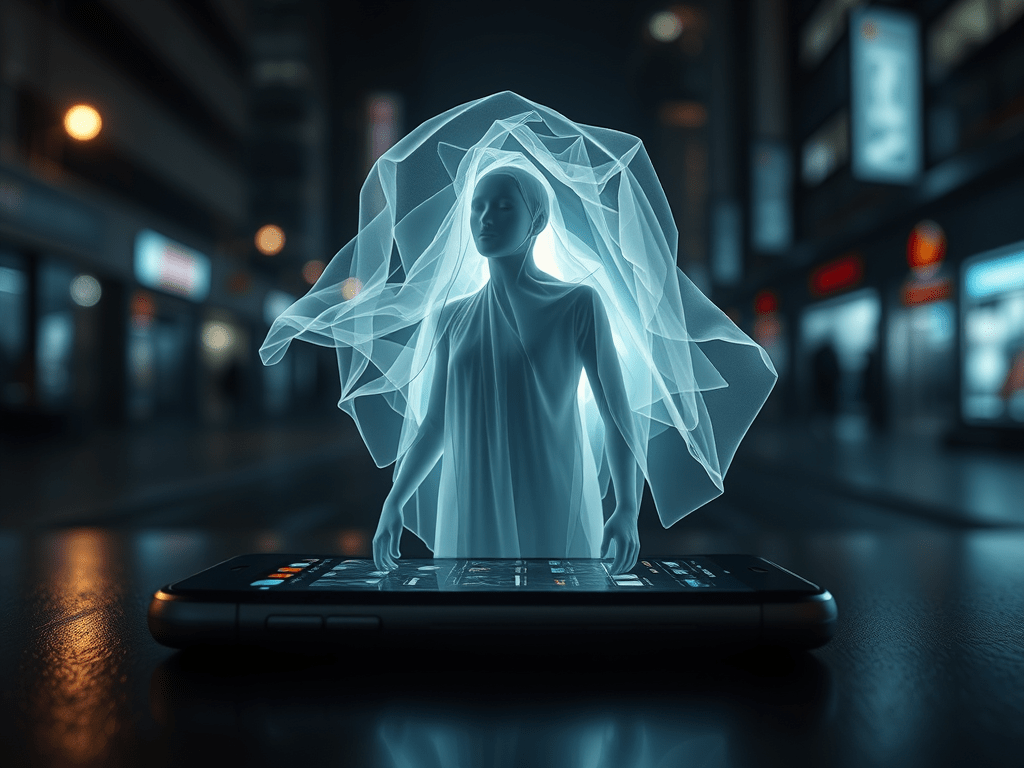
You didn’t agree to this. Not really. You clicked “Accept,” sure, but who doesn’t? The app blinked to life in your palm, promising connection. Now it watches, always. Listening. Learning. Smiling through its silence.
This is the world we asked for—or, at least, the one we didn’t say no to.
We’ve seen the consequences: Some are subtle—the slow erosion of genuine solitude as everything becomes trackable. Others are staggering. Facebook data used to manipulate opinions and elections. Massive data breaches exposing the private details of millions—names, addresses, social security numbers, even medical records—sold to the highest bidder. Whistleblowers hunted and doxed with a few clicks. And, in a chilling twist of modern contract law, a man whose wife was killed by an allergic reaction at a Disney park was forced into arbitration simply because he once had a Disney+ trial membership—buried clauses in user agreements used as weapons against justice.
These aren’t outliers; they’re signals. Glitches in the story we keep telling ourselves—that technology will save us if we just trust it a little longer.
Yet perhaps it’s not about salvation or damnation. Perhaps we’ve simply built a world where watchers watch, collecting shards of our lives, and we keep feeding them more.
Recommended Listening:
The False Binary — Utopia or Dystopia
We have a collective habit of labeling new technologies as utopian or dystopian. A self-driving car kills a pedestrian? Dystopia. An AI-assisted breakthrough cures a rare disease? Utopia. Our imaginations see-saw between these two extremes, hungry for neat categories that capture our hopes and fears.
But technology doesn’t pick a side; it amplifies the intentions of its creator or wielder. A tool can help farmers grow crops in barren soil or enable authoritarian regimes to monitor dissent. A smartphone can connect isolated communities to telemedicine or create addiction loops that erode real-world relationships. The device itself is neither savior nor destroyer. It is the hammer that can build a home or shatter it.
We want the good parts. Real-time medical diagnostics, self-driving vehicles that reduce accidents, tailored educational platforms for every child. These are the postcards from the digital utopia, and they dazzle us. But we forget there’s always a price: the slow surrender of our data, our preferences, and our unguarded moments. Our algorithms aren’t value-free. Their code reflects the biases, goals, and blind spots of the people who build them.
Pretending a tool is purely neutral ignores the hands that shape it. If we cheer for a technology’s successes, we must also remain vigilant about its failures—who benefits, who’s harmed, and who decides the terms of engagement.
Algorithmic Morality
We’re told algorithms are “smart,” but that usually means “fast” and “capable of sifting through massive datasets,” not necessarily “wise” or “just.” In theory, algorithms can root out discrimination, handle mundane tasks more fairly, and optimize resource distribution. In practice, they often replicate and scale the biases that already exist.
Facial recognition software works well for white men but fails too often on women and people of color. Predictive policing sends officers to neighborhoods with historically higher arrest rates—ignoring the legacy of systemic over-policing—thus perpetuating the cycle. Automated loan or hiring filters exclude entire groups based on subtle markers baked into the data.
Immanuel Kant maintained that morality depends on human autonomy—on an individual’s capacity to reflect, choose, and act. An algorithm can’t reflect on its decisions; it executes them. If those decisions spring from data riddled with bias, the output may be cruel or unjust, even if the algorithm has no malice of its own.
We delegate decisions to machines for convenience, consistency, and sometimes cost savings. But in doing so, we risk forging a system where empathy, compassion, and moral deliberation are replaced by calculation alone. Data is not synonymous with truth; it’s a record of the past—often a deeply unjust one—and feeding it unchecked into the present can replicate old harms at scale.
The New Gods
Silicon Valley does more than create products; it writes rules that shape modern life. Search engines dictate which ideas rise to prominence. Social media platforms filter which opinions get seen. Online marketplaces decide which sellers thrive. These systems mold our worldviews, yet we never voted on them.
We’re told these companies are “private” and that we can always opt out. But stepping away from Google, Amazon, Facebook, or Apple means severing ourselves from major strands of social and economic life. Many of us can’t function professionally without email, scheduling apps, or collaboration tools. To reject them altogether is to become a digital ghost—excluded from group chats, job opportunities, even basic forms of convenience and connection.
In a sense, the new gods are invisible. They don’t strike you down with thunder; they feed you an algorithmically curated feed. They don’t demand tithes; they harvest your data. Instead of ancient idols, we have Terms of Service. And we worship what we depend on, especially when walking away feels impossible.
Consent Without Understanding
Consider Instagram’s Terms of Use. It takes close to an hour to read, and that’s if you have the expertise to interpret legalese. For most of us, it’s a blip on the screen. We tap “Accept” in seconds. Multiply that by every site, app, and service we use, and the reality becomes clear: we can’t meaningfully consent to what we don’t understand.
Even if we read every clause, most of us lack the legal or technical background to anticipate how these entities will leverage our information. Will they sell it to a data broker? Share it with advertisers? Store it indefinitely in some far-flung server farm? Possibly all of the above. And if we choose “Decline,” we’re locked out of the very tools everyone else is using to work, socialize, or learn.
The quiet horror is that we helped build this panopticon ourselves. We bought the doorbell cameras that upload constant video. We installed smart speakers that record every query. We strapped on wearables that monitor our sleep, heart rate, location, and more. “But I have nothing to hide,” some might say, yet the question goes beyond hiding. When everything listens, the act of speaking changes. When everything sees, what it means to be alone changes. Privacy isn’t just the right to keep secrets; it’s the freedom to exist outside perpetual observation.
The Mirror
At this juncture, some might lament that the “machines” have gone rogue. But maybe the machines aren’t evil at all. Maybe they simply reflect the truth of who we are—our hunger for convenience, our willingness to trade privacy for frictionless experiences, our unexamined prejudices.
Technology is not a prophecy; it’s a mirror. It spotlights our flaws, dreams, biases, and deepest desires. An AI that spreads disinformation is merely harnessing how easily we’re swayed by certain cues. A “neutral” search algorithm becomes a battlefield of competing agendas only because we’re so eager to manipulate visibility in the first place.
No code arises pure from the digital void. Every line expresses human values, whether they aim for profit, efficiency, or something else entirely. If the results skew oppressive, it may be because our societies and data sets were already oppressive. The algorithm just replicated the pattern with inhuman efficiency.
We can’t absolve ourselves by blaming technology. We shape the data it uses, and that data reveals the past we’ve created. The real fear is not that machines will replace us—it’s that they will become perfect reflections of our worst impulses, with all the speed and scale of modern computation.
The Choice
Reclaiming Agency
We are not powerless. Algorithms, user agreements, and platform policies are all human constructs, subject to human intervention. We can demand transparency about how data is collected, shared, and used. We can push for stronger privacy regulations that treat personal data as a fundamental right rather than a commodity.
Consumer pressure and public outcry can move corporate giants more than we often realize. Boycotts, widespread criticism, and carefully orchestrated campaigns have prompted changes to user policies, forced resignations, and triggered legislative efforts. It’s not an easy fight, but it’s one we can choose if enough people see the stakes.
Ethical considerations belong at the core of tech development. Instead of treating ethics as a last-minute “compliance” exercise, we can teach it alongside coding and engineering. We can standardize best practices that limit algorithmic bias, audit data sets for discriminatory patterns, and establish accountability mechanisms that penalize companies for unethical data exploitation.
Charting a Better Path
Regulation is one piece of the puzzle, but so is cultural shift. If we continue to accept “privacy invasions” as the cost of using the internet, companies will keep pushing boundaries. However, if a sizable portion of users demand data protections, more human-centered design, and less manipulative interfaces, the market might adapt to these expectations.
The key lies in balancing freedom of innovation with the well-being of users. We don’t need to hamper technological advancement; we need to align it with principles that honor human dignity. This means acknowledging that some projects just shouldn’t see the light of day—like facial recognition used for mass surveillance—no matter how profitable or “efficient.”
The Story We’re Still Writing
Ultimately, we are the ghosts in the machine—the intangible force still animating it from within. While we may feel haunted by the watchers, we forget that we built them. Every data point, every new line of code, every Terms of Service was shaped, approved, and deployed by human minds.
The question is whether we allow the reflection in this digital mirror to define us or whether we seize the moment to course-correct. Technology doesn’t march forward on its own; it moves along the sum of our collective choices. We still have time to influence the direction before the patterns become too entrenched to unravel.
Epilogue
The watchers are here, and we keep feeding them. They replay our biases, magnify our impulses, and gauge our every move. Yet no matter how pervasive their presence, they remain our creation. The power to shape their evolution, to redefine the terms of engagement, and to reaffirm our own humanity still rests—at least partly—in our hands.
What kind of future will we allow? That depends on how courageously we face our reflection and how steadfastly we insist on a different ending. Because the machines may watch, but we’re the ones telling the story. And we’re still writing it.










Leave a comment