
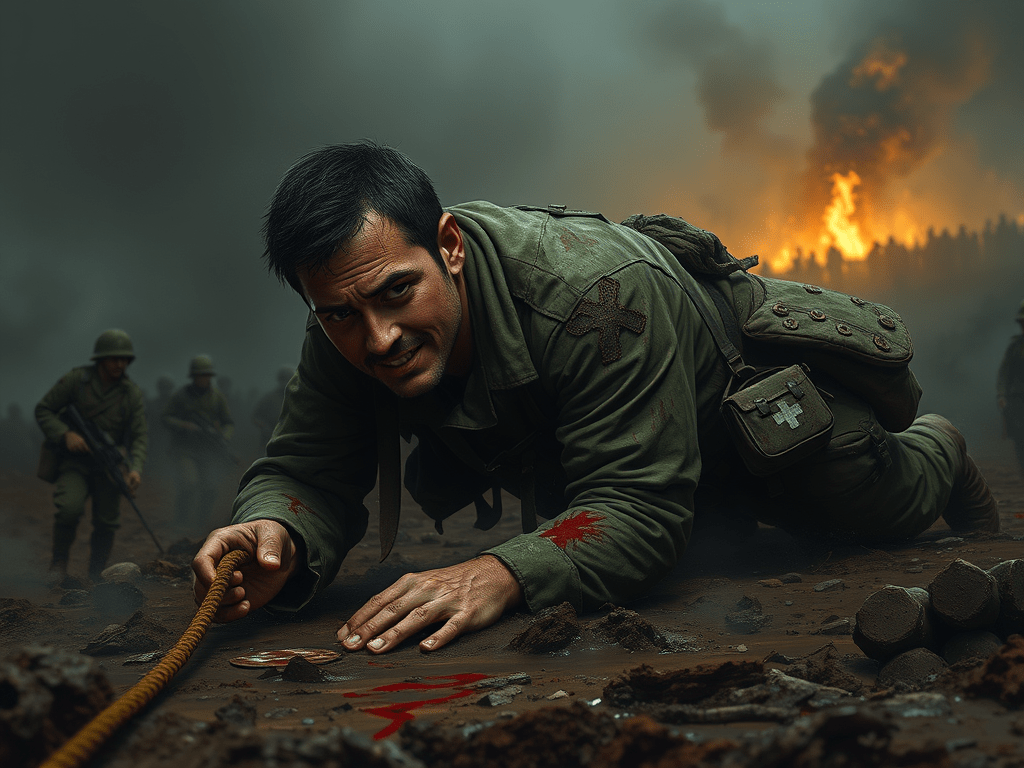
The air was thick with smoke and the stench of blood. Explosions rattled the jagged ridge, and cries for medics cut through the chaos. Men were dying—most already had. The wounded lay strewn across the escarpment, between mortar craters and mangled bodies. The order had come to retreat. Everyone else had gone.
Except for one man.
Private First Class Desmond Doss stood alone atop Hacksaw Ridge, without a weapon, without armor, and without any guarantee of survival. He carried no gun—just a stretcher, some bandages, and a rope. Where others saw the impossible, he saw the inevitable.
One more.
On hands and knees, Doss crawled back into the fire, found the next wounded soldier, and dragged him to the edge of the cliff. He tied a knot—likely one he’d practiced a hundred times growing up in Virginia — and began to lower the man down the 400-foot escarpment. No fanfare. No backup. Just his hands, his faith, and a prayer.
“Please, Lord,” he whispered, voice barely audible over the gunfire. “Help me get one more.”
He would say it again. And again. For twelve hours.
By nightfall, Doss had pulled 75 men from that hellscape, one by one, refusing rest or shelter until no cries remained. When medics finally found him, he was wounded—hit by shrapnel, then later by a sniper. He crawled to safety, refusing evacuation until the man beside him was taken first.
“I was praying the whole time,” he would recall later. “I just kept asking God: help me save one more. That’s all I wanted to do.”
He never called himself a hero. When asked how he did it, Doss would shrug.
“I couldn’t turn my back on them. I figured if I didn’t do it, they’d die. So I went back.”
No prophecy foretold his actions. No special power made him capable. He wasn’t fearless—he was terrified. But he moved anyway.
And that’s the part most stories get wrong.
What Stories Tell Us a Hero Is
Popular culture has long fed us a singular image of the hero: the chosen one. We see it time and again in fiction—from Superman, born with powers beyond human comprehension, to Harry Potter marked by prophecy, to Neo awakened as “The One.” Each of these characters is propelled by some undeniable fate that puts them in a position no one else can occupy. They save the day, not because they must, but because only they can. Their destinies are foretold, their powers are rare, and their purpose is singular.
We flock to these stories. They excite us, spark our imaginations, and allow us to believe that greatness might be a matter of bloodline or a lightning-shaped scar. In their world, the hero doesn’t just do something remarkable—he or she is something remarkable. It’s not just the act that’s heroic; it’s the person set apart from ordinary humans.
These stories carry tremendous power. They allow us to see ourselves as potential saviors if only, by some cosmic lottery, we are chosen. And they do this while also letting us off the hook: if you’re not born to do it, you never really have to try. Some call it escapism; others call it a cultural myth that keeps us waiting for the “special one” instead of becoming that person ourselves.
Yet when you look at real heroes—individuals who risked everything for a cause—no such cosmic lottery appears. That’s the difference between the fantasies we devour in books and movies, and the flesh-and-blood stories that truly shape our world.
Consider Harriet Tubman, for instance. She was no cosmic accident. She wasn’t “chosen” by a higher being who singled her out. Born into slavery, she could neither read nor write. She endured harrowing abuse, carried permanent scars on her body, and suffered a severe head injury as a child that gave her debilitating headaches and seizures throughout her life. Nothing about Harriet Tubman’s circumstances suggests she was destined to become the legendary conductor of the Underground Railroad. Yet she chose to escape, and she chose to go back—again and again—risking her own life to free more enslaved people. She defied the tyranny of her era not because she was uniquely gifted, but because she refused to accept an unjust world.
Or take Mahatma Gandhi. He was not born a saint; he didn’t descend from the heavens. He was an unremarkable lawyer—shy, by many accounts—who moved to South Africa in his youth and found himself discriminated against because of his skin color. That moment, being thrown off a train due to segregation, lit a fuse in his mind. He found that he could not abide a system that treated him, and others, with such blatant injustice. So he chose the path of civil disobedience and nonviolent resistance. He eventually led millions in India to fight for independence. There was no mystical sign marking him as the father of a movement. He was just determined and unyielding.
Whether Harriet Tubman, Gandhi, or Desmond Doss—none of them stood out as a “chosen one” until history looked back in awe. In the moment, they were terrified, uncertain, and fully aware they could fail. Yet they pressed on, anyway.
What Real Heroes Say
Talk to a real-life war hero, a frontline medic, a whistleblower, or a protestor who stood their ground, and you’ll hear something else entirely from the mythic narratives of fiction:
- “I didn’t think. I just acted.”
- “Anyone would’ve done the same in my shoes.”
- “It never occurred to me not to help.”
When Harriet Tubman was asked about her repeated journeys back into the slave states, she never portrayed herself as a superhuman figure. In her own words, she would often speak of the moral necessity to keep going. She felt the crippling fear—she had bounties on her head and constantly risked capture, torture, or worse—but she still moved forward because her conscience wouldn’t let her rest while others remained enslaved.
Likewise, Desmond Doss saw no alternative. He didn’t dwell on whether he was special; he simply refused to abandon those who needed him. He heard them screaming for help. He saw them lying helpless in the mud. He recognized that if he didn’t return to the lines to pull them out, nobody else would. His sense of duty overshadowed his terror.
Many times, those who survive moments of extraordinary courage don’t describe them with pride, but with humility—sometimes even disbelief at what they did. Gandhi himself was not immune to doubt or fear; nor was Martin Luther King Jr. Here was a preacher from Atlanta who found himself the figurehead of the entire American civil rights movement. King was thrown in jail, threatened with violence, and repeatedly faced with the brutal reality that every speech, every march, could be his last. Yet he, too, pressed forward—not because he thought he was chosen by prophecy, but because justice demanded it.
In each case, these real heroes saw a choice where others saw a dead end. They saw the undeniable presence of evil or danger or injustice, and they recognized they could not sit by. They had no illusions of their own invincibility. Harriet Tubman kept a pistol at times, not as an act of aggression, but as a measure to protect those she guided. Martin Luther King Jr. wrestled with anxiety over the safety of his wife and children, yet he still marched. Desmond Doss knelt under withering gunfire, bandaged wounds, and carried men to safety with his bare hands. None of them thought, I’m special. They each thought, This is necessary.
“I was praying the whole time,” Doss said. Harriet Tubman often spoke of divine guidance as well, expressing that each successful mission was a testament to something greater than herself. Gandhi believed unwaveringly in satyagraha—truth and firmness—that anchored him when fear set in. And Martin Luther King Jr. famously leaned on his faith and sense of moral calling, writing from a Birmingham jail cell that one has “a moral responsibility to disobey unjust laws.” These convictions carried them through doubt and danger. But ask any one of them—if we could—and they’d likely say they weren’t a “hero,” just a person who could not do otherwise.
The Quiet Truth About Heroism
Heroism, when stripped of its fiction, doesn’t shine. It burns.
It does not usually come with applause, orchestral scores, or triumphant parades—at least not in the moment. Harriet Tubman had to move quietly, under cover of darkness, hoping to lead enslaved men, women, and children across miles of terrain without being caught. She wasn’t cheered at every safe house; she simply knocked on doors in the middle of the night, trusting strangers to help. She took nothing but faith and a fierce determination that freedom was not negotiable. That is the messy, harrowing reality of heroism.
Similarly, Martin Luther King Jr. marched across the Edmund Pettus Bridge in Selma, Alabama, with hundreds of activists, knowing full well the lines of state troopers and local law enforcement waited to meet them with batons, tear gas, and brutality. Those images—of marchers battered to the ground, cowering under clubs—are haunting. But that’s heroism: confronting the possibility of pain, failure, and even death because not confronting it would be worse.
In Desmond Doss’s case, heroism looked like lying flat in the mud, hearing bullets whistle overhead, and returning again and again to a place where every logical bone in his body would scream, Run. He tore his uniform to make bandages for soldiers who’d lost limbs. The smell was overwhelming; the screams were deafening. Yet he kept going until his own body was eventually torn by shrapnel, and then by a sniper’s bullet that fractured his arm.
When we peel back the glamorous veneer, we see that heroism often comes at a great personal cost—physical, emotional, or psychological. Harriet Tubman struggled with seizures and headaches throughout her life, a direct result of a blow to the head inflicted by an overseer when she was young. Gandhi faced multiple imprisonments and endured hunger strikes that took him to the brink of death. King was stabbed, had his home bombed, and ultimately lost his life to an assassin’s bullet. Doss carried the weight of wartime nightmares, survived his injuries, and lived with the knowledge that not everyone he tried to save made it. Where the mythic hero might stand proud in triumph, the real hero often feels guilt and sorrow for those who could not be helped.
Real heroes live with the weight of what they couldn’t save.
For Desmond Doss, that meant recalling the men he couldn’t reach in time. For Harriet Tubman, it meant every life that slipped through the cracks of the Underground Railroad or never made it that far. For Martin Luther King Jr., it was the knowledge that racism would outlive him and that he couldn’t spare all his people the agony. And yet, each of them found the courage to step forward anyway.
Why We Prefer the Other Version
Why, then, do we cling so tightly to the myth of the exceptional hero—the ordained, the destined, the super-powered? Perhaps because it gives us something to admire without challenging us too deeply. If only the gifted can save the day, the rest of us are absolved of responsibility. We can watch from a safe distance, maybe cheering for the “chosen one,” but never confronting the fact that heroism could be our job, too.
This is not to say that stories like Superman or Harry Potter are unworthy. They inspire us in their own way—teaching virtues like courage, selflessness, and hope. Yet they also risk giving us an “out.” If heroism is relegated to those with inherent gifts, then we need not feel troubled when we fail to stand up in everyday life. “After all,” we might tell ourselves, “we aren’t the chosen ones.”
But real heroes—like Doss, Tubman, Gandhi, King—challenge us in a far more unsettling way. Their message is, Anyone can do this. They do not stand out by birth or destiny. They stand out by choice and action. Because they are “ordinary,” their stories remove our excuses.
Harriet Tubman forces us to realize that a person born into slavery, with no resources or formal education, could not only free herself but go back, risking a return to bondage or death, to liberate others. If she could do that, what’s stopping us from confronting oppression or inequality in our own communities?
Martin Luther King Jr. was an ordinary man by social standards—a pastor, a husband, a father—until a bus boycott in Montgomery thrust him into the spotlight. He kept stepping up, step after step, speech after speech, receiving death threats and constant harassment. Yet he refused to quit. Are we willing to stay the course when our personal comfort is threatened?
Mahatma Gandhi showed us that a small, softly spoken individual could awaken a sleeping giant of a people through peaceful protest. He orchestrated the Salt March against the British Empire, walking for 240 miles in the Indian heat, an act that seemed foolish—impossible, even—until it changed the conversation entirely. What acts of peaceful resistance might we be too timid to try?
Desmond Doss, for his part, was just a young man from Lynchburg, Virginia, who had grown up in the Seventh-day Adventist Church. He believed deeply in the commandment “Thou shalt not kill,” and refused to bear arms. The Army tried to discharge him as mentally unfit for service. He was ridiculed by fellow soldiers. And yet, on Okinawa, in one of the bloodiest battles of World War II, Doss saved 75 lives. He stood alone on that ridge because he chose to. No one tapped him on the shoulder with a magic wand and said, “You are the chosen one.” No cosmic forces parted the clouds to single him out. He was an ordinary soldier with an extraordinary sense of duty.
The myth of the exceptional hero flatters our longing for spectacle. It entertains us without requiring us to change. The real hero, on the other hand, shames us a bit. It tells us we can—and perhaps must—do better. Real heroism is messy, accessible, and uncomfortable because it suggests every person has the capacity to engage in these acts of courage. We are not absolved by our ordinariness; in fact, we are indicted by it.
The Invitation to Act
Desmond Doss didn’t change the entire world with a single grand gesture; he saved one man’s life. Then another. Then another. By the end of the night, it was 75 men carried over the ridge. That was enough.
He was not fearless. He was not chosen. He was not armed.
He just refused to leave anyone behind.
When Martin Luther King Jr. delivered his “I Have a Dream” speech on the steps of the Lincoln Memorial, it wasn’t because he was a prophesied savior. The civil rights movement demanded action, and he found himself at the helm. Harriet Tubman returned to the South time and again, risking everything because leaving people in chains was unthinkable. Gandhi marched to the sea to make salt because the injustice of an occupying empire was too glaring to ignore. And Desmond Doss, on his belly in the mud at Hacksaw Ridge, prayed for just “one more” life to save.
None of them were fearless. None of them believed they were extraordinary. They simply recognized that if they didn’t act, someone else would pay the price. Each moved forward, buoyed by faith in something greater, determined that justice wouldn’t stand on its own if good people refused to stand with it.
Real heroism doesn’t hinge on prophecy; it hinges on necessity. Doss, Tubman, King, and Gandhi all show that the boundary between “ordinary” and “heroic” is thinner than we like to believe. Their stories refuse to let us sit back and wait for a chosen one. Instead, they ask us to consider what might happen if we truly believed our action mattered—if only by saving a single life, challenging a single wrong, or marching just one step forward.
We’ve all encountered smaller versions of these crossroads. Maybe it’s seeing someone bullied and deciding whether to intervene, or watching a friend unravel and choosing whether to speak up. These moments rarely come with fanfare, but they are the seeds from which heroism can bloom—because heroism, at its core, is about stepping forward when you could step back.
So if that’s what it means to be a hero—if it means saving one more life, guiding one more lost soul, standing up to one more injustice—what’s stopping you? The world changes when ordinary people decide enough is enough. That’s why Desmond Doss, Harriet Tubman, Martin Luther King Jr., and Gandhi have become symbols of hope: they prove heroism can arise without prophecy or superpowers. It starts with seeing the moment, refusing to look away, and believing your action matters.









Leave a comment