

The sirens wail like distant wolves, echoing through once-deserted streets. Neon flashes of blue and red streak across the blacktop, bathing everything in a strobing, surreal glow. A trio of riot vans idles by the curb; silhouettes of armored figures spill out, methodically positioning themselves. The pavement is slick with chemical residue, a sharp, lingering burn that scrapes at your nostrils and gnaws on your lungs. Some protestors choke on their own breath, eyes burning, throats raw. Others huddle behind makeshift barriers, shirts pulled over their faces or gas masks strapped tight, refusing to yield.
A crack of a projectile reverberates down the avenue—tear gas canisters slicing through the night sky. The crowd scatters with a mixture of fear, defiance, and disorientation. Law enforcement officers close ranks, riot shields clattering as they brace for impact. A voice booms from a loudspeaker: “Move back!” The order isn’t just a suggestion; it’s an ultimatum. One more step, one more shout, one more sign raised in protest, and an avalanche of force will descend.
Somewhere behind the scenes, the justification is already locked and loaded: “They were hostile.” “I feared for my life.”The “why” and “how” don’t matter. The narrative has become painfully predictable in a country that once prided itself on ideals like freedom and democracy. When fear overrides principle, it’s the citizen who pays the price—in blood, in suffocated breath, or in the slow asphyxiation of civil liberties.
It wasn’t always this way. Or, perhaps, it always was, and people simply refused to see it.
Recommended Listening:
Roots of a Transformation
The transformation of American police from community guardians to quasi-military enforcers didn’t happen overnight. Throughout the early to mid-20th century, policing carried its own legacies of institutional violence—from strike-breaking to racially motivated brutality—but there was a distinct line between military action and civilian law enforcement. Officers were typically armed with service revolvers or pistols, designed to respond to local threats, not to wage war.
Then came the War on Drugs. In the 1970s and 1980s, as political rhetoric amplified concerns over drug trafficking and violent crime, local police departments were incentivized to embrace aggressive, military-style tactics. Funding poured into specialized units—most notably, SWAT teams—under the banner of “law and order.” Media sensationalism of crime waves and drug epidemics fueled the narrative that an existential threat lurked in every neighborhood, urging police to adopt an “us-versus-them” posture.
Eventually, the federal government opened the floodgates to military surplus. Tanks, armored personnel carriers, high-powered rifles, and specialized gear once reserved for battlefields in Vietnam or the Persian Gulf started finding homes in quiet American suburbs. The 1033 Program, instituted in the 1990s, allowed the Department of Defense to transfer excess military equipment to local police, often at minimal cost. The result was a swift rise in heavily armed SWAT raids, even for minor offenses. The blurring of lines between soldiers overseas and police officers on Main Street was no accident—it was a policy decision.
The Aesthetics of Authority
The very appearance of law enforcement shapes public perception. When officers don helmets, body armor, and camouflage, carrying weapons designed for war zones, their role shifts from community protectors to something more akin to occupying forces. The impact extends beyond aesthetics:
- Psychological Deterrence – Seeing military gear on the streets subconsciously implies a battlefield dynamic. It tells citizens that noncompliance may be met with lethal consequences. This visual language amplifies fear, ensuring that the mere sight of armored vehicles can quell dissent before it even sparks.
- Cultural Shift in Policing – Training adapts to equipment. Tactics become less about de-escalation and more about containment and control. Officers conditioned to view civilians as potential combatants erode trust within their own communities.
- Impact on Civil Liberties – When police resemble soldiers, civilians cease to be seen as citizens and become subjects. Protest is reframed as insurgency; resistance, however peaceful, becomes defiance.
Each armored vehicle rolling down suburban streets is another signal that force has replaced discourse. Compliance is no longer a request—it is an expectation enforced by fear.

International Contrasts: Policing Without the Specter of Fear
It’s tempting to dismiss aggressive policing as a universal necessity, but global comparisons suggest otherwise. Nations like the United Kingdom and Japan present stark contrasts:
- Limited Armament (United Kingdom)
British police officers generally do not carry firearms. Armed response units exist for emergencies, but the day-to-day presence of unarmed officers reduces the instinctive escalation of violence. Despite facing crime, the absence of ubiquitous firearms fosters more reliance on de-escalation techniques. - Community Policing and Strict Gun Control (Japan)
Japan’s police system benefits from stringent gun laws and an emphasis on nonviolent conflict resolution. Officers receive extensive training in de-escalation and are expected to engage with their communities rather than patrol them as hostile territories. Deadly encounters with police are exceedingly rare.
These models highlight that aggressive militarization is a choice, not an inevitability. They serve as reminders that law enforcement can exist without being an omnipresent threat to its own citizens.
A Slow Erosion of Democracy
Democracy thrives on public accountability. When those wielding force face no meaningful consequences, democratic principles erode. Militarized policing undermines democracy by:
- Suppressing Dissent – Protest, a fundamental democratic right, becomes hazardous. When demonstrations are met with tear gas and rubber bullets, civic engagement turns into a calculated risk.
- Selective Enforcement – Racial and economic biases in policing ensure that certain communities bear the brunt of militarization. Poor neighborhoods become occupation zones, fostering cycles of oppression and resistance.
- Criminalizing Poverty – Aggressive policing extends beyond crime; it punishes poverty itself. Unhoused populations, marginalized groups, and those struggling with addiction face disproportionate scrutiny, often finding themselves trapped in a cycle of incarceration and disenfranchisement.
When the state deploys force disproportionately against its own people, the question isn’t whether democracy is failing—it’s whether it was ever meant to succeed in the first place.
Conclusion: A Future in Question
As dawn breaks over riot-torn streets, the acrid stench of tear gas still lingers. Broken glass and bloodstains on the pavement serve as silent testaments to the night before. Some will argue that such force is necessary—that security requires strength. But history has shown that strength wielded against the people is not security; it is subjugation.
Comply and survive has become an unspoken motto, but compliance does not always guarantee safety. In such a climate, democracy gasps for breath, its voice drowned out by sirens and the heavy march of boots on pavement.
The question is not whether this is the system we built. It is whether we are willing to build something better.
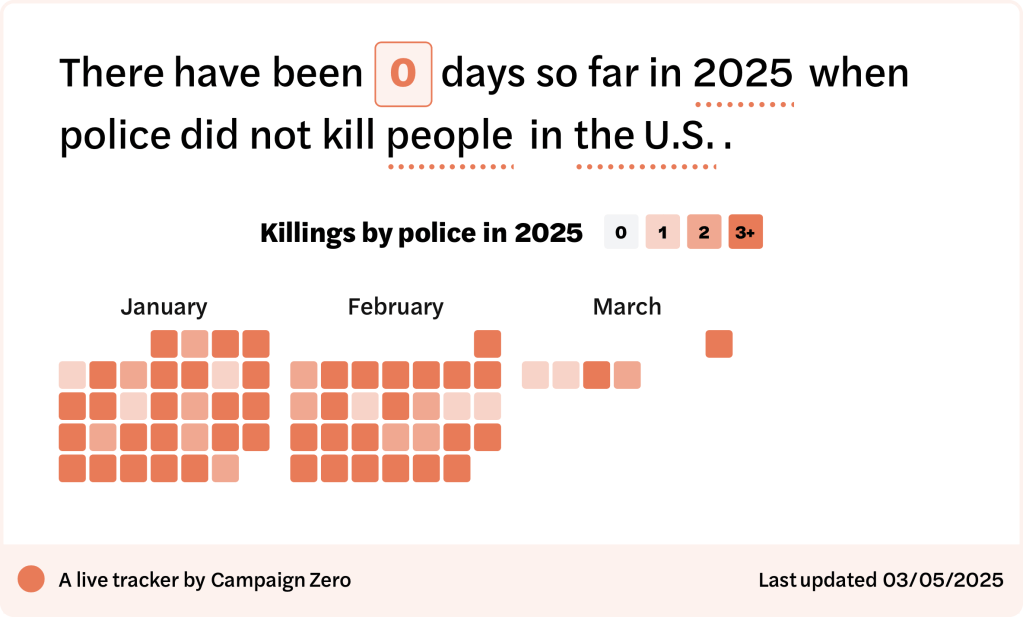
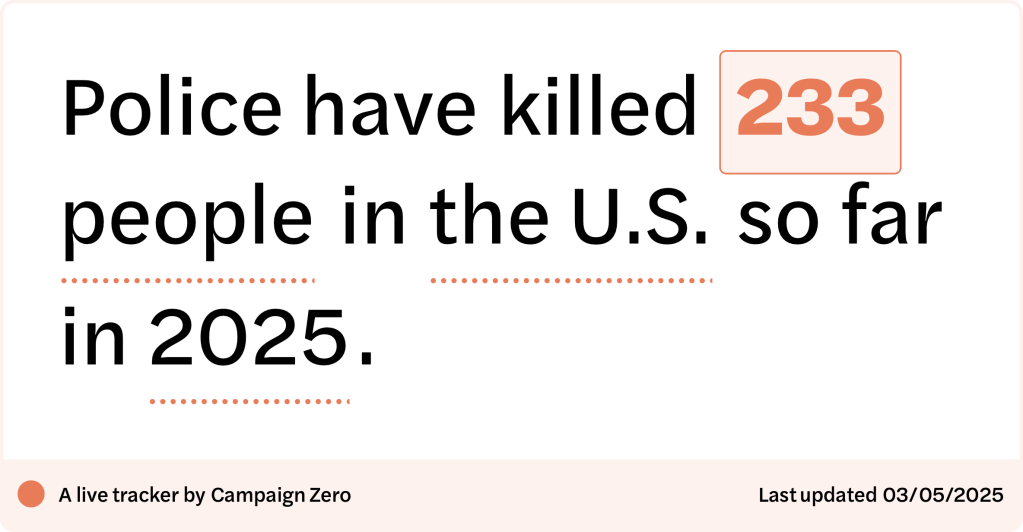
Further Reading, and the source of the infographics used in this article: https://mappingpoliceviolence.org






Leave a comment