
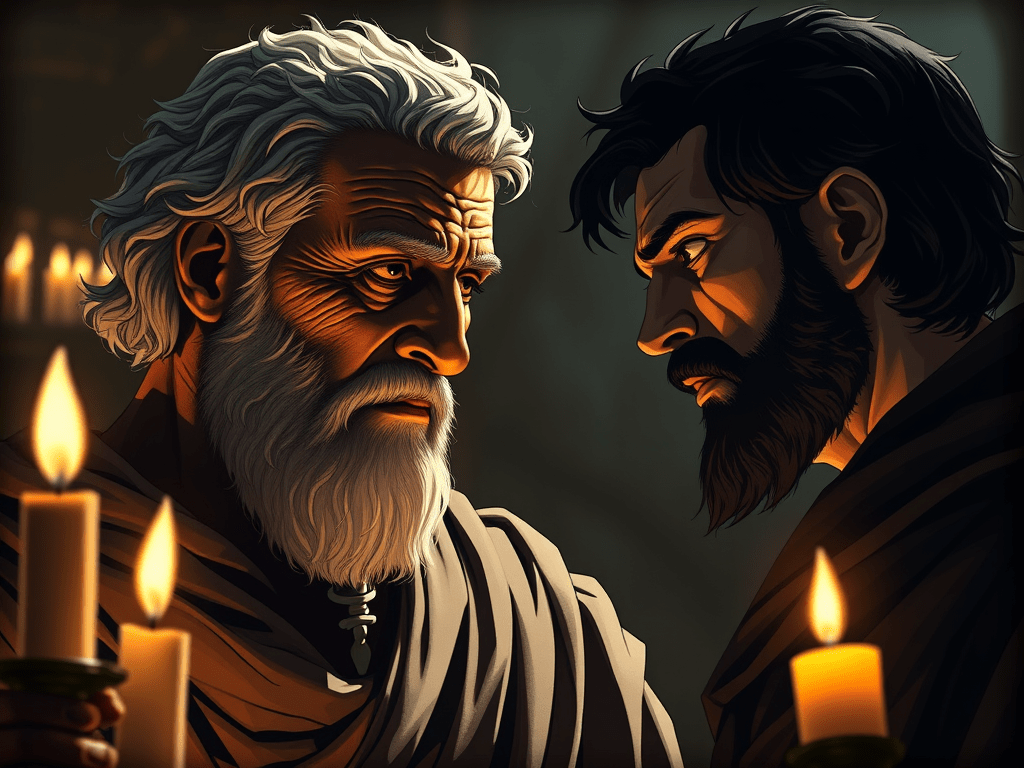
There is a pivotal scene in Gladiator that quietly sets the tone for the film’s profound exploration of virtue and leadership. Marcus Aurelius, sensing his impending death, asks his son Commodus if he is ready to do his duty for Rome. Commodus answers in the affirmative, but Marcus Aurelius replies with a crushing judgment: Commodus will not be emperor. Instead, the emperor’s powers will pass to Maximus, to be held in trust until the Senate can restore the Roman Republic.
In this same scene, Commodus recalls the “four chief virtues” his father once listed—wisdom, justice, fortitude, and temperance—and laments that he possesses none of them. Yet he pleads for his father’s acceptance, claiming other virtues: ambition, resourcefulness, a form of courage, devotion. “But none of my virtues were on your list,” Commodus says. He longs for a simple gesture of love—a hug or a kind word—but feels he has never received it. This moment culminates in betrayal and patricide: as they embrace, Commodus strangles Marcus Aurelius rather than accept the blow to his pride.
This exchange foreshadows the entire tragedy of Gladiator. Commodus is desperate to measure up to an ideal of virtue but fundamentally misunderstands its essence. He stands in stark contrast to Maximus, the general-turned-slave-turned-gladiator, who quietly embodies those virtues Commodus fails to grasp. One man speaks of virtue; the other lives it. And Maximus’s greatest strength often lies not in grand displays of power, but in measured restraint.
Recommended Listening:
Virtue as Action vs. Virtue as Self-Perception
Commodus believes—or tries to believe—he is virtuous. He frames his ambition as vision, his resourcefulness as intelligence, his craving for affection as devotion. Yet his actions consistently undermine these self-proclaimed qualities. Ascending to power through murder, he reigns through fear, intimidation, and vanity. His “virtues” serve his ego rather than the greater good.
Maximus, on the other hand, seldom speaks of his own character. He needs no speeches to prove his worth. His virtue is reflected in his unfailing loyalty to Marcus Aurelius’s dream of a restored Republic. Even when Rome betrays him—killing his family, reducing him to a slave—Maximus remains steadfast in his moral convictions. He upholds honor in a world beset by corruption. He demonstrates compassion in a culture that idolizes the sword. He shows restraint where others would resort to cruelty or personal revenge.
This chasm between Commodus’s stated virtues and Maximus’s lived example echoes classical conceptions of character. In Nicomachean Ethics, Aristotle argues that true virtue is woven into habit and action. It does not rely on proclamations; it arises from consistent choices that shape one’s character over time. Commodus’s tragic flaw is that he mistakes self-declared attributes for true moral excellence, while Maximus’s strength is that he acts rightly without needing to draw attention to himself.
Classical Roots: Stoicism and the Ideal of Restraint
The film features Marcus Aurelius, a historical emperor-philosopher whose work, Meditations, is a cornerstone of Stoic philosophy. The Stoics held that virtue, self-control, and internal fortitude are the keys to true power. They believed external events cannot tarnish an upright character unless the individual allows it. Maximus, enduring unspeakable loss and betrayal, remains guided by loyalty and justice—a testament to inner resolve.
Commodus, by contrast, is driven by external validation. He equates power with the adoration of the masses; he yearns for his father’s approval; he twists the Senate to his will. In Stoic terms, this means he surrenders control of his emotions and sense of worth to outside forces. When he does not receive the love or accolades he craves, he lashes out. Devoid of inner discipline, he mistakes domination for true strength.
Maximus’s restraint highlights a key Stoic idea: the real battle is internal. Power over others, while impressive on the surface, pales in comparison to the mastery of one’s own impulses and desires. By refusing to become a tyrant—or to exact revenge in the most brutal ways—Maximus manifests an inner freedom Commodus can only dream of.
The Unspoken Virtues of Maximus
1. Leadership Through Trust
Maximus’s leadership style is anchored in trust, not fear. We see this in the film’s opening battle: his men risk their lives for him because they respect him, not because they dread punishment. As a gladiator, stripped of status and rank, Maximus quickly becomes a leader among fellow slaves. Even the Roman crowd, initially indifferent, is drawn to him. This capacity to inspire loyalty, no matter his station, testifies to the authenticity of his character.
From a classical standpoint, this aligns with prudentia, or practical wisdom: understanding how to act for the greater good in real-world circumstances. Maximus evaluates situations calmly and acts decisively, all while respecting the people he leads. By combining competence with moral integrity, he naturally fosters trust—evidence that genuine authority is granted by followers, not forcibly extracted.
2. Honor in the Face of Betrayal
After Commodus seizes power, Maximus loses everything. The empire he served hunts him down; his family is brutally murdered. Such immense betrayal could drive anyone to bloodthirsty vengeance. While Maximus does fight for survival and, eventually, for the chance to confront Commodus, he channels his rage in a way that remains consistent with his ideals.
He remains devoted to Marcus Aurelius’s final wish: returning Rome to a republic governed by the Senate. His sense of honor elevates this goal over personal revenge. Even when faced with the opportunity to kill Commodus under unfair circumstances, he hesitates—indicating that justice, not raw hatred, motivates him. This principle resonates with justitia, the virtue of rendering each his due. Maximus believes even his enemy deserves a fair contest, unwilling to mirror Commodus’s treachery.
3. The Strength of Restraint
In a culture that prizes dominance—be it ancient Rome’s gladiatorial spectacles or the modern obsession with power—Maximus’s quiet restraint is remarkable. He never seeks the throne for himself, even though he could leverage his military acumen and the crowd’s support to seize control. He does not exploit his fame for personal gain. His ultimate aim is to fulfill an obligation to the late emperor and safeguard Rome’s future.
This resonates with the Greek concept of sophrosyne, often translated as moderation or self-control. Maximus exemplifies this when confronted with opportunities to satisfy his thirst for vengeance. He chooses not to indulge in cruelty or unscrupulous tactics. His greatness lies in his measured approach, proving that true power can be shown in what one refrains from doing just as much as in bold action.
Why This Matters Today
The tension between Commodus and Maximus offers lessons for modern leadership. Social media and public life are saturated with individuals who proclaim their moral stances loudly—what some might call “virtue signaling.” Yet their behavior often contradicts these self-professed values. Just as Commodus boasts about ambition and devotion but rules through fear and vanity, so too do modern figures sometimes wear the mantle of virtue without committing to its substance.
True virtue, however, emerges in what we do when no one is watching. Like Maximus, genuine leaders are consistent in private and public spheres, and they command respect because others recognize their authenticity. Any claim to moral authority that relies solely on self-praise remains as empty as Commodus’s ambition.
Moreover, Gladiator underscores the idea that leadership stems from service rather than from demands for loyalty. In contemporary politics or business, we might see leaders who attempt to coerce compliance or exploit crises for personal gain. By contrast, those who prioritize collective well-being, and who act from principles rather than ego, often garner genuine support and loyalty.
Lessons in True Virtue
1. Your actions reveal your true character.
Words alone are malleable; consistent deeds are far less so. Maximus’s worth is demonstrated through unwavering loyalty and fair conduct, even under severe duress. In any sphere of life—work, personal relationships, community involvement—our real character shines through in what we choose to do, especially when we could easily do otherwise.
2. Integrity stands firm when the world isn’t watching.
Maximus remains loyal to Marcus Aurelius’s vision even after being condemned, enslaved, and powerless. This parallels the modern idea that your ethics matter most in private, when immediate consequences are minimal. If you treat colleagues, employees, or strangers with integrity regardless of recognition or reward, you embody Maximus’s quiet moral resolve.
3. Restraint can be more powerful than force.
In an arena designed to showcase violence, Maximus’s most striking quality is his refusal to indulge in cruelty for spectacle. Restraint does not imply weakness; it can be a mark of profound internal fortitude. Whether in negotiation, conflict resolution, or daily interactions, knowing when not to push can be more transformative than always asserting dominance.
4. True leadership inspires rather than coerces.
Maximus leads by example. He never compels others to follow; they choose to because they respect his integrity. Commodus, on the other hand, secures short-term obedience through threats but earns no genuine devotion. This distinction is as relevant in family life as in global politics: forced compliance breeds resentment, whereas genuine inspiration fosters unity and growth.
The Climactic Test of Virtue
By the end of Gladiator, Maximus fulfills Marcus Aurelius’s final wish, ensuring that Rome can move toward becoming a true republic once again. Notably, he does not claim the throne for himself. His primary aim is to correct the moral and political imbalance Commodus has wrought. Even in his final moments, his concern is for Rome’s future, not his own status.
This stands in stark contrast to Commodus’s hollowness. Commodus sets out to claim the seat of power, but in doing so, he reveals his fundamental weaknesses: dependency on external validation, an unchecked hunger for adoration, and a willingness to betray anyone, including his own father. Where Maximus’s actions are rooted in service and honor, Commodus’s are anchored in self-interest and fear.
Such a contrast serves as a timeless reminder that moral authority—true virtue—cannot be seized or self-declared. It must be earned through unwavering commitment to principles that guide action, even when it’s inconvenient or perilous. Maximus does not need the Senate or the public to affirm his virtues; he lives them. By contrast, Commodus’s repeated claims of merit ring hollow to those who see through his facade.
Enduring Relevance: A Quiet Example for All Eras
Whether we look to ancient Rome or our modern world, the lessons from Gladiator endure: virtue is best understood as a habit formed by consistent, principled choices. Leaders who embody integrity do not merely say they care about the common good; they prove it through sacrifice and respect. Individuals who practice restraint and fairness, even when wronged, demonstrate an inner strength that outlasts any fleeting show of force.
In our current social and political climate, we often grapple with the same fundamental question posed by Marcus Aurelius’s conversation with Commodus: What truly defines virtue? Is it the outward show of power and ambition, or an internal moral compass that guides every choice—public or private? Is it enough to say we care about justice, or must we live it out, even when the personal cost is high?
Maximus’s legacy provides a clear answer. The measure of a person’s character lies not in proclaimed attributes but in lived behavior, especially under hardship. While Commodus rattles off virtues he claims to possess, Maximus exhibits them through his day-to-day decisions, ultimately inspiring all who witness his unwavering commitment to honor.
In the final reckoning, Gladiator shows that the quiet confession of one’s own moral failings—like Commodus’s tearful plea—is overshadowed by the quiet demonstration of true virtue in another’s life. Maximus’s story compels us to ask of ourselves: When the battle is over and the arena falls silent, will my actions reflect my claims? In that gap between words and deeds, the heart of virtue resides—and it speaks more loudly than any speech or show of force ever could.











Leave a comment