
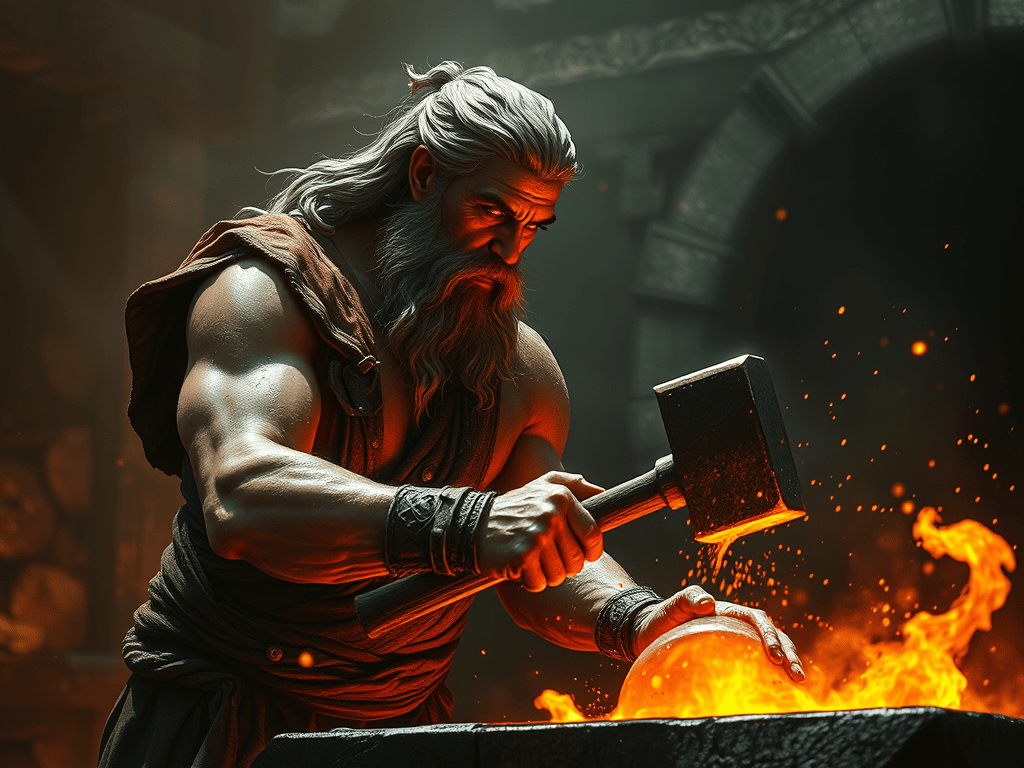
Sparks dance in the flickering gloom of the forge, each one a tiny star against the all-consuming darkness. Hephaestus stands at the center of that inferno, face set in determination, sweat rolling down soot-blackened cheeks. His hammer rises and falls in rhythmic fury, shaping the molten mass that glows a furious orange on the anvil. The clang of iron resonates like distant thunder, echoing through the cavernous workshop.
His voice shatters the silence between each strike. First, a roar of rage—a guttural cry that cracks through the heat, fueled by frustration and longing. The hammer crashes down again, spraying embers that fade into shadows. He lifts the hammer once more, and this time a moan of despair escapes his lips. Every blow against the metal feels like a blow to his own heart, and in that moment, he wonders whether all creation is doomed to constant suffering.
Yet Hephaestus does not relent. His breathing slows, his grip steadying. His next shout is one of longing—raw and wistful—as though each strike upon the steel calls out for something beyond the mortal realm: hope, perhaps, or the promise of redemption. Another few blows, and the sparks settle into a steady glow. His voice grows quiet. At last, calm envelops him like a gentle tide, and he coaxes the final shape into being, forging with delicate care.
Exhaling, Hephaestus sets aside his hammer. The mass on the anvil is no mere blade or shield. It is the shape of a person, still shimmering with the heat of its metamorphosis. As the soft luminescence of the forge reflects in newly formed eyes, Hephaestus regards his creation with somber pride. Without fanfare, he lifts the figure off the anvil, placing it gently with a row of others—each unique, each beaten into form by fire and strife.
He reaches into a crate beside him, thick fingers closing around the next unshaped mass of metal. The forge crackles behind him, awaiting its next task. Somewhere in the endless night of the forge, the hammer rises again.
Drawing Toward the Flame
For a long time, I’ve been developing a theory about why I’m drawn to certain people while others barely register in my awareness. It’s not entirely outside my control—something initially catches my attention—but it’s rarely a definitive trait. More often, it’s the way something is said, the undertone of a voice, or a particular nuance of body language. It reminds me of a statement I made in a recent article about the art of DovaNoire: “Those who have gazed into the abyss often recognize it in each other.”
Through recent reflection, I’ve come to believe that I’m drawn to people with depth—those who feel, think, and reflect on life more intensely than most. Unfortunately, this depth is often shaped by hardship, trauma, and struggles that have tested them to their breaking point. The people I connect with are not those who have sailed through life untouched, but those who have been knocked down time and time again—yet still rise, refusing to be defined by their suffering. They choose resilience, shaping themselves into something stronger rather than succumbing to the weight of their circumstances.
There’s a quote I often reference in passing (sticking to the positivity of the first line), but in this context, the full version carries greater weight. In it, Hemingway begins with a hard-won optimism—‘many are strong at the broken places’—but swiftly reminds us the rest of the world is relentless.
“The world breaks everyone and afterward many are strong at the broken places. But those that will not break it kills. It kills the very good and the very gentle and the very brave impartially. If you are none of these you can be sure it will kill you too but there will be no special hurry.”
—Ernest Hemingway, A Farewell to Arms
He reminds us that everyone, in one way or another, confronts the hammer and the heat. Some shatter under the blows; others find the broken places forged back together into something stronger—albeit forever changed.
This sentiment resonates with the insights of both ancient and modern thinkers—each recognizing that adversity, when faced directly, can refine rather than destroy.
Recommended Listening:
Tested by Fire: Philosophical Echoes
The Stoics and the Nature of Adversity
Ancient Stoic philosophers like Marcus Aurelius and Seneca viewed hardship as an inescapable part of life. According to them, our real power lies in how we respond to such trials. In Meditations, Marcus Aurelius wrote, “The impediment to action advances action. What stands in the way becomes the way.” Each setback, then, is a chance to cultivate resilience—a moment of decision where we either succumb or grow.
Those who demonstrate this resolve often reveal a calm steadiness, much like metal that hardens under a blacksmith’s repeated strikes. When I see someone with that inner composure, I recall the Stoic principle that “nothing is so bitter that a calm mind cannot find comfort in it.” Their depth resonates with me because it is earned; they have entered the forge of adversity and emerged tempered.
Nietzsche and the Crucible of Suffering
Friedrich Nietzsche famously argued that “That which does not kill us makes us stronger.” He believed struggle was not an unfortunate detour but a crucible essential to personal evolution. Confronting adversity—whether trauma, intellectual challenges, or moral dilemmas—sharpens us into something more profound.
Observing a person whose soul has been tested this way is like witnessing Nietzsche’s proclamation made flesh. Their empathy often runs deeper, their sense of purpose more pronounced, precisely because they’ve wrestled with suffering and persevered. They remind me of Hephaestus’s creations: hammered again and again, each blow contributing to a final shape that is unyielding yet strangely graceful.
Viktor Frankl and the Search for Meaning
In the 20th century, Viktor Frankl wrote Man’s Search for Meaning after enduring the horrors of the Holocaust. He discovered that, even in the worst conditions imaginable, individuals could transcend suffering by finding a sense of purpose. Frankl’s insight was that meaning itself can transform torment into a path toward hope.
When I meet someone who appears radiant yet carries the weight of their past, I think of Frankl. Rather than succumb to bitterness, they’ve found a thread of purpose running through their pain. This might involve caring for others, creating art, or forging deeper connections. Whatever its shape, it’s clear they have chosen to transform their suffering rather than be defined by it.
Jung’s Shadow and the Journey Inward
Carl Jung introduced the idea of the “Shadow”—the parts of ourselves we hide, deny, or repress. True personal growth, he suggested, requires a confrontation and eventual integration of these darker aspects. Hardship often forces us to face what lies beneath our surface.
Those who emerge from such confrontations display a remarkable authenticity. By looking into the mirror of their pain, they gain a self-awareness that integrates both light and dark. Like a figure freshly shaped on the anvil, they hold a new form—one reflecting the complex truths of who they are. This wholeness resonates with others who have undergone a similar reckoning of the soul.
Embers of Connection: Personal Glimpses
I recall a family member who, after years of chronic illness, was stripped of the comfortable illusions that once propped up his life. Even in retirement, he lost much of his financial security and watched certain relationships slip away. Yet in one of our last conversations, I heard a gentle confidence in his voice that I’d never encountered before. Despite ongoing pain, he’d discovered an unshakeable empathy for others and a startling moral clarity. It was clear his recent trials had tempered his soul—beyond even what he endured in earlier life and in the military. Each hardship seemed to have drawn out the impurities of superficial living, leaving something radiant in its place.
Another friend grew up in a very conservative religious community but was pulled away from that life far earlier than she had anticipated. She didn’t truly experience personal freedom or agency until she was twenty-four, and even now she carries echoes of those restrictive years. In a recent conversation, I observed that she might actually crave a deeper relationship—even if admitting so feels daunting—because she’s been hurt in the past, fears she may not be “enough,” or worries about burdening others with her struggles. When she confirmed that all three guesses were spot-on, I sensed both relief and vulnerability in her voice.
Yet for all her apprehension, she actively seeks joy and fulfillment through art, friendships, and spontaneous fun. In watching her embrace bold self-expression while quietly wrestling with old wounds, I see a resilience forged by hardship: a self-awareness born from knowing what it means to live without choice, and an unwavering desire to reclaim her own story.
For a more universal perspective, we might also look to someone like Nelson Mandela, who spent twenty-seven years in prison under South Africa’s apartheid regime. Rather than emerging embittered by injustice, he chose forgiveness and unity—actions that ultimately shaped him into a global symbol of reconciliation. Much like Hephaestus’s creations, Mandela’s soul was tempered by relentless hardship, yet he forged from it a capacity for empathy and leadership that continues to inspire.
The Choice to Break or Become
Like the figures lined up in Hephaestus’s workshop, each of us is shaped by the forge—hammered by experiences we never asked for, yet cannot escape. Some shatter beneath the weight of suffering, while others absorb the fire and emerge stronger, transformed but never untouched.
Yet strength alone is not the gift of the forge. The real miracle is the choice—whether to wield that strength as a weapon or as a light. Some become hardened, closed off, embittered by what they endured. Others take each strike, each scar, and forge something greater: wisdom, empathy, an unwavering bond with others who have walked through the fire.
When I say I’m drawn to those who have looked into the abyss, I mean the ones who have not only survived, but who have found meaning in survival. They do not wear their scars as trophies, but as truths—silent testaments to resilience, to transformation, to the simple yet extraordinary act of continuing.
And perhaps that is the final lesson of the forge: suffering will shape us, but it does not have to define us. The fire is inevitable. What we become within it—that is the only thing that is ours to decide.







Leave a comment