I recognize that the discussions about the authenticity of art, especially digital art, has become prevalent in online spaces. However, this article is not intended as a forum for such debates. My focus is on presenting the impressions of the art and the artist in the spirit in which they were shared. The intent is to explore the emotional and psychological impact of the work, rather than engage in discourse over its creation process.
I ask that readers approach this piece, and the art discussed within, with that same respect.
Art, as we often understand it, is an act of creation—an intentional expression of self, a vessel for emotion, a mirror of the human experience. It is a language without words, a medium through which artists share their thoughts, memories, and imaginations. Sometimes, art is a means of recording history, advocating for change, or simply capturing beauty. Other times, it serves as catharsis, a way for the artist to process pain, loss, or trauma.
But what happens when art is not just a response to trauma, but the trauma itself? When it ceases to be an intentional act of expression and instead becomes the residue of an experience too overwhelming to contain? This question arose in an unexpected way during a long conversation with an artist in VR—an encounter that reshaped my understanding of creation and suffering.
This artist’s work was not crafted with the deliberate intent of storytelling or self-expression. It was not a reflection of trauma—it was trauma made manifest, the imprint of pain left behind on the digital canvas, the scar of an experience rather than an attempt to process it. It was the first time I had seen art as something more than a medium—it was, in itself, the consequence of living through something inescapable.
This article explores that revelation: the rare and haunting instances when art is no longer a tool but a symptom, when creativity is not chosen but inevitable, and when the echoes of past experience refuse to fade, leaving their mark in ways both beautiful and unsettling.
A Step Backward: An Unexpected Encounter in VRChat
After a rough day at work, I logged into VRChat seeking escape. Maybe I’d blast music while piloting a fighter jet through a mountain pass, or get thoroughly outplayed in pool by friends. Something simple, something routine—until a friend invited me to an art gallery.
I agreed, expecting an evening of quiet appreciation. But as we stood outside the gallery, she casually mentioned she was on a date. My first thought: then why invite me? But she knows I love art, knows I write. Maybe she figured I’d enjoy the exhibit, even if I was left to wander alone.
I didn’t mind. I grew up surrounded by art—my aunt, an artist and teacher, nurtured my appreciation for it. I’ve always found meaning in more than just the aesthetics. I like losing myself in the message beyond the brushstrokes, searching for something that resonates on a deeper level.
The first floor was pleasant—vibrant prints, breathtaking digital photography, scenes rich with story. But when I ascended to the second floor, everything changed. The cheerful hum of conversation from below faded. My breath caught. Without thinking, my mic—still unintentionally live—let slip a single word.

“Fuck.”
Because this wasn’t just art. This was something else entirely.
To my left, a small sign stood, carrying a message from the artist:
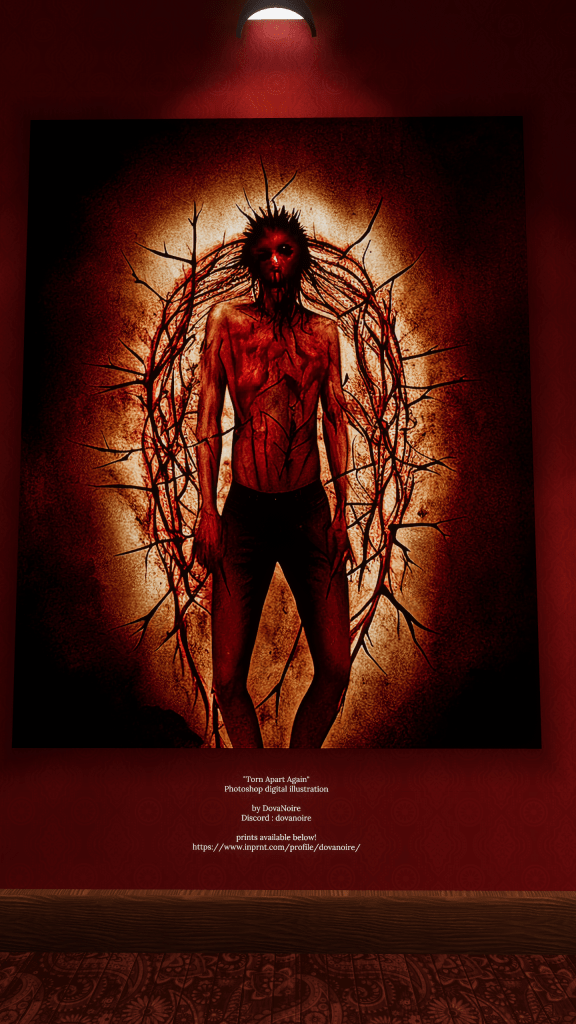
I despise every piece of art I’ve created, not for its quality, but for what it took to create, and what they stand for. These pieces are not for therapy, not to work through some problem, it’s just emotion. They’re created from raw emotion, from a place where few wish to go, where lost loved ones go, lost friends, and mentors. These pieces are created from what I’ve seen and done working my current job, all culminating into a sickly ink for my art.
~DovaNoire
The Art That Sees You Back
As I looked at the first piece, Barbed Saint, something unusual happened. I understood it—not as a narrative, not as a theoretical concept, but as something I had lived. The brutal silhouette on the canvas wasn’t just an image; it was a shadow cast by memories, by experiences I had carried, by wounds I thought had faded.
Moving from one piece to the next, the emotions intensified—isolation, disconnection, pain, recovery, and the ceaseless struggle with self—all laid out on blood-red walls. They didn’t just speak; they pulled. I was dragged from image to image, compelled forward not by curiosity, but by recognition. Not of the art itself, but of the soul that created it.
Dova Noire’s work isn’t merely a reflection of trauma—it is trauma, raw and unfiltered. His style exists at the intersection of dark surrealism and raw emotional expression, with stark contrasts, muted tones, and symbolic forms that blur the line between the real and the subconscious. It doesn’t invite analysis; it forces confrontation. His work doesn’t soften pain with metaphor or poetic abstraction. Instead, it strips the experience bare, leaving it as an unflinching testament to suffering and survival. His art doesn’t whisper—it lingers, heavy and undeniable, daring you to look away.
Eventually, I reached the end of the row. He was there, talking with a friend. I asked if I could share my reaction to his work, perhaps take a few pictures. What followed was a conversation that lasted two hours. His stories aren’t mine to share, but for those who truly see his work, there’s no need to explain. You already know.
The Weight We Carry
Everyone has their struggles, and those struggles are shaped by the world they live in—not the physical world, but the limits of their experiences and perceptions. For some, the biggest stressors might be the rising cost of groceries, the frustrations of an annoying coworker, or the challenge of parenting. For others, it’s the uncertainty of recovery from an injury, the endless procession of friends lost to time, and the constant battle between what they’ve done and who they are.
Neither experience is invalid. In truth, those who have suffered deeply often wish they hadn’t—it’s far easier to exist in a world where the weight of understanding is lighter. But the world is not always kind, and when kindness does exist, it often does so because there are those willing to bear the burden that others cannot.
For better or worse, who we are is shaped by what we’ve lived through—the choices we’ve made, the events that have defined us, and the moments that refuse to let go. Dova’s creations reminded me of an old thought, one that once circulated through cigarette smoke, an in-crowd joke of dark humor:
“Gaze into the abyss for long enough, and you’ll find that it has been gazing back into you.”
It’s both a blessing and a curse that those who truly understand this work on a visceral level are few and far between. There’s a price for such understanding, and it’s one I’m glad most don’t have to pay. But that reality leaves those who carry the heaviest burdens in an isolating position—one where few around them can relate, much less comprehend the source of the grim strength they so often depend on.
Dova said something during our conversation that has stayed with me:
“What happens when the rock everyone depends on needs something to lean on for a while?”
I gestured around the cigar lounge where we had retreated after the gallery’s crowd thinned, ending with my hand pointing at Despite them, you’re still alone, then at the two of us. “This. You come home, but it’s not the one you remember. You talk to friends that seem to have changed little, while fully aware that they don’t know YOU anymore. And every once in a while, you find someone you’ve never met that, in some ways, actually does.”
Often, the specifics are different, but they leave a similar, indelible mark, and those who have gazed into the abyss recognize it in each other.

I highly recommend his art, and if you are interested in viewing more of his work or purchasing prints, I encourage you to visit his INPRNT page, linked below.




Leave a comment